Take Home Messages
- Delaying the brown manure termination timing by four to six weeks doubled biomass production.
- Gibberellic acid (GA) had no yield benefit for grazing or hay production.
- Morava and Volga produced the most grazing biomass and highest hay yield
Aim
The aim of this research was to evaluate the effect of agronomic decisions, including the application of GA, on vetch end uses and soil moisture and soil mineral nitrogen (N) following the end use. The outcomes of the vetch phase are analysed here, and the trials will be sown to a cereal in 2024 to assess the effect on a subsequent crop.
Background
Common vetch (Vicia sativa) has been grown in the Victorian Mallee for many years as a common crop rotation for farms due to its versatility. Vetch can be used as a disease break, a grass weed break and for several end uses, including grazing, hay, brown manure or harvest for seed. It is known that sowing vetch earlier will increase biomass for grazing and hay yield (GRDC 2018). A trade-off in brown manure timings has also been reported: . The earlier termination occurs, the greatersoil moisture is left behind but fixed nitrogen (N) is lower. In contrast, the later the termination timing, the higher the level of soil mineral nitrogen left behind, but soil moisture levels are quite often lower (Ferrier et al. 2012). It is not well understood how agronomic decisions made during the season affect soil moisture and soil mineral nitrogen levels following the vetch phase, and what outcome this has on yield and quality of the subsequent crop. Agronomic decisions to consider, tested as part of this research, are grazing, variety choice and therefore maturity of vetch, termination timing and the use of plant growth regulators such as gibberellic acid (GA).
GA is a hormone naturally produced by plants in warmer weather which promotes cell elongation. It is used in intensive grazing systems to promote grass pasture growth over winter (Matthew et al. 2010). Some anecdotal evidence suggests there are benefits from applying GA to vetch crops, but there is limited research to support it.
Some of the herbicide treatments in this research contain unregistered herbicides, application rates and timings and were undertaken for experimental purposes only. The results within this document do not constitute a recommendation for that particular use by the author or author’s organisation.
Paddock Details
Location: Ouyen Kinnabulla
Crop year rainfall (Nov–Oct): 333mm 276mm
GSR (Apr–Oct): 196mm 187mm
Soil type: Sandy loam Sandy clay loam
Paddock history: Barley Barley
Trial Details
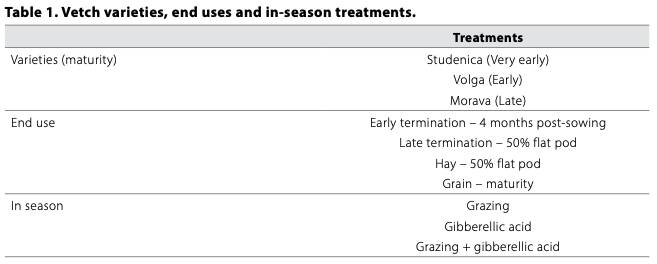
Crop type: Vetch, varieties are displayed in Table 1
Treatments: Refer to Table 1
Target plant density: 60 plants/m²
Seeding equipment: Knife points, press wheels, 30cm row spacing
Ouyen Sowing date: – 20 April 2023
Kinnabulla Sowing date: – 19 April 2023
Replicates: Four
Ouyen Harvest date: 10 November 2023
Kinnabulla Harvest date: 18 November 2023
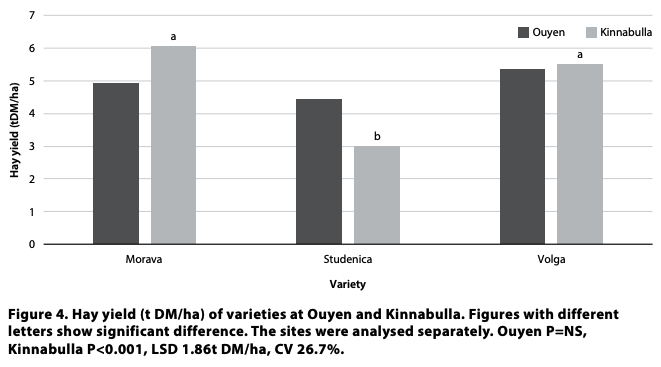
Ouyen Trial average hay yield: 4.9t DM/ha
Kinnabulla Trial average hay yield: 4.8t DM/ha
Trial Inputs
Trials managed as per best practice with regard to disease, weed and pest management.
Method
Two replicated field trials were sown at Ouyen and Kinnabulla using a complete randomised block trial design. Assessments included grazing biomass yield, hay yield, feed test quality, grain yield, soil nitrogen and soil moisture. GA was applied mid-June when the plants were at the eight node stage, targeting about four weeks before grazing. The grazing treatment was carried out just before canopy closure during mid-July at both sites.
Early termination timing was undertaken four months after sowing for all varieties irrespective of growth stage, whereas the late termination timing and hay cut timing were determined by variety maturity, when the variety reached 50 per cent flat pod formation.
Soil sampling was carried out at a site level before sowing to get a baseline understanding of each site’s soil moisture and soil mineral nitrogen levels. Post-harvest soil tests were carried out on each plot to determine soil mineral nitrogen and plant available water (PAW) to a depth of one metre and segmented into 0–10, 10–40, 40–70 and 70–100cm depths.
The two trials were analysed separately using a one-way analysis of variance (ANOVA).
Results & Interpretation
Biomass value
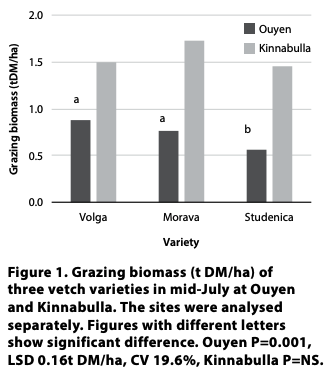
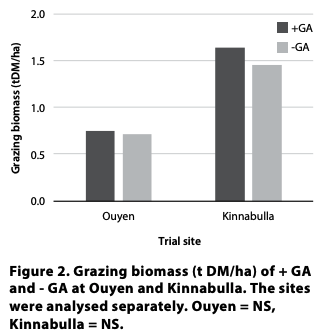
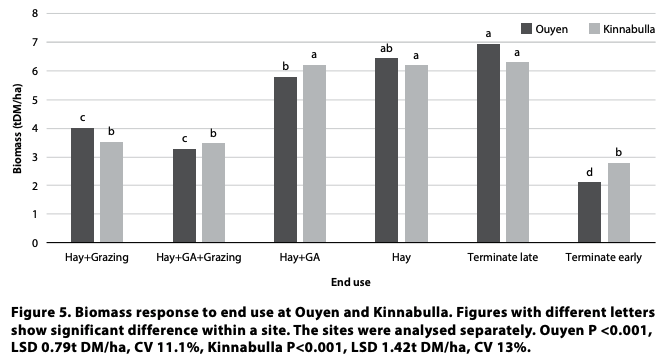
Statistical analyses showed a significant difference between grazing biomass produced for two varieties, Morava and Volga, compared to Studenica at the Ouyen trial (Figure 1). This differed from the grazing biomass produced at the Kinnabulla trial, where there were no significant differences (Figure 1). At both sites, GA applied four weeks before the grazing cut had no significant effect on biomass at the grazing time (Figure 2). At both sites, GA applied four weeks before the grazing cut had no significant effect on biomass at the grazing time (Figure 2).
Termination timing of brown manure treatments
There were large differences in the amount of biomass left behind between the early and late brown manure termination timings. An extra 4.79t DM/ha at Ouyen and 3.49t DM/ha at Kinnabulla was measured in the later termination timing. Despite the large variation in variety maturity, the only difference in variety performance across both sites was less biomass in the late termination timings of Studenica at Kinnabulla than in Volga and Morava (Figure 3).

Hay yield
Digestibility ranged from 65.4–73.1 per cent, which is suitable for moderate livestock production rates. Generally, pure legume or legume mixes had higher digestibility than cereals alone in September.
Crude protein was also highest for legume pastures exceeding 20 per cent protein, as well as the RGT Planet/Morava blend. Several blends raised the protein content higher than cereals alone. All pastures were testing >9.5MJ ME/kg DM at flowering – providing useful levels of energy for maintenance of dry ewes, ewes in early pregnancy or young lambs, but not for production feeding. Pastures testing above 10.8MJ ME/kg DM would support fast-growing lambs.
Acid detergent fibre (ADF) and neutral detergent fibre (NDF) levels were increasing, but still met targets used for high quality hay of ADF <30–32 per cent and NDF <55 per cent.
Hay quality
Two plots of several pastures were sown, both with and without fertiliser. As occurred in 2022, there was a useful fertiliser response in biomass (Table 3).

Soil moisture and soil nitrogen
Two plots of several pastures were sown, both with and without fertiliser. As occurred in 2022, there was a useful fertiliser response in biomass (Table 3).

Commercial Practice and On Farm Profitability
Morava performed well throughout 2023. Volga showed its versatility, as an early maturing variety performing similarly to Morava (late maturing) and recovering well from grazing. Studenica’s performance was sub-optimal compared to the other varieties, which reflected its very early maturity in a longer-than-average season. Delaying termination timings by four to six weeks significantly increased the volume of biomass left behind and, although not reflected in the immediate soil test results, it could result in an additional ~70–95kg N/ha being available for the succeeding crop (using an estimate of 20kg of nitrogen being fixed for each tonne of dry matter produced (Peoples et al. 2012)). The trade off in drier years of choosing a later termination timing is there might be less moisture available for the subsequent crop. Taking into consideration the wet summer so far of 2023–24 this is unlikely to impact this trial.
Application of GA can create large visual differences in vetch paddocks, however those differences were not reflected in biomass yield measurements. In 2023, there was no yield benefit from applying GA in mid-winter for grazing or for the succeeding hay cut. Previous research at BCG investigating the impact of GA on vetch did not observe differences in hay yield, a delay in flowering or a change in plant height that might indicate better harvestability (Bennett 2020). Trials carried out in South Australia have shown small increases in grazing and hay yield, although the results are not consistent across seasons and locations (Anderson and Allen 2021). In 2023, vetch hay generated the largest income of the treatments.
At the completion of the 2024 season, we will be able to determine if any additional yield for subsequent cereal crops has been generated by the 2023 treatments, and if this results in increased income over the two seasons.
References
Anderson D., and Allen R., 2021, 2021 Hart Trial Results, ‘Improving Vetch Dry Matter Production’ pp 52–58, <https://www.hartfieldsite.org.au/media/2021%20TRIAL%20RESULTS/2021_Hart_Trial_Results_Improving_vetch_dry_matter_production.pdf>.
Peoples MB., Brockwell J., Hunt JR., Swan AD., Watson L., Hayes RC., Li GD., Hackney B., Nuttall JG., Davies SL., and Fillery IRP. 2012, Crop and Pasture Science 63 ‘Factors affecting the potential contributions of N2 fixation by legumes in Australian pasture systems’ pp 759–786.
GRDC, 2018, Vetch Grow Notes, ‘Seeding’ pp 4.1 2, <https://grdc.com.au/__data/assets/pdf_file/0023/293117/GRDC-GrowNotes-Vetch-Southern.pdf>.
Ferrier D., Watson L., and Peoples M., 2012, 2012 BCG Season Research Results, ‘Vetch Termination: Finding a Compromise’ pp 49–53, <https://www.bcg.org.au/research-article/vetch-termination-finding-a-compromise/>.
Bennett B., 2020, 2020 BCG Season Research Results, ‘The effects of gibberellic acid on biomass and harvestability of vetch hay’ pp 115–119, <https://www.bcg.org.au/research-article/the-effects-of-gibberellic-acid-on-biomass-and-harvestability-of-vetch-hay/>.
Matthew C., Hofmann WA., and Osborne MA., 2009, New Zealand Journal of Agricultural Research, ‘Pasture Response to Gibberellins: A Review and Recommendations’ pp 213–225.
Farquharson EA., Ballard RA., Herridge DF., Ryder MH., Denton MD., Webster A., Yates RJ., Seymour NP., Deaker RJ., Hartley E., Gemmel LG., Hackney B., and O’Hara GW., 2022, GRDC Inoculating Legumes: Practice and Sciencepp 76–80, <https://grdc.com.au/__data/assets/pdf_file/0023/400865/Inoculating-Legumes-Guide_FA_May23_online.pdf>
Acknowledgements
This research was funded by the GRDC as part of the ‘NGN – Vetch agronomy for the lower Vic Mallee’ project (BWD2304-001SAX).
Thank you to Stuart Nagle, South Australia Research and Development Institute (SARDI), for providing a technical review of this article.