Take Home Messages
- GIA Thunder was the best performing lentil variety in the Mallee and North Central regions for 2023.
- Lentil and field pea yields in the Mallee were comparable to the North Central region.
- Lentils were the most profitable pulse crop in 2023.
Aim
To compare the performance of field pea and lentil varieties in the Mallee and North Central regions.
Background
A wide range of pulses has been well adopted in the Mallee as a valuable addition to growers’ rotations. New varieties are continuously coming to market giving more options to combat soil constraints, improve weed control and increase profitability. However, increased global demand for human consumption of pulses has pushed a movement to grow more pulses on marginal soil types.
In the North Central region, growers have typically used canola and vetch as a break crop. However, there is an increasing need for another profitable break crop. The reason grain pulses have not been well adopted in this area is tough soil constraints, including acidity and salinity.
These trials help to demonstrate pulse variety performance in areas where pulses are widely grown and the possibility of profitably pushing crop types, such as lentils and field peas, into more unsuitable areas.
Trial Details
Crop type/s: Lentil and Field Pea varieties
Target plant density Lentils: 120 plants/m2
Target plant density Field Peas: 40 plants/m2
Seeding equipment: Knife points, press wheels, 30cm row spacing
Replicates: Three
Location Details
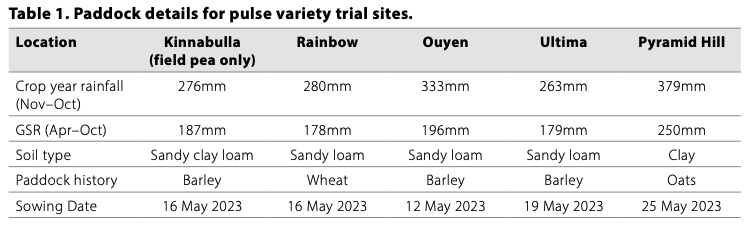
Trial Inputs
Nutrition, weeds, insects and disease were managed as per best practice.
Method
A series of replicated field trials was established to compare the performance of field pea and lentil varieties in the Mallee and North Central regions. Maturity and grain yields were assessed for trials in the Mallee region. At Pyramid Hill, field pea hay yield estimates were undertaken through biomass cuts as the varieties reached flat pod growth stage. Grain yield and quality were also assessed at the end of the season at this site. The data displayed in this article is a combination of NVT results, multi-environment trial analysis (MET) long-term summaries and independent variety trials. Grain yield data is represented as a percentage of the site mean for the 2023 yield results and long-term averages.
Results & Interpretation
Lentils
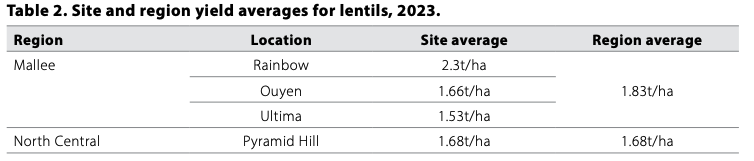
A region average of 1.83t/ha was recorded across the three Mallee sites, ranging from 1.53t/ha at Ultima to 2.31t/ha at Rainbow. The single North Central site at Pyramid Hill averaged 1.68t/ha, similarly to the Mallee region. Caution must be taken when comparing region averages in 2023 as rainfall, trial design and varieties were all different between sites. In saying that, this season did demonstrate the ability to grow lentils in a more marginal soil type with slightly above average rainfall.
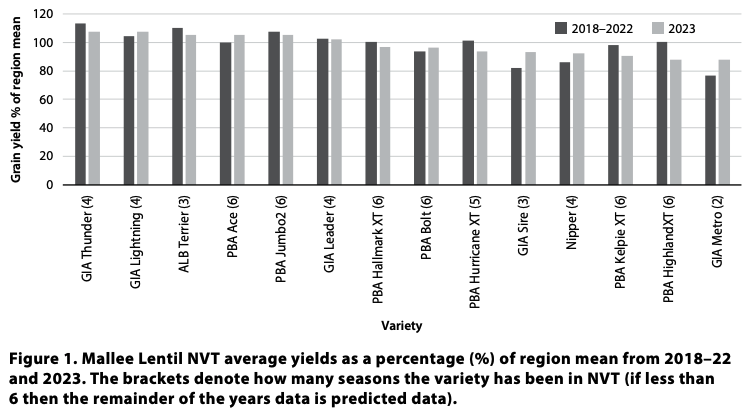
In the Mallee, GIA Thunder, GIA Lightning, ALB Terrier, PBA Ace and PBA Jumbo2 were the highest yielding varieties at 105 per cent or more of the region mean in 2023 (Figure 1). GIA Thunder and ALB Terrier seem to be standouts in the long-term data, however, these varieties have only been in trials for four and three years so the remaining years are predicted yields. This means performance data has yet to be collected in a dry year. PBA Jumbo2 has been a consistent performer in the long-term data but has limited broadleaf control options, unlike GIA Thunder and ALB Terrier which are tolerant to imidazolinone herbicides.
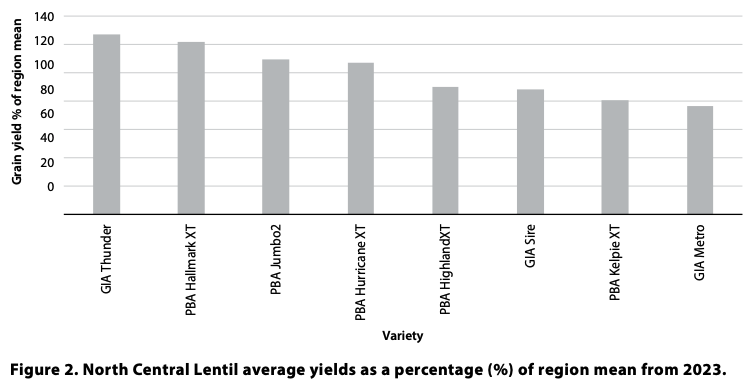
In the North Central region, GIA Thunder and PBA Hallmark XT were the top performers yielding more than 120 per cent above the site average. GIA Thunder has shown great adaptation to a range of soil types, performing well on sandy and clay soils.
Field Peas
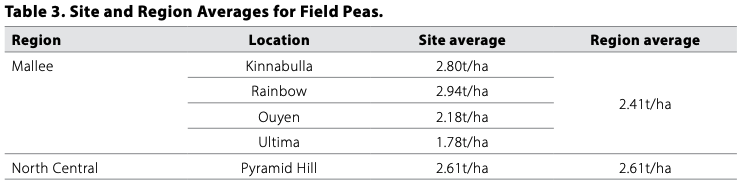
Overall site average yields of 2.41t/ha were recorded across the four Mallee sites, ranging from 1.78t/ha at Ultima to 2.94t/ha at Rainbow. Northern Mallee pulses yielded lower due to crops maturing earlier, which meant they missed out on taking advantage of October rain. The site at Pyramid Hill averaged 2.61t/ha, yielding slightly better than the Mallee. Again, caution must be taken when comparing region averages in 2023 as rainfall, number of trials and varieties were different across the sites.
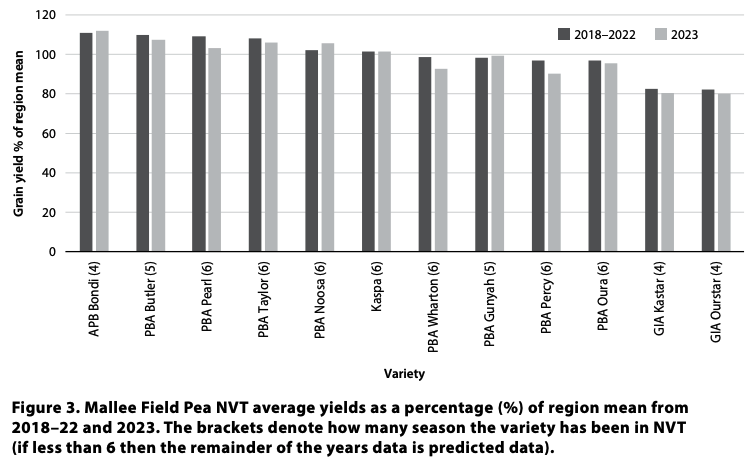
In the Mallee, APB Bondi, PBA Butler, PBA Taylor and PBA Noosa were the best performing varieties in 2023. According to the long-term data, APB Bondi, PBA Butler and PBA Taylor were also the highest yielding varieties since 2018. Note that APB Bondi has only been in trials for four years with remaining years of data being predicted yields. PBA Pearl has also been a higher yielding variety, but performance was average in 2023.
At Pyramid Hill in 2023, variety choice seemed to be less important for grain as there were no significant differences between varieties for grain yields. In terms of hay yields however, there was a significant difference, with PBA Hayman, OZP2103 and APB Bondi the largest biomass producers yielding more than 3t/ha. Twilight was the worst performer in the trial producing only 2.26t/ha. OZP2103 and APB Bondi may be good dual-purpose options for the future, producing good grain and hay yields in 2023.

Commercial Practice and On Farm Profitability
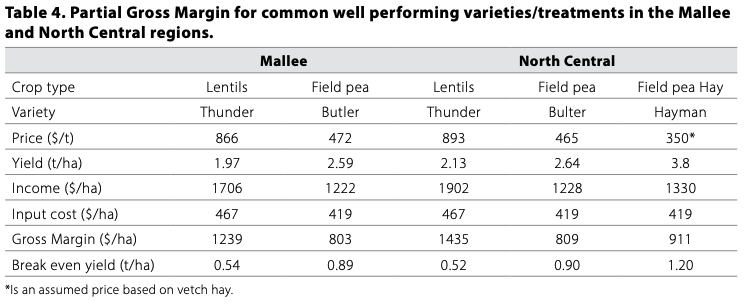
Lentils and field peas were highly profitable crops in both the North Central and Mallee in 2023 (Table 4). Given the high price of lentils, they were the most profitable crop providing similar returns for growers in both regions. End-use had little impact on profitability in field peas with similar returns from hay and grain. Lentils however are higher risk in the North Central due to their intolerance to salinity; yield was affected in soils testing above 2dS/m (N Katerji, 2001). Consistent rain during 2023 at Pyramid Hill meant crops didn’t have to rely on deeper more saline subsoil moisture. In a drier year, there might be bigger yield penalties than occurred in the Mallee. If considering growing lentils, it is crucial for growers to carry out soil sampling pre-sowing and ensure salinity is less than 2dS/m in the top 40–60cm. Field peas present a slightly lower risk option due to their dual-purpose ability.
Variety selection is an important consideration for all crop types, including lentils and field peas. When considering changing a variety, long-term performance must be considered instead of changing over on the basis of yield results for a single year. GIA Thunder, ALB Terrier, and GIA Lighting show potential to become the next standard varieties grown in the Mallee. GIA Lightning is an option for growers with lighter sandier soils as it performs well in these environments. ALB Terrier is a newly released line bred by Australian Lentil Breeding (ALB). It is a mid-maturing, mid flowering, small red lentil that is tolerant to imidazolinone (imi) herbicides. GIA Metro (tolerant to imi and metribuzin herbicides) and GIA Sire (tolerant to imi and clopyralid herbicides) have a possible fit as they allow for more options for residue broadleaf control. Growers must be mindful when using imidazolinone and clopyralid herbicides as residue can cause damage to sensitive crops in the following year. Imi tolerant barley, canola or wheat should be considered in the rotation if using imidazolinone herbicide for broadleaf control in lentils.
When making a crop rotation decision, it is important to consider a range of factors, including logistics. Small areas of pulses sown in the overall farming system may allow for some risk to be spread, as well as providing some operational flexibility. The potential benefits from a pulse crop, while difficult to quantify, should not be dismissed, particularly for residual nitrogen and for managing weeds and disease.
References
GRDC, 2023, 2024 Victorian and Tasmanian Crop Sowing Data Summary, https://grdc.com.au/resources-and-publications/all-publications/nvt-crop-sowing-guides/vic-tas-crop-sowing-guide
GRDC, 2023, National Variety Trials yield data, https://nvt.grdc.com.au/
Katerji N., van Hoorn J.W., Hamdy A., Mastrorilli M., Oweis T., Erskine W., 2001, Response of two varieties of lentils to soil salanity, Agriculture Water Management 47(3), pp 179–190. Accessible online at https://www.sciencedirect.com/science/article/abs/pii/S0378377400001098
Acknowledgements
Research was funded by GRDC and Agriculture Victoria (DJP2105-006RTX), in partnership with Southern Farming Systems, BCG, Frontier Farming and FAR Australia.
Research was conducted through the National Variety Trial (NVT) program delivered by the GRDC.Thanks to Harm van Rees, CropFacts, for providing a technical review of this article.