Take Home Messages
- Vetch hay was the most profitable break crop by $411/ha in 2024.
- Field peas and faba beans were the best performing grain legumes in 2024 growing conditions.
- The addition of lime, gypsum and granular manure soil amendments to a saline soil resulted in no yield response.
Aim
To compare the profitability and legacy effect of different pulses on a saline soil type in the North Central region.
Background
Growers in the North Central region have typically used canola and vetch as a break crop. In general, other pulses have not been widely adopted in this area due to their sensitivity to soil constraints including waterlogging, acidity, and salinity. However, improvements to genetic tolerance, in combination with the use of soil amendments, could increase the viability of faba beans, lentils, field peas and chickpeas as a break crop in these systems. Whilst vetch is a common break crop in the area, primarily grown for hay or brown manure, it can be often considered a weed that can be challenging to control. Vetch hay is also heavily reliant on dry conditions for cutting, and hay operations can often overlap with harvest, creating more logistical issues for growers.
This highlights the need for another pulse crop in the North Central, so growers still gain the system benefits of a pulse in the rotation, without taking on the additional costs and risks associated with processing vetch hay. Another pulse option could also allow growers to spread risk across a wider range of crops.
Pulse crop types have varying levels of tolerance to the aforementioned constraints, however there is a range of varietal tolerance within each species. New varieties with improved tolerance to salinity and boron have been developed. Lentils and chickpeas are more sensitive to waterlogging, soil salinity, and boron toxicity than field peas, faba beans, and vetch. In contrast, canola, another typical break crop for a region, has a much higher salinity and acidity tolerance, and adequate tolerance to waterlogging and boron toxicity (Christopher et al. 2021). Whilst many of the soil constraints (sodicity, salinity, and waterlogging) common in the North Central can be ameliorated to some degree, boron toxicity can only be managed by variety selection.
This is the first of a two-year systems trial. In Year 1, various amendments were applied to different pulse species. Amendments were chosen based on common soil constraints in the area. Gypsum for salinity and sodicity, lime for pH and pelletised manure to improve soil condition. An additional brown manure treatment (no soil amendment applied) where the crop was desiccated at 50 per cent flowering was also added as an alternative to growing pulses for grain. In Year 2, the entire trial will be sown to a cereal to evaluate the legacy effect.
If constraints can be managed through amelioration and variety selection, the addition of pulses to a farming system may provide benefits of nitrogen (N) fixing, weed control and disease breaks, along with being a profitable grain crop in their own right.
Paddock Details
Location: Mitiamo
Crop year rainfall (Nov–Oct): 470mm
GSR (Apr–Oct): 182mm
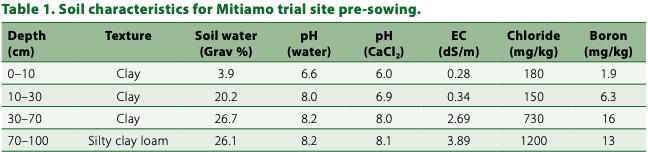
Soil type: See table 1 below
Paddock history: Oaten hay (2023)
Trial Details
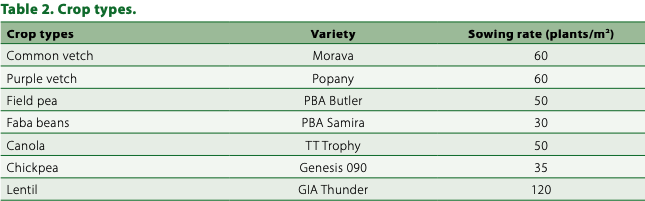
Crop type/s: Refer to Table 2
Treatments: Refer to Table 3
Target plant density: Refer to Table 2
Seeding equipment: Knife points, press wheels, 30cm row spacing
Sowing date: TOS1 – 26 April 2024, TOS2 – 7 May 2024
Replicates: Four
Harvest date: 5 December 2024
Trial Inputs
Trial managed as per best practice, aside from soil amendment treatments (see Table 2).
Method
The trial was sown in a split plot design by crop type, with soil amendment treatments randomised within each crop type block. All vetch, canola and brown manure treatments were sown 26 April, and all remaining treatments were sown 7 May. Assessments included establishment scores, crop biomass at termination timings or 50 per cent flowering (at vetch termination and 50 per cent flowering for other pulses and canola) as well as yield and grain quality parameters. Gross margins were estimated using the 2024 Farm Gross Margin and Enterprise Planning Guide for South Australia (SAGIT, 2024), with prices taken from The Weekly Times 11 December 2024 for Charlton (grain prices) and Elmore (hay prices). This trial will be resown in 2025 with a cereal to determine how certain pulses and management practices affect the following crop.

Results & Interpretation
Seasonal Conditions
The site received a germinating rainfall of 27mm on 11 May, which resulted in both time of sowing (TOS) establishing at the same time. Below average rainfall and several frost events made it a challenging year for pulses. Five frost events occurred between 10 of September and 18 September. During this period most pulses were either flowering or at early podding, at a growth stage where they can be prone to grain loss. These events could have had a detrimental effect on yield, particularly on lentils, chickpeas and field peas which have a low tolerance to frost (Hawthorne, 2007).
The site received 60.8mm rainfall between 24 November and 30 November, when all crops were at or near maturity. The trial was visually assessed for pod loss before harvest. Despite the large rain events, chickpeas, faba beans and field peas experienced minor pod losses (between zero and 5 per cent), demonstrating their ability to withstand harvest rain. However, lentils experienced 20 per cent pod loss and canola 26.5 per cent.
Pulse performance
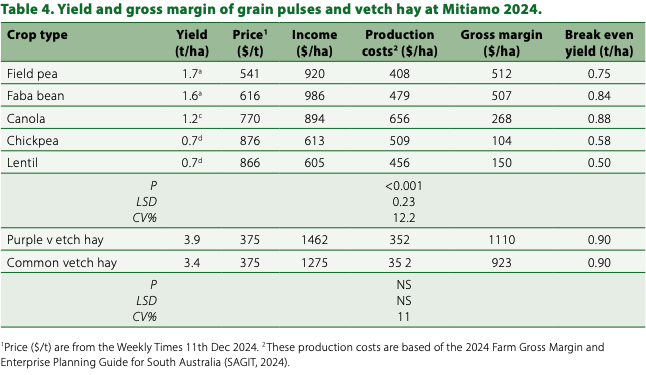
Despite the frost events, field peas and faba beans were significantly higher yielding than other pulses at Mitiamo in 2024, averaging 1.7t/ha and 1.6t/ha respectively (Table 3). Field peas and faba beans were also by far the most profitable pulse in the trial with gross margins of $507/ha to $512/ha. They also substantially outperformed canola which delivered $268/ha. This disparity is likely a combination of canola’s relatively high gross margins and pod loss prior to harvest, which potentially reduced yield by up to 26.5 per cent.
Compared to other pulses in the trial, field peas and faba beans may have achieved higher yields due to earlier flowering time which would have led to earlier grain-fill before frost events. Faba beans also have the best frost tolerance of pulses (White, 2000). Field peas and faba beans also have greater tolerance to salinity than lentils and chickpeas.
Lentils and chickpeas w ere both the lowest yielding at 0.7t/ha, and the least economical options, with gross margins of $104/ha to $150/ha. Chickpeas flower later than other pulses and generally avoid yield losses from frost in an average year. However, critical frost events in 2024 occurred later in the season when chickpeas were at the late flower/early pod development stage, resulting in empty pods and shriveled grain in the sample (about 5 per cent). Lentils were podding during the frost event and might have been subject to yield loss; however, no empty pods were observed at harvest and very few grains were small or shriveled. Pod loss of about 20 per cent in lentils was also observed at harvest and heavily impacted final yield. Salinity and boron toxicity were the two main soil constraints at the site. Both lentils and chickpeas have lower tolerances to these constraints relative to field peas and faba beans. These factors likely resulted in chickpeas and lentils producing a relatively lower yield and gross margin as input costs were similar for all pulses (Table 4).
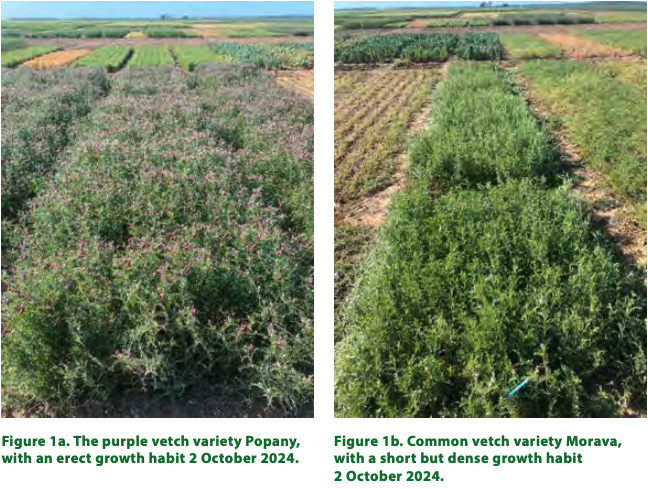
Vetch hay averaged 3.7t/ ha and was the most profitable crop in the trial, with a gross margin of $923/ha to $1110/ha. The earlier maturing common vetch Morava and a longer season variety, purple vetch Popany, showed no significant differences in hay yield when cut at flat pod (common vetch – 25 September, purple vetch – 8 October), despite having visual differences. Popany has a more erect plant structure which gave the illusion of more biomass whereas Morava was shorter but denser (Figure 1).
Soil amendments
For each crop type there was no difference in grain or hay yield with the addition of a soil amendment (data not shown). Liming is often slow acting when surface applied and should be incorporated for a more rapid response (Miller, 2024). Soil pH (water) at the site was also adequate for pulses at 6.6 so a rise in pH would not necessarily have improved yields. Gypsum responses in previous research has found that a response is inconsistent and that predicting a soil type response economically is poor (Hall. D, 2019). The greatest impact on soil sodicity from gypsum applications is generally observed over the long-term, as gypsum is not particularly mobile or as responsive as lime. As such, the addition of the gypsum treatment would have little effect on soil sodicity, particularly considering gypsum had historically been applied to the paddock. These inputs significantly increased production costs in 2024 but provided no yield or economic benefit. Their potential impact on crop production will continue to be monitored in 2025.
Commercial Practice and On Farm Profitability
Vetch was still the most favourable break crop for the region in 2024, with significantly greater profitability than all other break crops. This was due to its ability to produce biomass despite below average rainfall. Hay cutting conditions were ideal in 2024, however, if a wet spring occurred, vetch hay may have been logistically challenging. Some of the high value break crops – including canola, chickpeas, and lentils – were not highly profitable with yield limited by frosts and harvest rain.
These higher value crops are often considered risky in unfavourable conditions, especially with the tough soil constraints in some areas of the North Central region.
Field peas could be a good fit for the area due to their flexibility in end-use and ability to be a profitable grain, hay, or brown manure option (see article ‘North Central lentil and field pea varieties by time of sowing’, page 212, for variety suitability to constrained soils). However, bacterial blight and frost can often cause significant yield loss in field peas. Planting disease-free seed, crop rotation, variety selection and avoiding early sowing can help reduce the risk of bacterial blight (Fanning, 2022) in field peas.
Including diversity in the farming system allows growers to spread risk across the program which can minimise the high losses caused by unpredictable weather as seen in 2024. This trial will be resown with a cereal in 2025, to show the legacy effect of different pulses – both brown manured and harvested for grain – compared to canola.
References
Christopher J., Page K., Dang Y., and Menzies N., 2021, GRDC Update Papers ‘Identification of cropspecific and varietal tolerance limits to acidity, salinity and sodicity’. <https://grdc.com.au/resourcesand-publications/grdc-update-papers/tab-content/grdc-update-papers/2021/03/identification-ofcrop-specific-and-varietal-tolerance-limits-to-acidity,-salinity-and-sodicity>
White C., 2000, ‘Pulse and canola frost identification: the back pocket guide’. <https://library.dpird.wa.gov.au/cgi/viewcontent.cgi?article=1139&context=bulletins>
Hawthrone W., 2007, ‘Managing Pulses to Minimize Frost Damage’. <https://www.pulseaus.com.au/storage/app/media/crops/2007_APB-Pulses-frost.pdf>
Pulse Australia, 2015, ‘Minimising Frost Damage in Pulses’. <https://www.pulseaus.com.au/growingpulses/publications/minimise-frost-damage>
Fanning J., and Lindbeck K., 2022, Identification & Management of Field Crop Disease in Victoria ‘Foliar Diseases of Field Pea’. <https://agriculture.vic.gov.au/__data/assets/pdf_file/0012/901101/Field-CropDiseases-ID-manual-2022small.pdf>
Acknowledgements
Research was funded by GRDC and Agriculture Victoria (DJP2105-006RTX), in partnership with Southern Farming Systems, BCG, Frontier Farming and FAR Victoria.
Thank you to Dr Jason Brand, Frontier Farming, for providing a technical review of this article.
BCG sincerely thanks Adam Gould for hosting the trial site at Mitiamo and for support throughout the project.