Take Home Messages
- Choosing the correct adjuvant as per the product label when spraying is important to get the most out of herbicides being used.
- Certain herbicides, including Group 14, are ineffective without adjuvants.
- Adding Group 14 spikes to glyphosate and adjuvant mixes will speed up the rate of brownout.
Aim
To assess and demonstrate the effect of adjuvants on knockdown herbicides (glyphosate and paraquat) and Group 14 herbicides, and to demonstrate the outcomes of mixing the herbicides metribuzin (Group 5) and glyphosate.
Background
Adjuvants are designed to enhance the activity and effectiveness of herbicides. It is important to note that not all adjuvants are the same and, while some might be able to be used interchangeably, others cannot as they are designed for specific purposes. There are different categories of adjuvant and each acts in a different way to enhance a herbicide’s effectiveness. For a guide to the different categories of adjuvant, a reference point is the GRDC Adjuvants National Reference Manual found on the GRDC website.
Knockdown herbicides such as paraquat (Group 22) and glyphosate (Group 9), and a range of Group 14 herbicides (such as carfentrazone, pyraflufen, oxyfluorfen and butafenacil) are commonly used in farming systems, particularly during summer fallow or as knockdowns before sowing.
Adjuvants improve the effectiveness of some herbicides and are widely used in a variety of spray applications, as stated above, and can play an important role in how well herbicides perform. A spray‑trial was established to demonstrate the different effects of adjuvants on knockdown and Group 14 herbicides to help growers better understand the importance of adjuvant use and selection. The Group 5 herbicide metribuzin was also included in the trial to demonstrate the effects of mixing this herbicide with glyphosate.
Some of the adjuvants and herbicides used in this trial are not registered for use with certain herbicides and were tested for experimental purposes only. Always read the label and adhere to directions when using herbicides and adjuvants.
This trial was for demonstration purposes only, and as such, was not replicated or statistically rigorous. Data presented is observational only. Results should be interpreted with caution and discussed with a trusted advisor.
Paddock Details
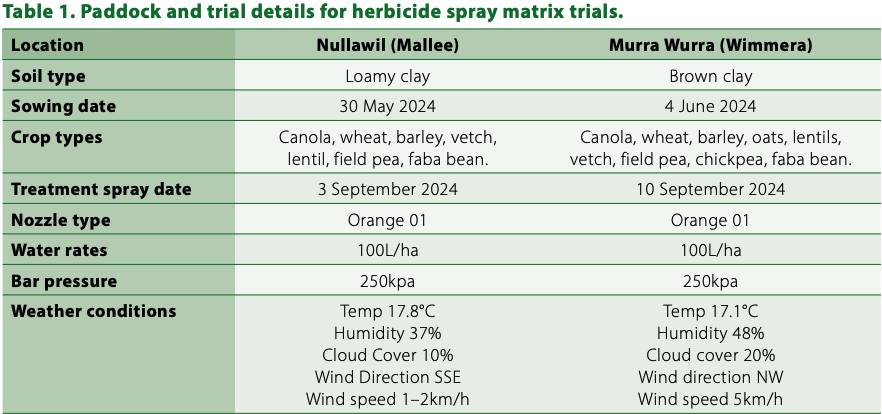
Location: Nullawil and Murra Wurra
Crop year rainfall (Nov–Oct): Nullawil 361mm
Murra Warra 380mm
GSR (Apr–Oct): Nullawil 178mm
Murra Warra 225mm
Trial Details
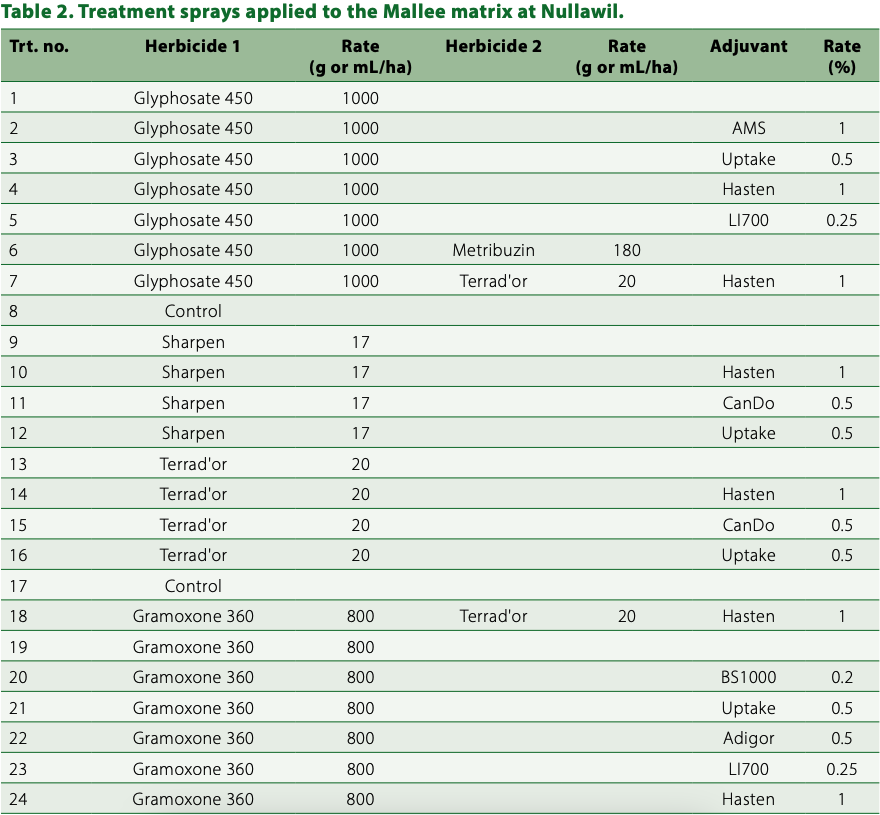
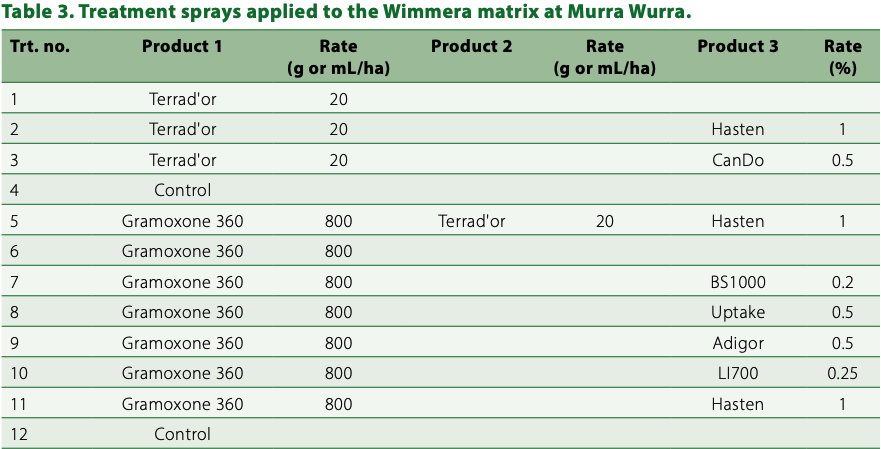
Treatments: Refer to Tables 2 and 3
Seeding equipment: Knife points, press wheels, 30cm row spacing
Trial Inputs
Fertiliser: Granulock Supreme Z + Flutriafol (400mL/100 kg) @ 60kg/ha at sowing
Herbicide: Refer to Tables 2 and 3
Insecticide: N/A
Fungicide: Wimmera demonstration: Aviator Xpro @ 500mL/ha on 26 July 2024
Method
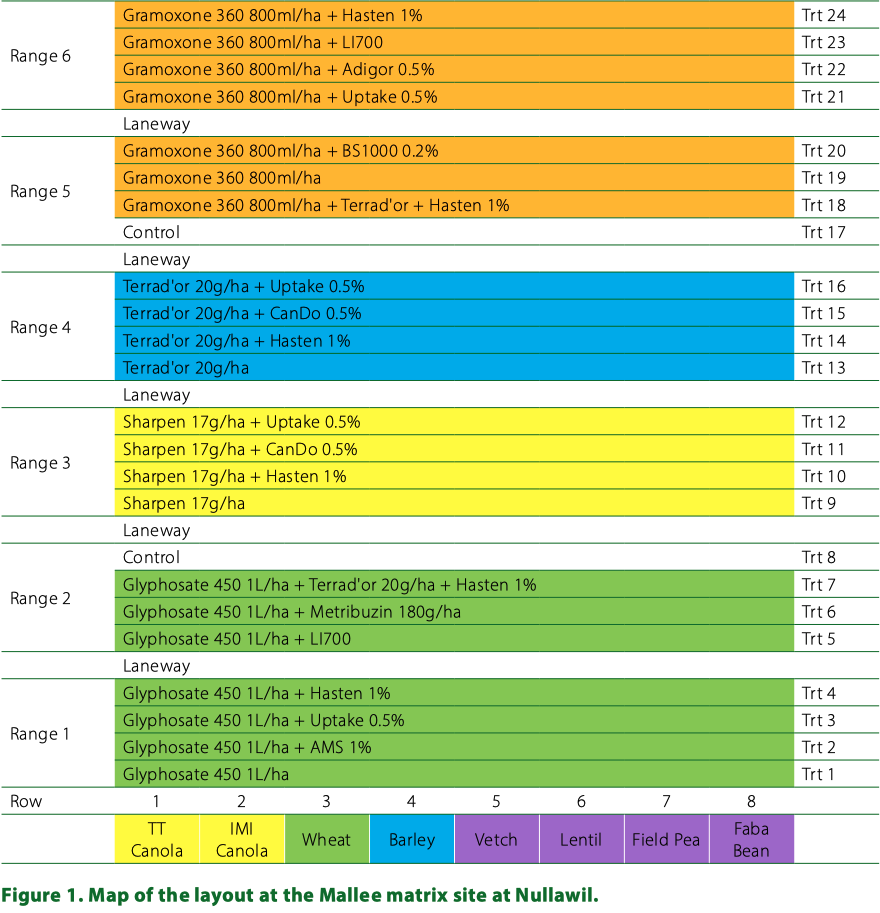
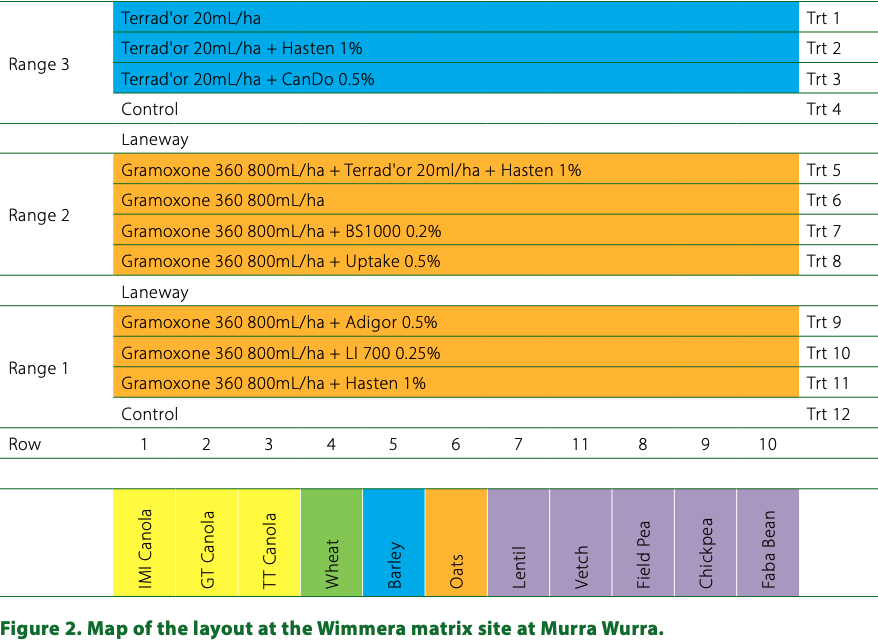
Both sites were sown in strips for demonstration purposes, with crop types planted by row. The Nullawil trial contained six ranges by eight rows and the Murra Wurra trial contained three ranges by twelve rows. The treatment sprays were applied across the ranges with four treatments fitting per range. Treatments were applied using either a hand boom or a shielded sprayer behind a tractor. See Figures 1 and 2 for details of trial layouts. The treatments were not replicated across the same crop type as the main purpose of the trials was for demonstration purposes only. Treatments are displayed in Tables 2 and 3.
Assessments included burndown scores and control scores. Photographs of the different treatments were taken to support findings.
Results & Interpretation
Group 14 herbicides
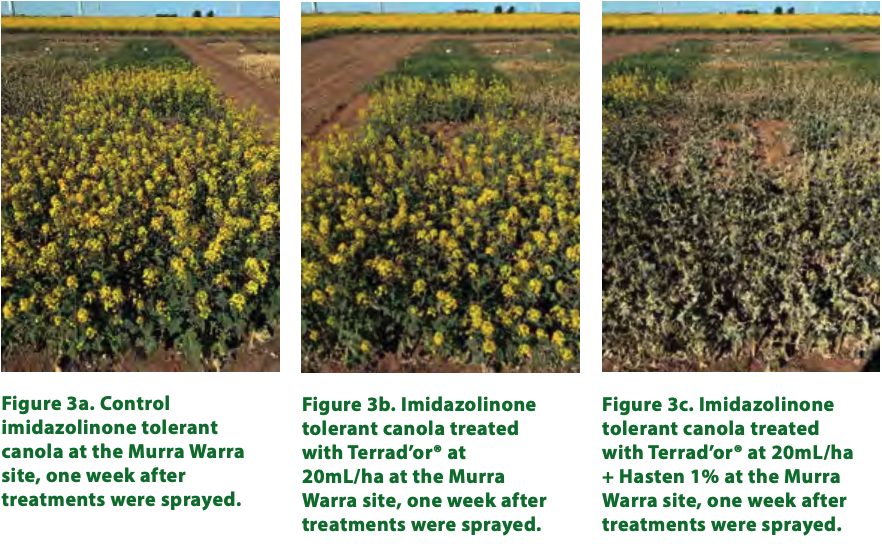
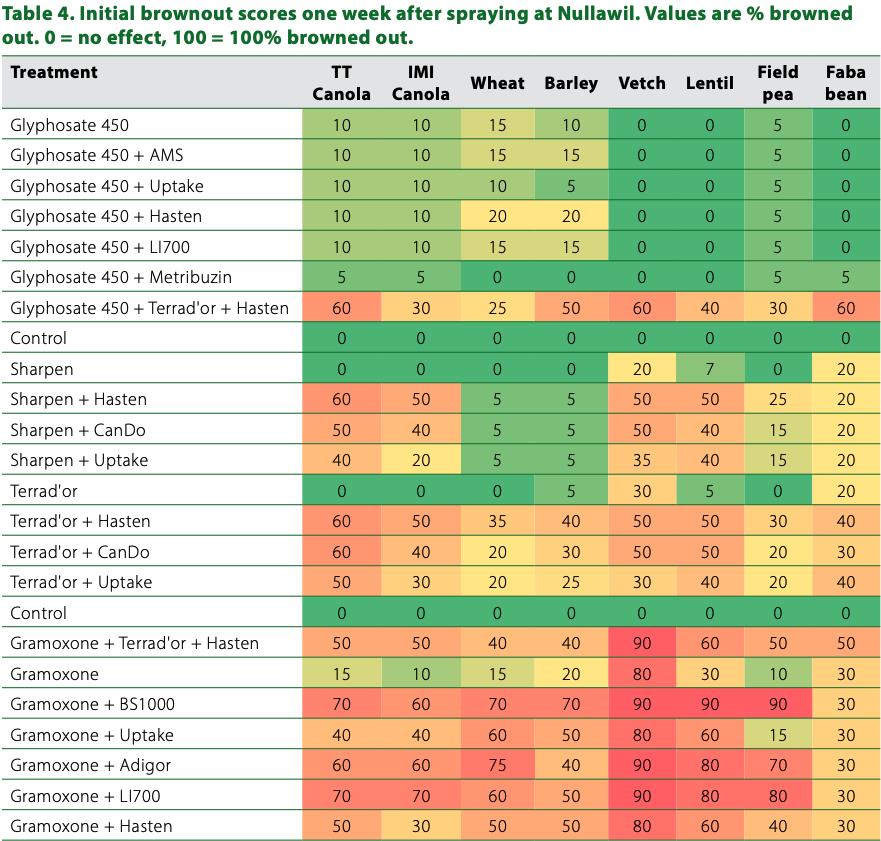
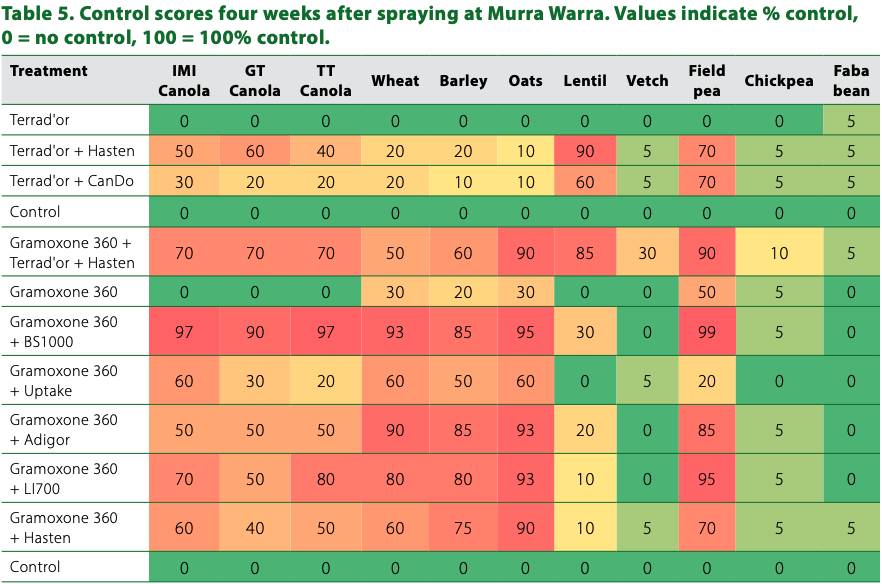
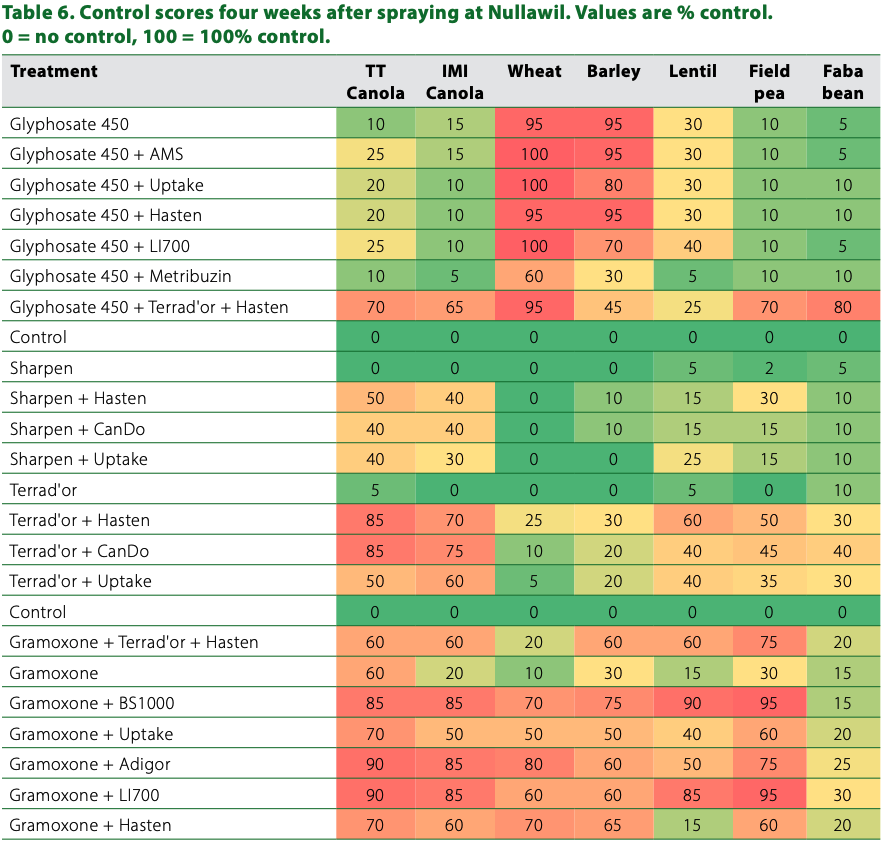
Both Group 14 herbicides, Terrad’or® and Sharpen, were relatively ineffective at controlling weeds when used without adjuvants. Effectiveness improved notably when used with adjuvants (Figures 3a, 3b, 3c), however, the level of control was still unsatisfactory for several crop types as most had less than 85 per cent control after four weeks (Table 5 and 6). Therefore, full control may be better achieved with the addition of other knockdown herbicides.
Initial brownout
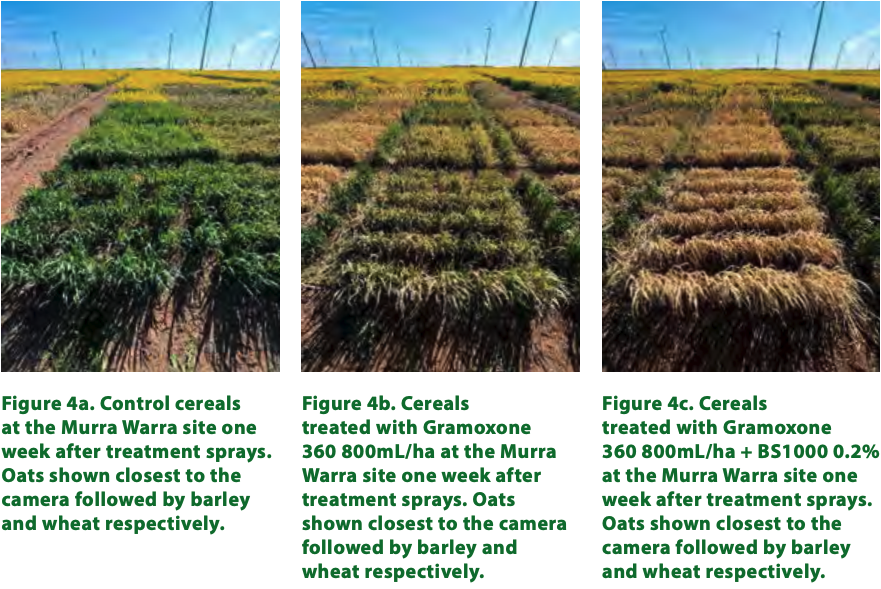
Gramoxone + BS1000 was the most effective treatment followed closely by the other adjuvant‑incorporated gramoxone treatments. Gramoxone alone had a considerably lower impact in terms of initial brownout (Figures 4a, 4b, 4c). Glyphosate treatments did not show noteworthy initial brownout after one week, apart from glyphosate + Terrad’or® + Hasten (Treatment 7, Table 2) which demonstrated a higher rate of browning (Table 4).
Knockdown herbicides
Gramoxone 360
While all Gramoxone treatments that included an adjuvant performed better than Gramoxone alone, there were clear differences between the effectiveness of the different adjuvants. For example, the Uptake and Hasten treatments were generally less effective than BS1000, LI700, and Adigor treatments.
Four weeks after application, the most effective treatment in pulses at the Murra Warra site was Gramoxone + Terrad’or® + Hasten, whereas in the cereal and canola it was Gramoxone + BS1000 (Table 5). At Nullawil, Gramoxone + LI700 had the best control for canola and pulses while Gramoxone + BS1000 was the most effective for cereals (Table 6). Treatments that included BS1000, LI700 and Adigor performed similarly in terms of level of control when compared across all crop types. Gramoxone alone exhibited unsatisfactory control.
Glyphosate 450
Glyphosate + Terrad’or® + Hasten outperformed glyphosate alone and all other glyphosate treatments in the Nullawil canola and pulses (Table 6). After four weeks, the treatment effect was unsatisfactory for canola and pulses, which was expected due to the application of a sub-lethal rate to highlight differences between adjuvants for demonstration purposes.
In the cereals, the glyphosate treatments all showed a higher level of control with no noticeable differences found between glyphosate alone or with adjuvants. Adding metribuzin to glyphosate reduced weed control in wheat, barley, and lentils, suggesting growers should take care when considering this practice. Higher on-label rates may overcome this effect. Growers are reminded that this trial was for demonstration purposes, and the findings should be interpreted with caution, given the lack of treatment replication. Vetch at Nullawil was sprayed out early – two weeks after applications – to prevent any seed set at the site, so control scores could not be completed for this crop type.
Commercial Practice and On Farm Profitability
The results of these trials were presented as demonstrations at the BCG Main Field Day (Nullawil) on 11 September 2024 and at the Wimmera crop walk (Murra Warra) on 18 September 2024.
The demonstration illustrated the significant impact of adjuvants on the success of herbicides. Adding Terrad’or® to glyphosate also accelerated initial brownout and increased overall control. However, glyphosate was sprayed at non-lethal rates for demonstration purposes, therefore at the standard higher rate of glyphosate, this advantage on overall control may be less clear. It is important to choose the right adjuvant for the intended herbicide as this will help growers maximise herbicide impact.
The addition of both Terrad’or® and Hasten to glyphosate seemed to improve control in certain crops, highlighting the importance of considering weed type before choosing whether to include a Group 14 spike. Although no additional benefit was observed from the use of adjuvants with glyphosate in this demonstration, this is contrary to other findings. Label instructions are clear on the use of this herbicide, and growers are encouraged to discuss their approach with an experienced advisor.
Adding metribuzin to glyphosate had a negative impact and reduced weed control on wheat, barley, and lentils. This was expected due to the known antagonistic effect between these chemicals under some conditions. However, this effect may be overcome at higher application rates. Sub-lethal rates were used in this demonstration; given the non-replicated nature of the demonstration, these findings are observations for interest only.
The demonstration showed an adjuvant must be added to Gramoxone 360 for the herbicide to work as expected. This makes sense as it is clearly stated on the label that an adjuvant is required. Using BS1000 over Uptake or Hasten may be a better choice for higher levels of control.
Group 14 herbicides are best used in conjunction with other herbicides to minimise resistance issues. The most effective way to use Group 14 herbicides is to mix them as a spike with a knockdown herbicide, along with the recommended adjuvant specified on the label.
In these demonstrations the use of Group 14 herbicides without adjuvants provided no benefit, nor did the addition of adjuvants to Group 14 herbicides alone. This indicates that – along with the above case for managing resistance – the best use for Group 14 herbicides seems to be as a spike mixed with a knockdown herbicide and appropriate adjuvant.
It is important to note that this trial was set up for demonstration purposes only and was not replicated. Some treatments included the use of off-label chemistry. Growers are advised to use their discretion when considering the findings outlined in this trial, and to discuss their weed control strategy with an experienced advisor.
References
NSW Department of Primary Industries, ‘Using adjuvants with herbicides’, <https://www.dpi.nsw.gov.au/biosecurity/weeds/weed-control/herbicides/using-adjuvants-with-herbicides>, accessed 16/01/2025.
Congreve M., and Cameron J., 2019, A National Reference Manual ‘Adjuvants – Oils, surfactants and other additives for farm chemicals used in grain production’, accessed 16/01/2025.
Acknowledgements
This trial was funded by BCG members through their membership.
BCG would like to acknowledge Angus Butterfield, BCG, and Chris Davey, Next Level Agronomy, for designing demonstrations and treatments.
BCG would also like to acknowledge Dr Yolanda Plowman, BCG, Harm van Rees, Cropfacts, and Alistair Crawford, Driscoll Ag, for their technical reviews of this article.
BCG sincerely thanks the Watts family and David Jochinke for generously hosting the demonstration sites at Nullawil and Murra Wurra.