Take Home Messages
- Flaxleaf fleabane is a challenging weed to control, but failing to manage it can have significant economic consequences.
- First spray applications are critical for effective flaxleaf fleabane control – premium herbicide products often deliver better results in the first spray.
- The addition of Dropzone® to a standard summer spray significantly improved control of flaxleaf fleabane, while common mixes such as 24-D ester and triclopyr didn’t offer additional control over a standard glyphosate mix.
- Glyphosate and Terrad’or® may not be required for the control of flaxleaf fleabane, and the exclusion of these products could significantly reduce costs.
Aim
To identify optimal herbicide options for first and second sprays in a double knock strategy.
To investigate the efficacy of camera sprayer rates and evaluate the economic impact of these chemical mixes.
Background
The presence of flaxleaf fleabane (Conyza spp.) weed is steadily increasing across key agricultural regions in Australia. Since the adoption of no-till farming systems, the control of fleabane has been increasingly challenging across key cropping regions in Australia. There are seven different fleabane species in Australia, however flaxleaf fleabane is the most prevalent (Walker et al. 2012). Fleabane is a wind-borne surface germinating weed that has natural tolerance to glyphosate and thrives in low competition situations (Daniel, 2015). The weed has a high reproductive capacity, with each plant capable of producing up to 110,000 seeds (Wu, 2012).
Herbicide strategies often fail to control weeds effectively, which poses a threat to agricultural productivity. In the past, soil disturbance through tilling was a successful method of control. However, the shift to no- or low-till farming means that there is now a heavy reliance on knockdown herbicides. Residue herbicides such as clopyralid provide excellent control (Brill et al. 2012), however these herbicides are not ideal for rotations that incorporate pulses. Knockdown herbicides are most effective when applied when fleabane is at the rosette or seedling growth stage. However, emergence occurs between 10 °C and 30 °C, meaning the weed can emerge under an established crop in the spring and is unable to be targeted at early growth stages (Walker et al. 2012). Once the plant elongates, its hairy, narrow leaves and thick cuticle reduce herbicide penetration, complicating control further (Wu, 2012).
Paddock Details
Location: Jil Jil
Summer rainfall (Nov–Mar): 150mm
Paddock history: Lentil stubble
Trial Details
Target weed species: Flaxleaf fleabane
Treatments: Refer to Table 1 and Table 2
Spray dates: First spray 9 February; Double knock 16 February
Replicates: Three
Method
Two field trials were established to compare the efficacy of herbicide strategies, as outlined in Table 2. These strategies were imposed on a weed-infested site located at Jil Jil, in the Mallee (-35.869551, 142.982099). At the time of trial establishment, fleabane plants were pre-flowering and between 5–10 cm tall. Both field trial designs were randomised complete block with three replicates. The site contained a large population of fleabane at an advanced growth stage. First spray herbicide options compared various Group 4 herbicides to a glyphosate mix (outlined in Table 2), and all treatments were sprayed with a mixture of paraquat 250 2000mL, Terrad’or® 20g and Hasten 1% 7 days after first spray. Second spray herbicide options included different herbicide mixing partners with paraquat, as well as simulated camera sprayer treatments (outlined in Table 3). Treatments for the trial were determined by researchers and local agronomists.
First spray applications were applied on 9 February 2024, followed by a second spray application completed seven days after the initial spray. Both trials were scored using the European Weed Research Council (EWRC) scale (Dear et al. 2003) (Table 1) on days 4, 7, 14, 21 and 28 after the last herbicide application. A lower EWRC score indicates higher efficacy of herbicide control (i.e., weed death). Scores were taken in-field and based on whole-plot assessments. Data from the two trials were analysed separately using one-way ANOVA in Genstat 22nd edition.

Results & Interpretation
First spray herbicide options: Trial 1
Glyphosate alone (Table 2, Treatment 8) provided poor control of fleabane (68.3% control at 28 days).
The addition of Group 4 herbicides to a glyphosate mix, which are commonly used over summer fallow, displayed mixed results: 24-D ester, Starane® and triclopyr (Treatments 4, 5, 6, and 7) were not significantly different to glyphosate alone, whereas the addition of 2,4-D amine, dicamba and a 2,4-D ester/dicamba mix (Treatments 1, 2, 3) significantly improved control of fleabane.
Dropzone®, a 2,4-D amine formulation, provided the highest control (98.3%).
Cost per hectare for the optimal options (Treatments 1 to 3) were in the mid- to high-cost range, relative to the less effective options, reinforcing the importance of proactive weed management.

Second spray herbicide options: Trial 2
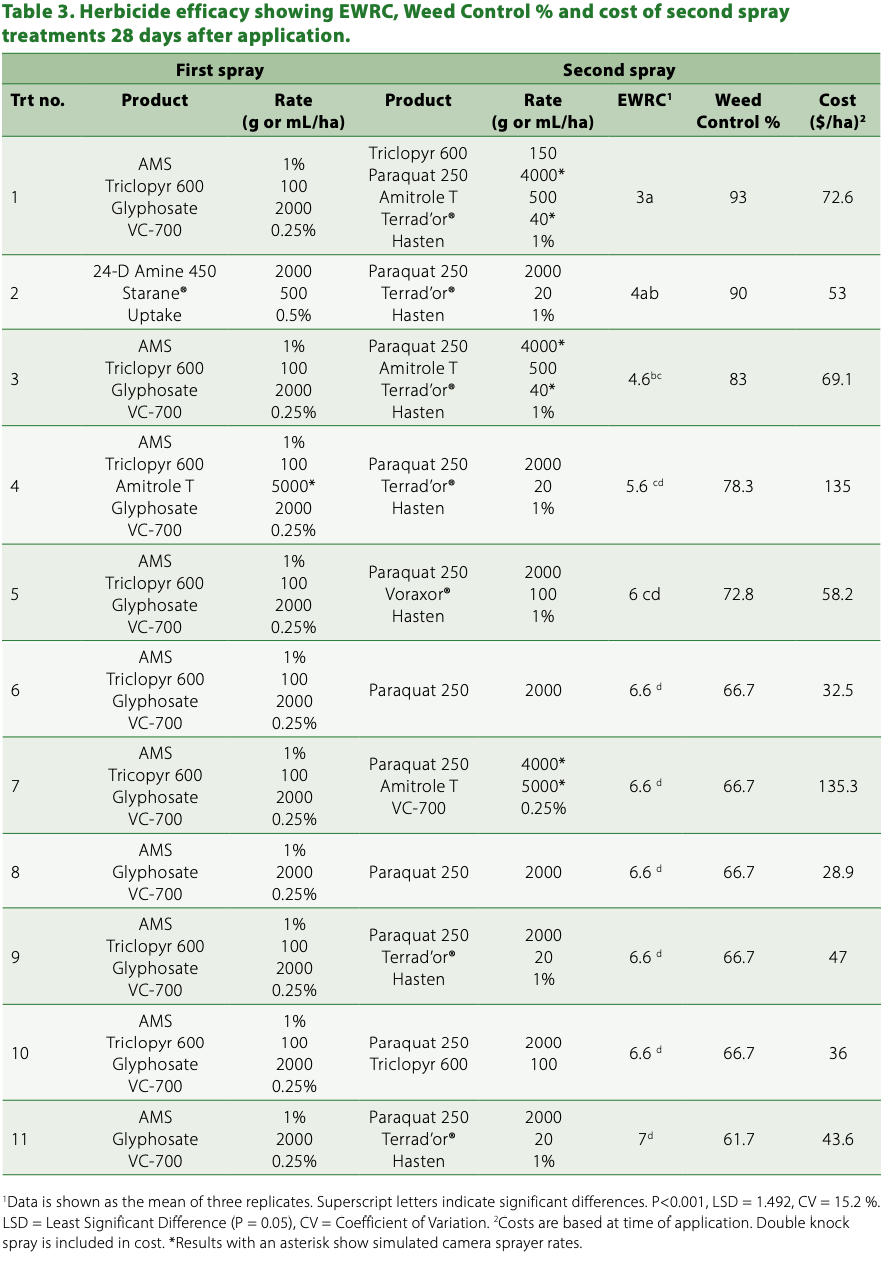
High paraquat rates (camera sprayer rates) combined with Terrad’or® and amitrole T at 500 mL, achieved 93% control (Table 3, Treatments 1 and 3). However, high rates of amitrole T (Treatment 7) decreased efficacy, resulting in significantly lower control.
Including effective Group 4 herbicides in the paraquat and Terrad’or® mix (2,4-D amine and Starane®) enabled strong results (90% control) even without glyphosate in the second spray.
This highlights two key points; the importance of Group 4 herbicides in the first spray, and that glyphosate may not be essential for fleabane control. Given the high price of glyphosate ($15.7/ha including AMS and VC-700), adopting this strategy could significantly reduce costs. This, however, may not be the case for other summer weeds, so growers must consider the whole weed spectrum before considering this approach. The addition of Group 14 herbicides with standard paraquat rates did not result in increased control when compared to a paraquat stand‑alone double knock. This suggests growers are receiving less value when using 20 g/ha of Terrad’or® on fleabane, given the cost of Terrad’or® at $14.7/ha.
Commercial Practice and On Farm Profitability
It is crucial for growers to continue efforts to control fleabane and reduce weed seed banks, particularly because the weed populations can increase rapidly due to their prolific seed reproduction.
Findings from these trials indicate that the first sprays were more critical for controlling fleabane than the second. Farmers should consider using premium products in their first spray rather than the second spray.
Premium options like Dropzone® in the first spray phase, combined with effective knockdown strategies, deliver the most effective results, whereas many common mixes such as 24-D ester and triclopyr didn’t enhance control over a standard glyphosate mix. In addition, the control provided by paraquat was only improved with increased camera sprayer rates.
Reducing reliance on costly products like glyphosate and Terrad’or® is possible under specific conditions, providing significant cost savings for growers.
References
Brill, R, Street, M, Monroe, J (2012) ‘Management of fleabane in crop rotations.’ Available at <https://www.dpi.nsw.gov.au/__data/assets/pdf_file/0007/431269/Fleabane-management-in-croprotations.pdf> [Accessed 2 July 2024].
Daniel, R (2015) ‘Farming systems strategies to manage fleabane and feathertop Rhodes grass.’ Available at <https://grdc.com.au/resources-and-publications/grdc-update-papers/tab-content/grdc-update-papers/2015/07/farming-systems-strategies-to-manage-fleabane-and-feathertop-rhodesgrass> [Accessed 2 July 2024].
Dear, BS, Sandral, GA, Spencer, D, Khan, MRI, Higgins, TJV (2003) The tolerance of three transgenic subterranean clover (Trifolium subterraneum L.) lines with the bxn gene to herbicides containing bromoxynil. Australian Journal of Agricultural Research 54, 203–210.
Walker, S, Widderick, M, McLean, A, Werth, J, Cook, T, Davids, B, Price, L (2012) ‘Northern IWM fact sheet: Flaxleaf fleabane, A weed best management guide.’ Available at <https://www.daf.qld.gov.au/__data/assets/pdf_file/0005/65903/Flaxleaf-fleabane.pdf> [Accessed 2 July 2024].
Wu, H (2012) ‘Why is flaxleaf fleabane (C. bonariensis) so invasive?’ Available at <https://grdc.com.au/resources-and-publications/grdc-update-papers/tab-content/grdc-update-papers/2012/08/why-isflaxleaf-fleabane-c-bonariensis-so-invasive#%3A~%3Atext%3DFleabane%20is%20a%20prolific%20seed%2C500%20m%20from%20the%20source> [Accessed 2 July 2024].
Acknowledgements
This trial was funded by the Hugh Williamson Foundation.
Thanks to Pat Conlan (Swan Hill Elders) for advice on herbicide use and to growers Jon Haslam and Scott Anderson for allowing BCG to use their properties.