Take Home Messages
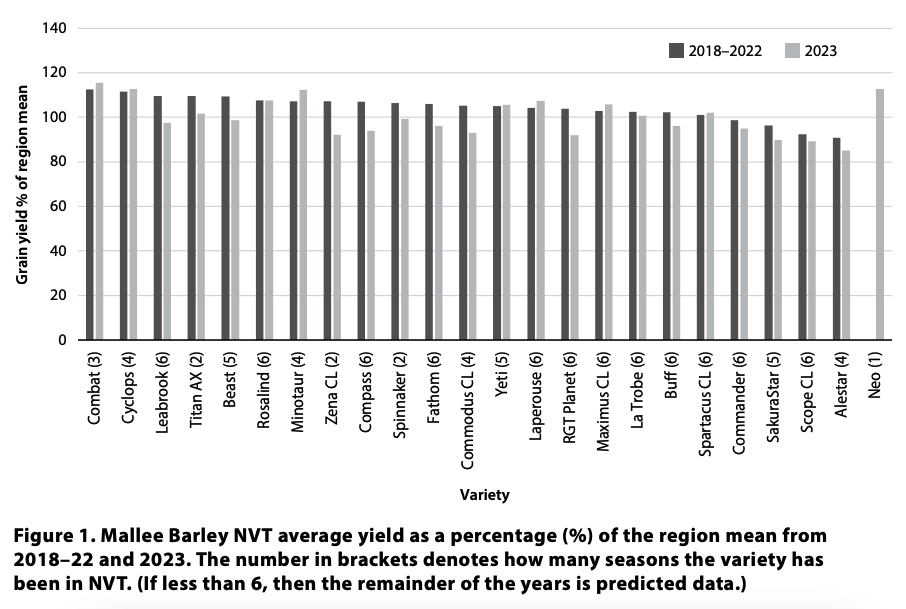
- Combat, Cyclops, Minotaur and Laperouse all yielded higher than the region mean in the Mallee, and have performed well in the past five years.
- Neo CL outperformed all other varieties in the North Central, but with no historical data it is difficult to compare with varieties that have performed well in the past five years, such as Combat, Cyclops and Minotaur.
- In the Wimmera, Combat, Cyclops and Leabrook all yielded well against historical data in 2023.
Aim
To compare the performance of new and existing barley varieties in the Mallee, Wimmera and North Central NVT.
Background
Barley is arguably the nation’s lowest cost and lowest risk winter crop given its quick maturity, ability to be sown later in the cropping program, and lower susceptibility to frost than other crop types such as wheat (DAFF, 2014). According to ABARES, barley production in Australia is forecast to increase by 6.1 per cent, with an estimated production of 11.1 million tonne in 2024.
The Mallee, Wimmera and North Central regions are diverse in nature, with varying climatic conditions and rainfall patterns, soil types and stressors for farming systems. This variability highlights the importance of choosing a barley variety most suited to individual needs.
Having access to National Variety Trial (NVT) data allows growers to see how different varieties perform across different regions, with consideration of attributes such as maturity, overall disease package, and varietal classification.
Trial Details & Inputs
Crop type: Barley, refer to Figures 1–3 for varieties
Target plant density: 130 plants/m² (Mallee), 160 plants/m² (North Central),
Seeding equipment: Knife points, press wheels, 30cm row spacing
Replicates: Three
Nutrition, weeds, insects and disease were managed as per best practice.
Method
This research was conducted through the NVT program delivered by the GRDC. The program involves a series of replicated field trials that test varieties across different crop types. These trials aim to maximise genetic potential yields, rather than profitability. The sites receive multiple fungicide applications and are managed to ensure they are not nitrogen limited to avoid confounding factors when assessing the genetic potential of varieties. The data displayed in this article is a combination of NVT data, individual site reports and multi-environmental trial analysis (MET) long-term summaries. Variety performance is presented as the grain yield percentage of the site average, with MET data indicating performance in 2023, relative to the previous five years (2018–22).
Results & Interpretation
New varieties released in 2022
Neo CL, bred by Intergrain is a quick-maturing Clearfield variety. It has similar agronomic characteristics to RGT Planet but with improved grain size. Neo CL is currently undergoing malt accreditation with a result expected in 2025. 2023 was the first year Neo CL appeared in NVT. Spinnaker is a very quick to quick-maturing variety suited to medium to high rainfall zones. It will be released in early 2024 and was submitted for the first stage of malt accreditation in 2023. It was bred by Secobra Recherches with seed available in 2025 through Seednet.
Yield results
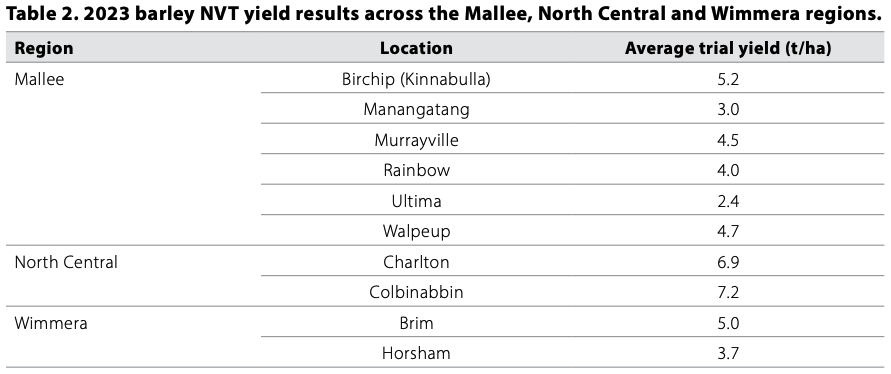
Yield results in the Mallee ranged from 2.4t/ha in Ultima to 5.2t/ha in Birchip, averaging 3.8t/ha overall. In the North Central, Charlton yielded 6.9t/ha and Colbinabbin yielded 7.3t/ha, resulting in an average yield of 6.9t/ha. Yields in the Wimmera ranged from 3.7t/ha in Horsham to 4.9t/ha in Brim, averaging 4.3t/ha overall. Combat is the highest yielding long-term variety in all three regions, but it has only been in the NVT trials for the past three years. Although a non-malting variety, it brings other benefits from its disease resistance rating of Resistant-Moderately resistant (RMR) for spot form of net blotch (SFNB) and a provisional rating of Moderately resistant (MR) for net form of net blotch (NFNB). New variety Neo CL performed well in the North Central and Mallee in its first year in NVT in 2023, yielding above 8t/ha in both Charlton and Colbinabbin, and fourth overall in the Mallee. Commonly grown variety Spartacus CL yielded similar results to the long-term average in each of the three regions. However, Compass yielded below the long-term average in the Mallee and North Central and slightly above in the Wimmera.
During the past five years the top performers in the Mallee NVT have been Combat, Cyclops, Leabrook, Titan AX and Beast (Figure 1). This is only the third year for Combat and the second year for Titan AX in the Mallee NVT, however both yielded well in 2023. Combat was the highest yielding variety at Manangatang, Ultima and Walpeup, whilst Titan AX was the highest yielding variety at Rainbow. First year variety, Neo CL, was the top variety at Birchip and Murrayville. In 2023, the highest yielding varieties in the Mallee region were Combat (115 per cent), Neo CL (113 per cent), Cyclops (113 per cent) and Minotaur (112 per cent). Of these, Combat, Cyclops and Minotaur yielded above the site mean at all Mallee NVT sites, as did Yeti.
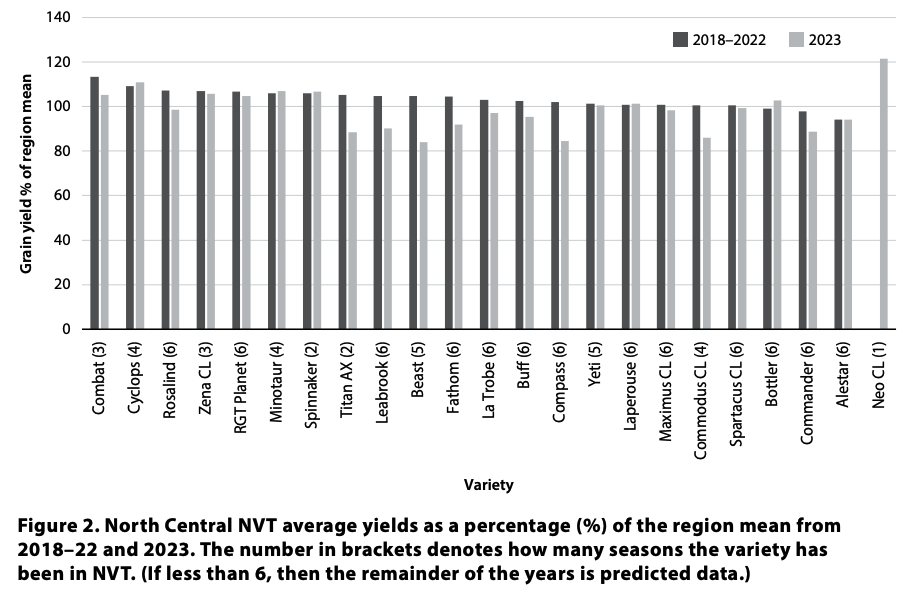
In the North Central, Combat, Cyclops, Rosalind, Zena CL and RGT Planet have been the top varieties over the past five years (Figure 2). Of these, all except Rosalind yielded higher than the region mean for North Central in 2023. Neo CL was the highest yielding this year at 121 per cent. Also yielding well in 2023 were Cyclops (111 per cent), Minotaur (107 per cent), Spinnaker (107 per cent), Zena CL (106 per cent), Combat (105 per cent) and RGT Planet (105 per cent).
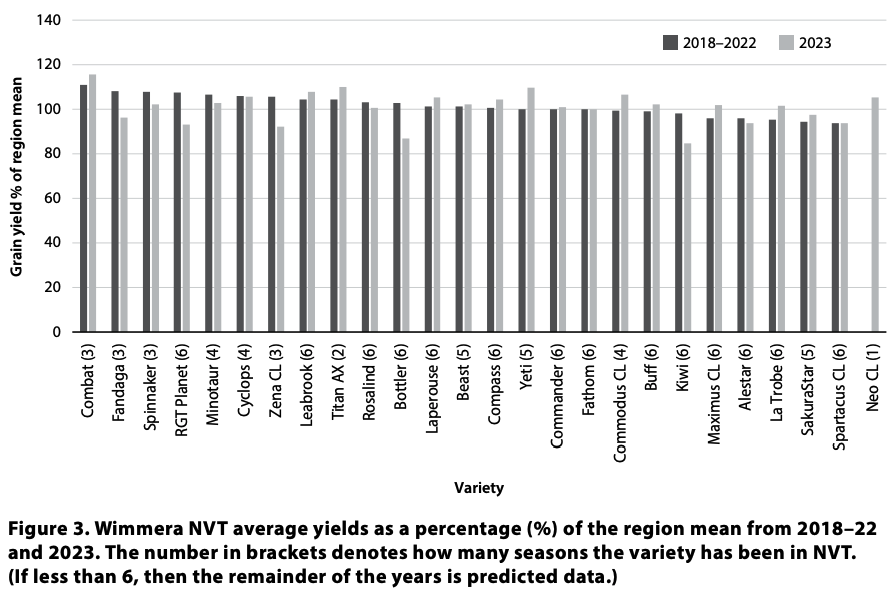
During the past five years, Combat, Fandaga, Spinnaker, RGT Planet and Minotaur have been the top performers in the Wimmera NVT (Figure 3). In 2023 Combat was again the top variety at 115 per cent of the region’s average with Minotaur 103 per cent and Spinnaker 102 per cent also yielding above the long-term average. Other varieties that performed well in 2023 were Titan AX (110 per cent), Yeti (110 per cent), Leabrook (108 per cent) and Commodus CL (107 per cent).
Commercial Practice and On Farm Profitability
NVT results provide growers with an opportunity to compare different varieties based on yield, grain quality and disease rating. This data is a useful tool for growers to use to determine which variety is performing well in their area. Growers can compare newly released varieties to those they currently grow or other popular varieties in the area for both the current year, as well as the previous five years. They can use this information to decide which variety is best for them.
Choosing whether to grow malt or non-malt varieties can be complex, with several points to consider. While in some years there may be a notable difference in the price between feed and malt; in 2023 malt only had a $5–$12/t advantage over feed barley. The likelihood of meeting malt specifications and extra inputs needed to meet those requirements versus the yield advantages of feed over malt varieties should also be considered. Combat is a high yielding feed variety that could be considered.
Certain areas of the Mallee, Wimmera and North Central regions were exposed to disease pressure in barley crops, most commonly spot form of net blotch (SFNB) and net form of net blotch (NFNB). Therefore, another consideration for variety choice is the level of disease resistance it offers. An addition to the NVT program in 2023 was the newly released barley variety Neo CL. This quick-maturing variety offers a good disease resistance package that may make it a suitable option for growers in medium to high rainfall environments experiencing increased disease pressure. Another variety with a good disease resistance package is Combat. This variety might help to ease in-season spraying pressure, allowing time for growers to focus on other crop types and varieties that may require spraying and spreading.
Although barley generally yielded well across the Mallee, Wimmera and North Central regions, growers experienced difficulties at harvest time with lodging, brackling and head loss in different varieties, with Compass-type varieties the most susceptible. Data from existing BCG research (see ‘Barley Management Options to Close the Yield Gap and Reduce Pre-Harvest Losses’, Figure 2, page 98) showed canopy management in association with high input management provided significant increases to grain yield in 2023. The data also highlights how the use of plant growth regulators and canopy defoliation both significantly reduced crop lodging, and increased fungicide intensity helped improve straw strength and reduced lodging. While there are in-season management options to lessen these impacts, variety selection is also important. Choosing a variety with characteristics such as strong straw strength can decrease yield losses and make harvesting the crop easier. Varieties to consider include Cyclops or Maximus CL.
Even though this research highlighted variety choice as the biggest factor in yield differences of all treatment variables, the impact of time of sowing should not be discounted. Therefore, whilst variety choice is an important decision and can be guided by combining NVT data, individual site reports and MET long term data from the past five years, growers should always consider other variables such as time of sowing, management strategies and inputs.
Grain quality data from NVT was not available at the time of compiling this report.
References
GRDC, 2023, 2024 Victorian and Tasmanian Crop Sowing Data Summary, https://grdc.com.au/resources-and-publications/all-publications/nvt-crop-sowing-guides/vic-tas-crop-sowing-guide.
GRDC, 2023, National Variety Trials yield data, https://nvt.grdc.com.au/.
Department of Agriculture, Fisheries and Forestry, 2014, Barley – planting and disease guide 2014 Queensland and NNSW, https://www.daf.qld.gov.au/__data/assets/pdf_file/0003/145587/Barley-Planting-Guide-2014.pdf.
Price T., Poole N., and Bennett B., 2024, 2023 BCG Season Research Results, ‘Barley Management Options to Close the Yield Gap and Reduce Pre-Harvest Losses’ pp 93.
Acknowledgements
This research was conducted through the National Variety Trial (NVT) program delivered by the GRDC.