TAKE HOME MESSAGES
- Hybrid varieties (44Y84CL, 44Y24RR, Hyola® 555TT) topped the yields at the Mallee sites, particularly on deep red Mallee sand.
- The shorter season varieties (ATR Stingray, IH30 and GT41) were not able to capitalise on the spring rainfall as well as later maturing varieties.
- New RoundUp Ready and Triazine Tolerant canola variety Hyola®525RT® was not a yield record breaker, but the technology is very exciting. Expect more varieties to be released with greater yield potential in the near future.
BACKGROUND
This year, the commitment of growers to sow canola was challenged: lack of summer rainfall (stored soil moisture), a late break and plantback issues (e.g. Amine® or Balance®) increased risk. This, coupled with the perceived higher input costs of growing canola (particularly in the Mallee), resulted in mostly cereal dominated rotations. However, many farmers have seen the benefits of incorporating profitable break crops into their rotations and some still grew a significant portion of canola in 2013.
It is extremely difficult to truly know how reliable and consistent a canola variety is going to perform for the simple fact that, in comparison to wheat, most varieties are short-lived. This makes comparing over multiple seasons difficult. BCG has strongly encouraged growers to choose a canola variety based firstly on their weed spectrum and the corresponding canola group (Triazine tolerant, Clearfield tolerant, RoundUp Ready or Conventional). Growers should then look at the specific varieties within those groups.
Table 1. Variety information and agronomic characteristic of canola varieties.
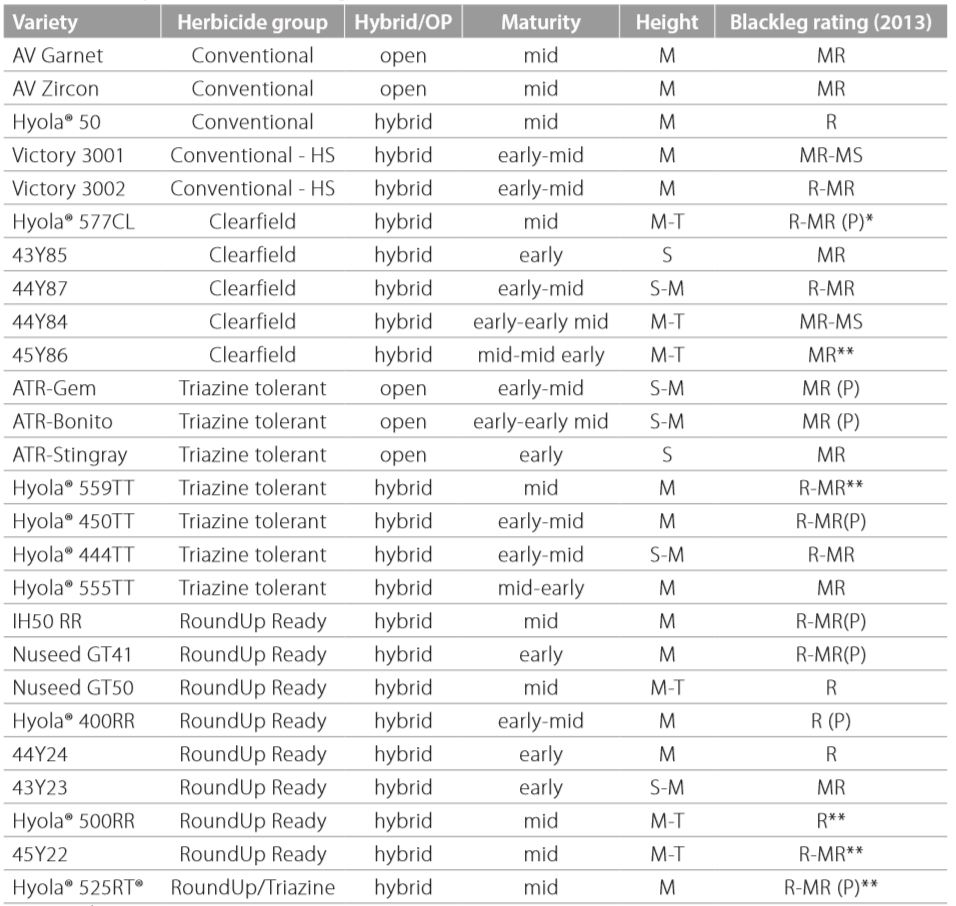
VARIETY DESCRIPTIONS
(source: DEPI winter crop summary 2013 and SARDI canola sowing guide 2014.)
CURRENT VARIETIES
Conventional AV-Garnet: mid-maturing, medium height, open-pollinated variety with generally high oil content. Blackleg rating is MR (2013). Bred by Vic DEPI. Released 2007 and marketed by Nuseed.
AV-Zircon: mid maturing, medium height, open-pollinated variety with good early vigour. High to very high oil content and a blackleg rating of MR (2013). Released 2011. Bred and marketed by Nuseed.
Hyola® 50: mid to mid-early maturity hybrid of manageable height and good standability. High yield potential, suited to medium rainfall areas, with good seedling vigour. Blackleg rating R (2013). Released in 2007. Bred by Canola Breeders International and Pacific Seeds; marketed by Pacific Seeds.
Conventional High Stability
Victory® V3001: early-mid maturity high stability hybrid. Good yield potential and a blackleg rating of MR-MS (2013). Developed by Cargill and Vic DEPI and grown under premium contract production with Cargill/AWB. Released 2008.
Victory® V3002: early-mid maturity high stability hybrid. Slightly later than V3001, but good yield potential and high oil content. Blackleg rating R-MR (2013). Developed by Cargill and Vic DEPI and grown under premium contract production with Cargill/AWB. Released 2011.
Clearfield Pioneer®43Y85 (CL): early season hybrid that extends adaptation to low and medium rainfall areas. Excellent early vigour, low plant height and excellent standability. Blackleg rating MR (2013). Released in 2011. Bred and marketed by Pioneer Hi-Bred.
Pioneer®44Y84 (CL): early to early-mid season maturing hybrid with high oil content, medium to tall plant height and a blackleg rating of MS (2013). Widely adapted to medium and low rainfall areas. Released in 2010. Bred and marketed by Pioneer Hi-Bred.
Pioneer®45Y86(CL): mid to mid-early maturing hybrid with excellent early vigour, high yield potential and high oil content. Targeted to replace 46Y83(CL). Provisional blackleg rating of MS (2013). Released in 2012. Bred and marketed by Pioneer Hi-Bred.
Triazine Tolerant ATR-Gem: early-mid maturing open-pollinated variety with good vigour, high oil content, and short to medium plant height. It has a blackleg rating of MR (2013). Released 2011. Bred and marketed by Nuseed.
ATR-Stingray: early maturing open-pollinated variety with short plant height and a compact pod set. Moderate to high oil content and a blackleg rating of MR (2013). Released 2011. Bred by AgSeed Research and DEPI Vic and marketed by Nuseed.
Hyola ®444TT: early-mid maturing hybrid ideally suited to medium-high rainfall zones. Medium-short plant height, moderate-high oil content, good vigour and standability. Blackleg rating R-MR (2013). Released in 2010. Bred and marketed by Pacific Seeds.
Hyola ®555TT: mid/mid-early maturing hybrid broadly adaptable to rainfall. Good seedling vigour, medium height, uniform flowering and a blackleg rating of R-MR (2013). Released in 2010. Bred and marketed by Pacific Seeds.
Hyola ®559TT: mid-maturing hybrid broadly adaptable to rainfall. Medium plant height and delivers high oil content. Provisional blackleg rating of R-MR (2013). Released in 2012. Bred and marketed by Pacific Seeds.
RoundUp Ready GT41: early maturing hybrid indicating high yield with good early vigour and very high oil content. A provisional blackleg rating of R-MR (2013). Released in 2012. Bred by Monsanto in conjunction with Vic DEPI and Nugrain and marketed by Nuseed.
GT50: early-mid maturing hybrid indicating high yield with good early vigour and very high oil content. Blackleg rating of R (2013). Released in 2012; bred by Monsanto in conjunction with Vic DEPI and Nugrain and marketed by Nuseed.
IH50 RR: A mid-maturing hybrid suited to medium to high rainfall zones. Good early vigour and uniform flowering. Blackleg rating R-MR (2013). Released in 2012, this variety was bred and marketed by Bayer CropScience.
Pioneer® 43Y23 (RR): early season maturing hybrid indicating wide adaptation to most canola growing districts. High yield potential for maturity and moderate-high oil content. Provisional blackleg rating of MR (2013). Released in 2012. Bred and marketed by Pioneer Hi-Bred.
Pioneer® 45Y22 (RR): mid-maturing hybrid with medium to tall habit and exceptional standability in high yielding environments. Blackleg rating of MR-MS. Released in 2011. Bred and marketed by Pioneer Hi-Bred.
Varieties withdrawn and no longer available include Hyola® 433, Pioneer® 45Y82, ATR Snapper, Jackpot TT, Fighter TT
2014 NEW RELEASES
Clearfield Pioneer®44Y87 (CL): early-mid maturing hybrid showing good adaptability to medium-medium/high rainfall zones. Short to medium plant with excellent early vigour and high oil potential (suggested as an equivalent to 44Y84). Pioneer issued blackleg rating of R-MR. Bred and marketed by Pioneer Hi-Bred.
Hyola ®577CL: mid maturing hybrid with excellent early plant vigour and medium-tall plant height. Very high yield and oil potential, best suited to medium-high rainfall zones. Internal blackleg rating is R-MR. Bred and marketed by Pacific Seeds.
Triazine Tolerant ATR Bonito: early-early/mid maturing open-pollinated variety showing good adaptability to a wide range of areas in NVT screenings. Short-medium plant height, capable of good yields and high oil. Nuseed blackleg rating is MR. Bred and marketed by Nuseed. End Point Royalties apply to this variety (EPR $5).
Hyola® 450TT: early-mid maturing hybrid showing good adaptability to low-medium rainfall zones. Medium plant height and very high oil potential. Provisional blackleg rating of R-MR. Bred and marketed by Pacific Seeds.
RoundUp Ready
Pioneer®44Y24: early-mid maturing hybrid suited to medium-high rainfall zones and irrigation. Medium height plant with good early vigour, very high yield potential and high-very high oil. Provisional blackleg rating R. Bred and marketed by Pioneer Hi-Bred.
Hyola® 400RR: early-mid maturity hybrid suited to low-medium rainfall zones. Medium height variety with very high yield and oil potential. Provisional blackleg rating is R. Bred and marketed by Pacific Seeds.
Hyola® 500RR: mid maturing hybrid suited to medium-high rainfall zones and showing good early vigour and medium-tall plant height. Very high yield potential and able to achieve excellent oil levels. Provisional blackleg rating is R. Bred and marketed by Pacific Seeds.
RoundUp/Triazine – New Technology
Hyola ®525RT®: mid maturity hybrid with new herbicide technology; both RoundUp Ready and Triazine Tolerant. Good yield and oil potential in a medium height variety that appears to be adaptable to a wide range rainfall zones. Internal blackleg rating R-MR. Bred and marketed by Pacific Seeds.
2013 NVT RESULTS
Figure 1 shows the performance of a range of canola varieties in the medium and high rainfall zones. With no OP varieties included in the Clearfield trials, it is difficult to ascertain any advantage the hybrids are having in these areas. However, looking at the RR and TT data, it appears that OP varieties performed quite well with ATR Bonito, ATR Stingray (TT) and GT50 (RR) still among the top yielding varieties. Generally, there was consistency across sites, however, Charlton certainly had some anomalies which have been attributed to frost. Hyola 575CL, Hyola 474 CL and Pioneer 45Y22 were notably affected more than other varieties. CB Telfer’s yield far exceeded its performance at other sites however, this would suggest that the majority of varieties were affected by frost to some degree and CB Telfer less so. The Charlton data should thus be treated with caution.
In the Mallee, there was limited data available as the Hopetoun and Birchip sites suffered herbicide (phenoxy) damage during the season. The Ultima site had poor establishment and was later sown compared to the district (results not included but available on the NVT website).
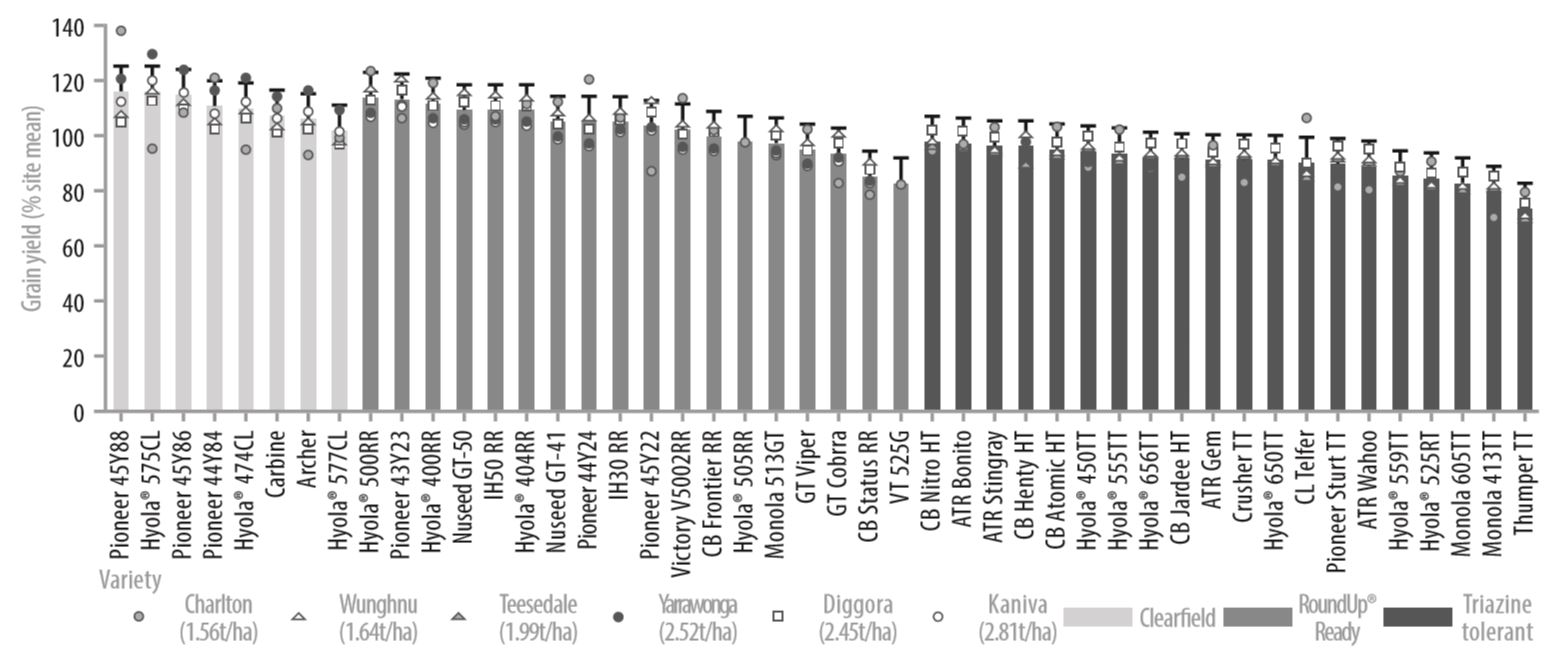
Figure 1. Site mean (%) for medium and high rainfall zones at NVT sites.
BCG 2013 CANOLA VARIETY TRIALS
This paper summarises five trials at various BCG research sites across the Wimmera and Mallee in 2013.
AIM
To determine the performance of commercial canola varieties in the Wimmera and Mallee.
METHOD
At each site, varieties were compared using a split-plot design. Varieties were grouped by their herbicide tolerance (main plots) and then randomised within (sub-plots). There was a minimum of four replicates in each trial. The plot size was 2.1m wide by 12m long, with six rows on 30cm spacings. Due to canola’s habit of tangling with adjacent plots, a plot gap of 60cm was used. The yields were subsequently adjusted to account for this.
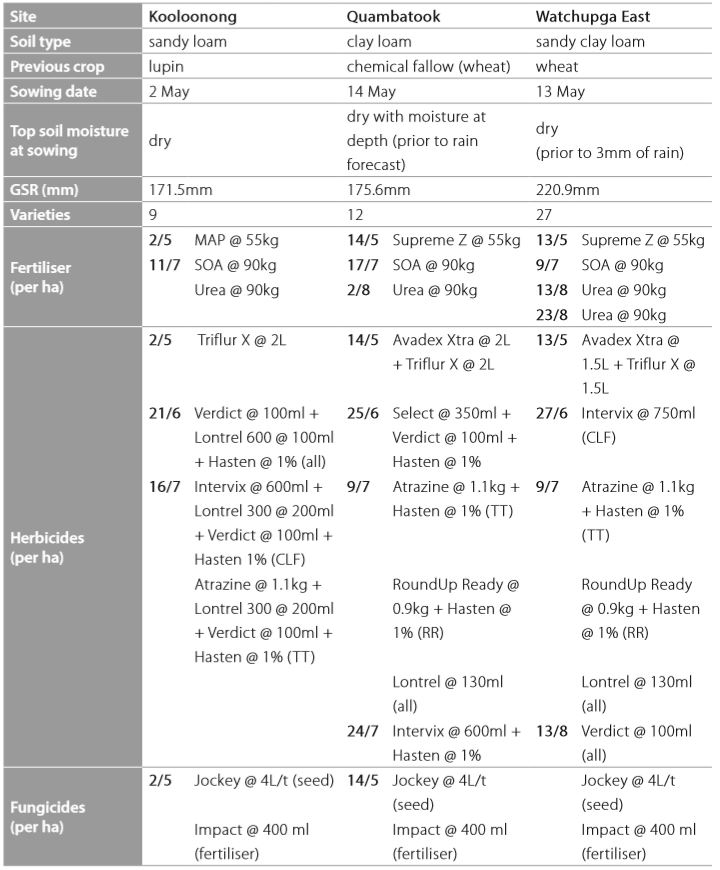
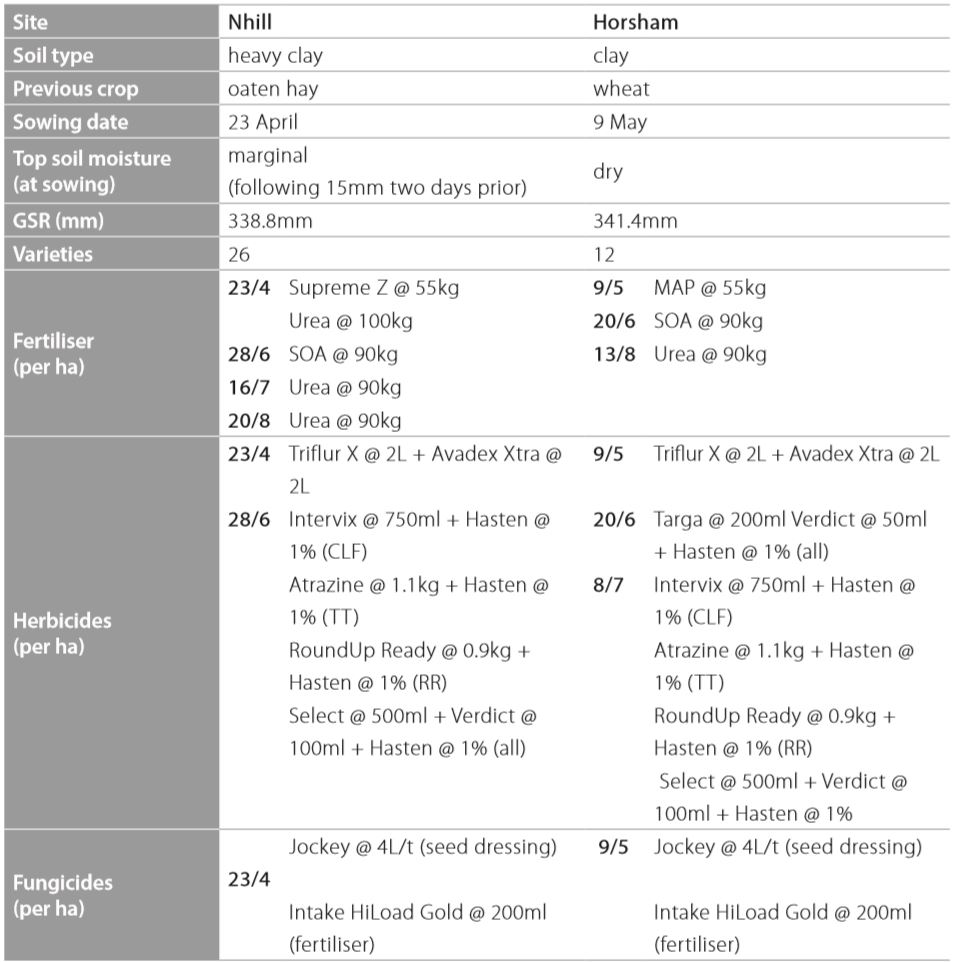
Table 2. Fertiliser, herbicide and fungicide applications on canola across the sites.
Plots were direct-headed with a Kingaroy plot harvester and oil content measured using a Foss Infratec NIR whole grain analyser. Yields were corrected to six per cent (%) moisture. To ensure all varieties ripened together, plots were desiccated prior to harvest. Any shattering or brackling within plots was accounted for in this analysis.
RESULTS AND INTERPRETATION
With such variation in growing season rainfall in the regions (Wimmera and Mallee), canola yields were mixed this year. This is reflected in the summary of trials presented in this article.
The late break, lack of stored soil moisture and a particularly dry August put the Mallee sites under significant moisture stress in late August and early September. As a result, the varieties flowered early (particularly the early maturing varieties). By 13 September the early maturing varieties had lost all their flowers and begun pod-filling. The significance of this stress is crucial to understanding why those early maturing, shorter season varieties did not perform well in a low yielding year as would have been expected. A significant rainfall event occurred 15 September (22mm). As a consequence, those slightly later-maturing varieties (Crusher, 44Y84 and Hyola®474CL) still mid-flower were able to continue to flower and produce additional pods, unlike the shorter season varieties. Varieties such as ATR-Stingray, ATR-Bonito and ATR-Gem have performed well in previous years. It is likely that the warm dry period in August had a much greater effect on the early varieties than the later.
Despite this, the benefit of hybrid varieties over open-pollinated was more evident in the Mallee than the Wimmera. At all the Mallee sites, a hybrid variety (Pioneer 44Y84, Hyola 555TT, Pioneer 44Y24 and 43Y23) topped the yields within each respective herbicide group. However, in the Wimmera, OP varieties such as Crusher and Nuseed GT50 performed equally as well or better than all hybrids.
The Kooloonong trial site was unique in that the canola was sown on deep red sand. Many growers had previously stated how difficult it was to establish and grow canola on these soils. There were no canola trials evaluating varieties on these soil types, yet they are governing factors on which Mallee growers are basing their decisions. The trial was sown dry into a lupin stubble and suffered uneven germination even after 24.5mm of rain at the end of May. It was evident at the time of the rain and following, that the soil was temporarily non-wetting, as dry seeds and soil were found 3-5cm away from wet soil with germinated plants. While the non-wetting effect was the same for each variety the hybrids established much better than the OPs and were more vigorous. The Clearfield hybrids 44Y84 and 43Y85 significantly out-yielded the OPs 43C80 and 44C79, while Crusher (OP) and Hyola 555TT (hybrid) topped the TTs. The results suggest that hybrids, though presenting greater upfront risk (from additional seed cost), may have a better fit in the low rainfall environments where establishment can be challenging.).
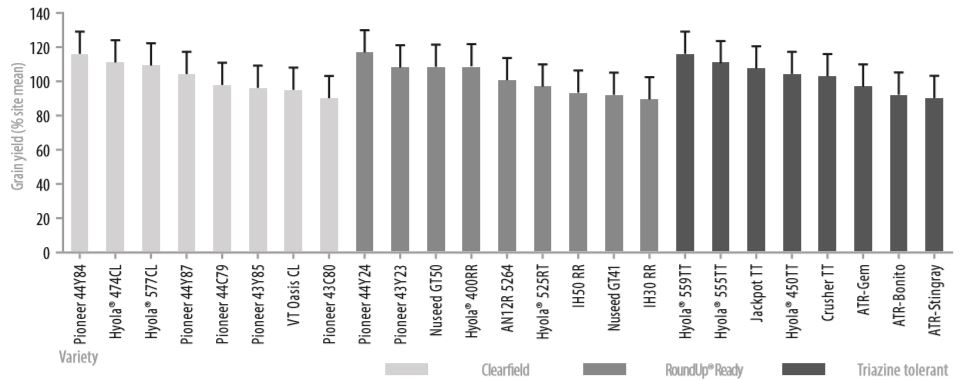
Figure 2. Grain yield (expressed as a % of site mean) at Watchupga East (Mallee). Sig. diff. <0.001, LSD=14%, CV9.6%).
In the Wimmera, conditions were opposite to those experienced in the Mallee. Both the Nhill and Horsham sites did not experience a dry period throughout the season (with the exception of the late break and summer). However, the mean yields produced at each site were similar; 1t/ha (Mallee) and 1.3t/ha (Wimmera).
Regional canola yields in the Nhill-Kaniva area were in excess of 2.5t/ha which raises the question, why were the trial yields so low?
The Nhill and Horsham sites had prolonged periods of wet conditions and accessibility was limited. Intended second herbicide applications were not carried out because the canola had advanced beyond the budding stage by the time the site was accessible by vehicle. Subsequently, there was some late infestation of wild oats (particularly in the RR varieties) and milk thistles (most notably in the RR, conventional and CLF). This would have affected the yields. Nitrogen (N) was also applied to the trial when water was still lying on the soil surface. Under these conditions, denitrification can cause substantial loss of N. The low N status of the Nhill site, was probably the cause of the limited yields.
The Horsham site would have benefited from another application of N, but a significant frost event on 18 October in the Wimmera region may have affect yields. Unfortunately, no frost score was taken prior to harvest.
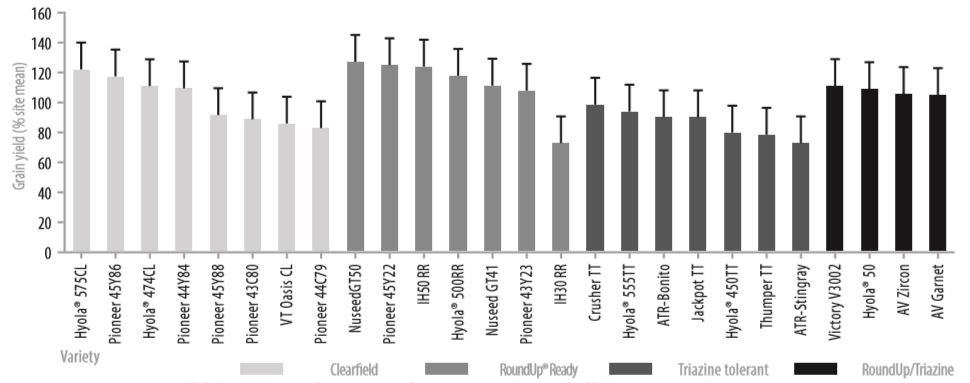
Figure 3. Grain yield (expressed as a % of site mean) at Nhill (Wimmera). Sig. diff. P<0.001, LSD=18%, CV12.9%.
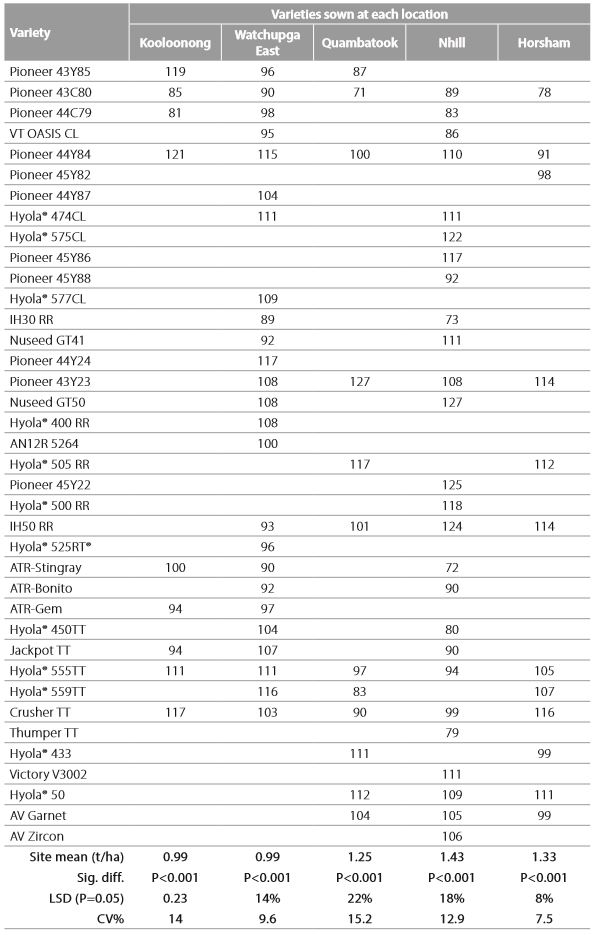
The grain yield (expressed as a per cent of the site mean) of each variety at the various sites is shown in Table 3. While the site means do not change very much, the ranking of several varieties does change significantly.
Table 3. Comparison yields of each variety at the different sites. Yields are expressed as a % of site mean.
Oil quality was exceptional in the Wimmera trials with the mean oil percentage being 45% (Nhill) and 48% (Horsham). The mean oil content in the Mallee trials was 42%.
COMMERCIAL PRACTICE
The role canola plays within rotations is sometimes misrepresented in variety trials such as these, as its contribution to reducing weed numbers and breaking stubble and root-borne disease cycles adds greater profitability and production to subsequent crops.
Herbicide plantbacks (particularly Clearfield, Atrazine and Lontrel) need to be considered in 2014. The effect of herbicide residues can significantly reduce yields and exacerbate disease effects on the subsequent crops.
This year the value of the hybrids really stood up, particularly in the CLF and RR. While there are still consistently good yielding OP varieties with the Conventional (AV Garnet and AV Zircon) and the TT (Crusher, ATR Stingray and ATR Bonito) groups, the hybrid varieties are beginning to close the gap. Hyola 555TT has better blackleg resistance than, and similar yields to, Crusher. Should Crusher be phased out, this variety will be a suitable replacement.
While the new variety Hyola®525RT® failed to yield exceptionally well compared with other varieties, its tolerance package is going to excite many growers. This is because it will allow them to take the pressure off group A herbicides such as Select® and Verdict® for grass control, while providing adequate broad spectrum control of broadleaf weeds such as wild radish. As this technology develops and higher yielding varieties are found, it’s unlikely that varieties from those other groups (TT, CL and RR) will be widely grown in the future.
REFERENCES
SARDI sowing guide 2014.
DEPI Victorian Winter Crop Summary 2013.
ACKNOWLEDGMENTS
The BCG variety trials were funded by BCG members. The NVT results were funded by GRDC.