Take Home Messages
- Achieving DR1 grain quality remained extremely difficult with only very high rates of nitrogen (331kg N/ha) achieving the target protein (13 per cent) in 2023.
- High application rates of nitrogen, such as 331kg N/ha in 2023, hayed off the crop in the West Wimmera and reduced yield and grain quality parameters.
- A dry spring in the West Wimmera did not result in crown rot affecting grain yield and quality, despite localised reports of crown rot expression in the region but nil in the trial
Aim
To determine the efficacy of Syngenta’s Victrato® seed treatment at controlling crown rot in durum wheat.
To identify the rate of nitrogen required to achieve 13 per cent protein in durum wheat in 2023.
Background
Durum wheat is an important crop for human consumption, known for its excellent cooking qualities and aptness for pasta production (GRDC 2017). In recent years great advances have been made in varieties for suitability in more marginal rainfall environments and improved disease resistance helping to make it a competitive crop option. There are however, two key agronomic areas – nitrogen (N) and disease (specifically crown rot) – that durum growers must manage effectively to meet quality standards and attract a price premium along with achieving high yields to make it a more profitable option than bread wheat.
The main driver of durum quality is grain protein, so getting in-season nitrogen applications right is critical. Nitrogen applications at late flag emergence are more likely to raise grain protein. However, determining how much urea to spread each season can be a challenge, particularly when 13 per cent protein is needed to achieve the desired DR1 standard (McDonald and Hooper, 2013).
When it comes to achieving yields comparablre to bread wheat, in addition to nitrogen management, the risk of crown rot infection needs to be controlled. In comparison to barley and the different bread wheat varieties, durum wheat is the most susceptible to crown rot. Predominantly caused by the stubble-borne fungus Fusarium pseudograminearum, all winter cereals, as well as many grass weeds, are hosts of the pathogen, which can survive for many years in infected stubble. Crop rotation and inter-row sowing are therefore key management strategies but other approaches, such as new seed treatments, are also being explored.
A trial was established at Kaniva in 2023 testing different nitrogen rates and their impact on grain protein and yield, as well as investigating the effectiveness of Victrato® – a soon to be commercially available seed treatment product from Syngenta that contains the active ingredient cyclobutrifluram – at limiting yield losses from crown rot. The 2023 trial builds on work conducted by BCG in 2021 at Birchip West and 2022 at Kaniva. Seasonal conditions were not conducive for crown rot expression in each of those years and thus no yield differences were observed.
Paddock Details
Location: Kaniva
Crop year rainfall (Nov–Oct): 504mm
GSR (Apr–Oct): 318mm
Soil type: Clay
Paddock history: Lentil
Predicta B Result: 0.5 log (pg DNA/g soil) (low crown rot disease risk)
Trial Details
Crop type: Durum wheat: Bitalli
Target plant density: 140 plants/m²
Seeding equipment: Knife points, press wheels, 30cm row spacing
Sowing date: 1 June 2023
Replicates: Four
Harvest date: 22 December 2023
Trial average yield: 4.2t/ha
Trial Inputs
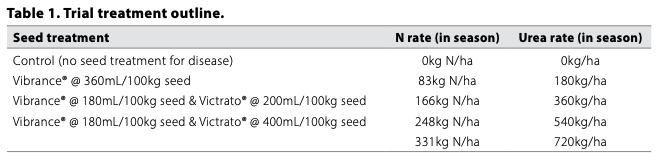
Fertiliser: Granulock Supreme Z + Flutriafol (400mL/100 kg) @ 60kg/ha at sowing and in-season applications. Refer to Table 1
Seed Treatments: Refer to Table 1
Weeds, insects and foliar diseases were managed as per best practice
Method
A replicated field trial was sown using a complete randomised block trial design. Assessments included establishment counts, basal browning and white head scores, grain yield and grain quality parameters. The nitrogen treatments were applied as a split application on 13 July at GS13 and 22 September at GS49.
Results & Interpretation
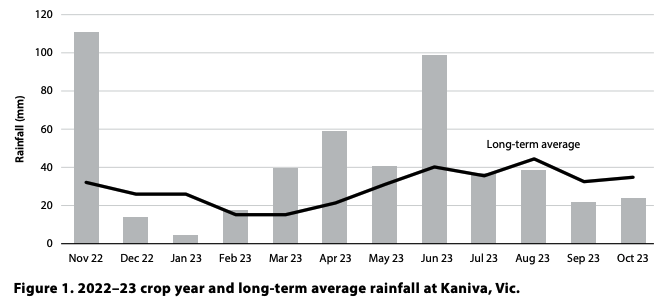
The 2023 growing season at Kaniva was mixed, with above average rainfall to start but below average rainfall in mid-late winter and spring (Figure 1). As a result, the trial established well, averaging 107 plants/m², but experienced some periods of moisture stress and frost during the grain filling period (data not presented).
Crown Rot
Despite localised reports of crown rot expression within the Kaniva district and the below average spring rainfall, there was little expression of crown rot in the trial. This was evident from no basal browning and low to nil white heads as assessed on 2 November 2023 (data not presented).
A lack of physical expression of crown rot also translated to yield and grain quality with no differences observed between seed treatments for a third year in a row (data not presented). This highlights that, despite a conducive season for crown rot development, good paddock selection such as low disease risk (see Predicta B result) can greatly reduce the disease’s impact
N Rates
The rate of nitrogen applied had a significant effect on yield and all grain quality parameters tested (Table 2). In terms of yield, the 331kg N/ha of urea (highest rate) was much lower than the other rates, which did not differ. This was contrary to what was expected, and perhaps can be explained by the timing of the nitrogen application, with more being needed earlier in the season (starting soil mineral nitrogen = 75kg N/ha to 80cm) and/or with the tighter spring in the West Wimmera that caused the crop to hay off.
For the different grain quality parameters, the highest nitrogen rate had the highest grain protein, lowest test weight, highest screenings (although rates were all <5 per cent) and lowest thousand grain weight (Table 2). Ignoring protein, the highest nitrogen rate had lower overall grain quality (excluding protein) which is consistent with a hayed off crop. The highest nitrogen rate was, however the only one to achieve the desired 13 per cent protein.
There also were no interactions between seed treatment and nitrogen rate for grain yield and all quality parameters tested (data not presented).

Commercial Practice and On Farm Profitability
Is there a role for Victrato® in crown rot management?
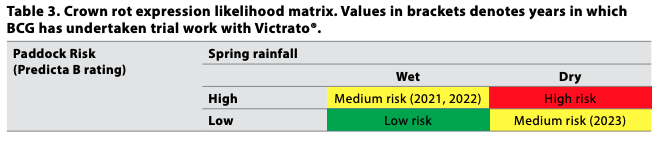
Maybe. While three years of BCG trials have not been able to demonstrate any benefit from the application of Victrato® seed treatment, the product has not been tested under the most extreme crown rot disease risk combination (Table 3).
Current best practice of rotating crop types, inter-row sowing, testing paddocks for their disease risk, and making rotation changes based on these tests is minimising the impact of crown rot in durum wheat production. Nonetheless, under the ideal conditions for crown rot expression, other independent trial work has shown Victrato® to be effective in limiting yield loss from crown rot (Finger 2022).
When does chasing DR1 go too far?
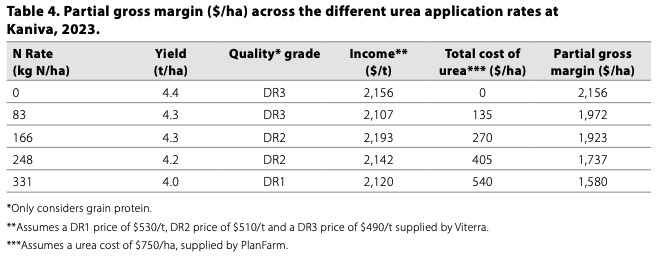
In a season like 2023, it is possible for excess nitrogen application to negatively impact crop yields and some quality parameters (not protein). When taking into account all quality parameters tested, every nitrogen rate made DR3 so applying no nitrogen would have been the most profitable. If we just focus on grain protein, the most profitable nitrogen application strategy in 2023 was also the no nitrogen treatment (see Table 4). However, caution needs to be taken when examining these partial gross margins as grain yield displays a strong influence. Under different circumstances, higher applications of nitogen would be expected to equate to increased yield (contrary to the results of this trial) and thus be more profitable.
N Rates
When compared to the Kaniva NVT results for the bread wheat variety Scepter, growing durum was still more profitable than bread wheat (depending on nitrogen rate). Scepter wheat returned a $1957/ha partial gross margin, based on the NVT average Scepter yield of 5.8 t/ha, assuming AUH2 grain quality (11.5 per cent protein) was achieved at a price of $347/t and the total nitrogen application for the trial was 34.5kg N/ha.
Grain quality data from NVT was not available at the time of compiling this report.
References
Finger, K,. 2023, 2022 BCG Season Research Results, ‘New seed treatment for crown rot management’, pp 118–122.
GRDC, 2017, GRDC Grownotes Southern Region, ‘Durum: Section A Introduction,’ <https://grdc.com.au/__data/assets/pdf_file/0030/369471/GrowNote-Durum-South-0-Introduction.pdf> [accessed 18 January 2024].
GRDC, 2023, National Variety Trials yield data, <https://nvt.grdc.com.au/trial-results/> [accessed 17 January 2024].
McDonald G. and Hopper P., 2013, GRDC Update Paper, ‘Nitrogen decision – Guidelines and rules of thumb’, <https://grdc.com.au/resources-and-publications/grdc-update-papers/tab-content/grdc-update-papers/2013/02/nitrogen-decision-guidelines-and-rules-of-thumb#:~:text=Nitrogen%20can%20be%20applied%20late,protein%20rapidly%20diminishes%20after%20flowering> [accessed 22 January 2024]
Acknowledgements
This research was funded by the Southern Australia Durum Growers Association (SADGA) and BCG members through their membership.
We thank the Dyer family for hosting this trial.
Thank you to Claire Pickles for providing a technical review of this article.