Take Home Messages
- Proactive disease management, which combines variety selection, paddock selection and appropriate fungicide use, provides proven sustainable and economic disease control.
- Septoria tritici blotch (STB) reduced grain yield in highly susceptible wheat varieties by 21 per cent in the MRZ (Wimmera) during 2024. However, yield losses may be reduced if sowing time can be adjusted as part of integrated control of STB.
- Monitoring symptoms is critical for STB control. To maximise efficacy, apply fungicides after the appearance of first symptoms on the lower canopy
Aim
To determine optimal sowing time for management of STB in wheat.
To optimise fungicide application timing for better efficacy of STB control.
Background
Septoria tritici blotch (Zymoseptoria tritici, STB), is a stubble-borne fungal disease of wheat, that is now widespread and damaging in many parts of Victoria. In recent years, it has become the most prevalent disease across Victoria’s medium (MRZ) and low (LRZ) rainfall zones with grain yield losses of greater than 20 per cent in susceptible crops during seasons conducive for the disease. The increased incidence and distribution of the disease is largely due to current intensive farming practices, including no-till and stubble retention, which have led to inoculum build-up. During 2022, Agriculture Victoria (AgVic) and Birchip Cropping Group (BCG) trials showed up to ~43 per cent yield loss and quality reductions in susceptible varieties, demonstrating that losses can be greater during wet seasons (Dadu et al., 2022).
To determine the best management practices suited to LRZ and MRZ for STB control, Agriculture Victoria in partnership with the South Australia Research and Development Institute (SARDI) – with supporting investment from GRDC – conducted 48 field experiments over four seasons during 2021–24. This research revealed yield losses can be significantly reduced by avoiding susceptible varieties, adjusting sowing time, managing stubble loads, rotating wheat with other crops, and using foliar fungicides. This article summarises the results from two experiments conducted during 2024 in the MRZ, Victoria, to optimise sowing time and fungicide timing for STB management.
Paddock Details
Location: Longerenong (MRZ)
Crop year rainfall (Nov–Oct): 338mm
GSR (Apr – Oct): 149mm
Soil type: Clay
Paddock history: Faba bean
Trial Details
Crop type/s: Wheat
Treatments: Refer to Tables 1 and 2
Target plant density: 150 plants/m²
Seeding equipment: Knife points, press wheels, 30 cm row spacing
Sowing date: Early sown: 24 April 2024; Late sown: 21 May 2024;
Fungicide timing: 24 April 2024
Replicates: Six
Harvest date: 5 December 2024
Trial average yield: 5.5t/ha
Trial Inputs
Fertiliser: Trials managed as per best practice reflecting the region and to ensure nutrients are not limiting.
Herbicide/Insecticide: Trials kept weed and pest free.
Fungicide: Refer to Tables 1 and 2
Seed treatment/inoculant: Refer to Tables 1 and 2
Method
1. Experiment 1: Sowing time as a strategy for STB management
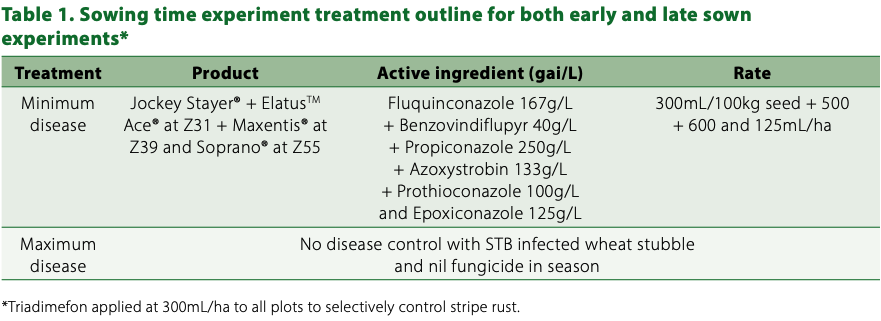
During 2024, two field experiments with two times of sowing – one sown on 24 April (early) and one sown on 21 May (late) – were compared in the MRZ at Longerenong, Victoria. Each experiment included three wheat varieties (Hammer CL Plus (MSS), Scepter (S) and Razor CL Plus (SVS)) in six replicates and two treatments (inoculated with +/- disease) sown in a randomised block design (Table 1). Both experiments were assessed for disease severity, grain yield and quality.
2. Experiment 2: Optimise fungicide timing for better efficacy
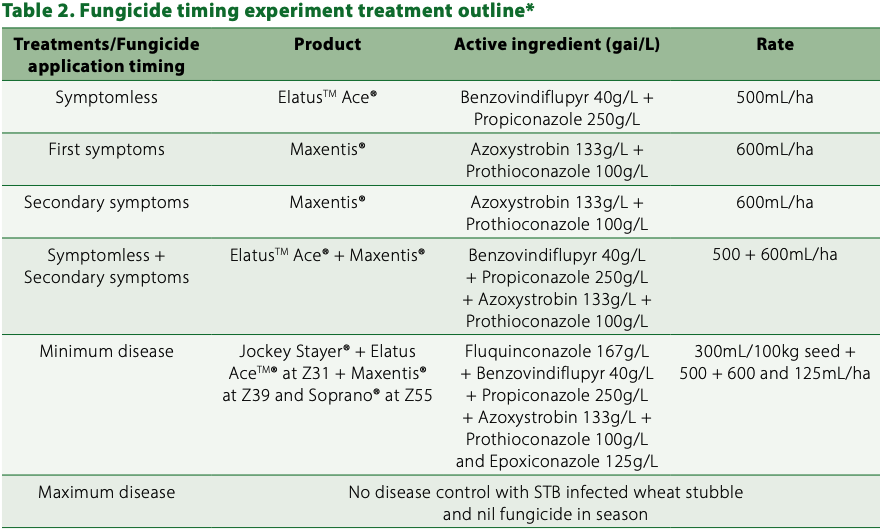
During 2024, one field experiment was conducted in the MRZ at Longerenong, Victoria. The experiment was sown to a susceptible variety, Scepter, and inoculated with infected stubble. The experiment was visually monitored for disease, and fungicide treatments applied at incremental disease levels with effects compared to a minimum disease control (Table 2). All the treatments were replicated six times and assessed for disease severity, grain yield, and quality.
Results & Interpretation
1. Sowing time as a strategy for STB management (Experiment 1)
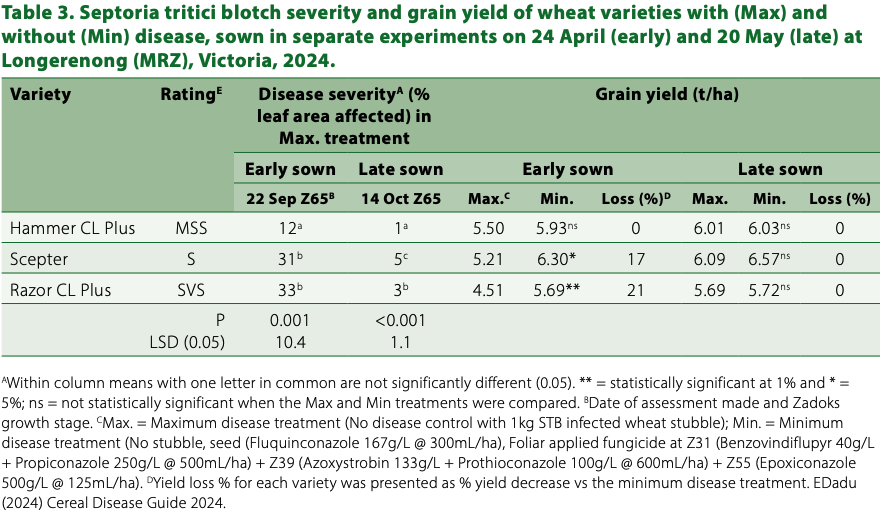
Septoria tritici blotch (STB) severity significantly varied with sowing time, variety, and fungicide application. Early sowing in April demonstrated losses of up to 21 per cent (~1.2t/ha) in susceptible varieties because of higher STB infection levels of up to 33 per cent at late flowering stage (Table 3). However, when sowing was delayed by about a month and still within the optimal sowing window, the risk from disease significantly reduced and no yield was lost. Equally, by avoiding susceptible varieties yield loss was minimised even when sown early. Early sowing allows for more disease infection cycles causing significant yield loss, while delayed sowing would avoid early release of spores from stubble, delay primary infection, and reduce risk of yield loss. Higher STB severity in early sown experiment also affected grain quality of Scepter (S) and Hammer CL Plus (MSS), with a small increase in screenings and reduction in 1000 grain weight, but did not affect protein (data not shown). Late sowing did not affect the grain quality of any of the three wheat varieties.
These experiments clearly highlighted the benefit of integrating different management strategies to avoid disease impacts which may even mitigate the need for fungicide intervention. The finding of reduced impacts of STB from avoiding susceptible varieties and delayed sowing is consistent with the findings of Murray et al. (1990). With increasing occurrences of fungicide resistance in diseases in Victoria, it is beneficial to have strategies that can suppress disease severity
2. Optimising fungicide time and efficacy (Experiment 2)
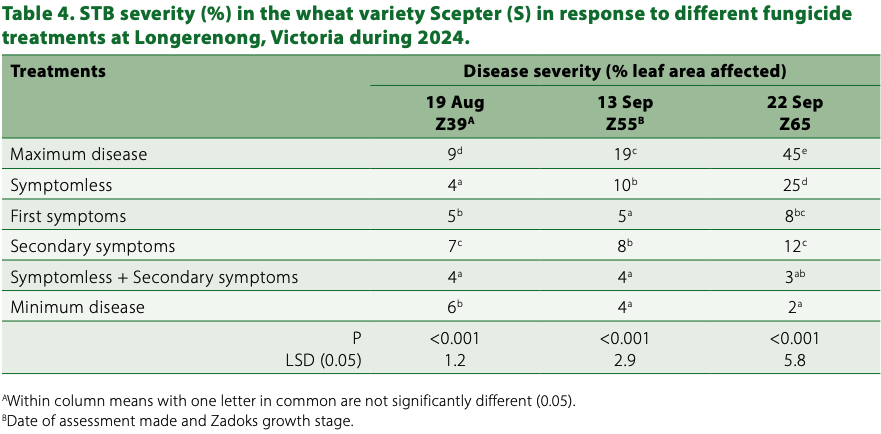
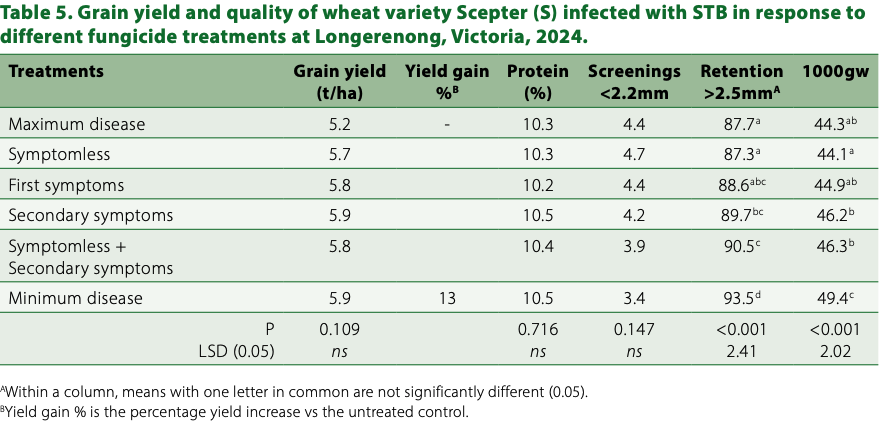
Fungicides effectively suppressed STB infection in Scepter (S) and increased grain yield by 13 per cent when compared to the untreated treatment (Table 4). In addition, grain retention and thousand grain weight were also improved (Table 5). Fungicides were more effective when applied after STB symptoms were detected in the crop. This finding contradicts the general consensus that preventative applications are more effective for STB control. However, a pre-emptive foliar application alone did not provide complete control and an additional application was needed, increasing the economic cost of the management. The long latent period (~30 days), which is the time between infection and appearance of first symptoms, poses challenges for timely fungicide application. Delaying application could lead to underestimation of the disease risk and lead to yield loss, while applying too early may result in suboptimal control.
Therefore, monitoring symptoms in wheat crops for STB is critical to improve the efficacy of applied fungicides. Early season STB infections typically affect lower leaves in the canopy. As the canopy develops, disease progresses upwards to the yield-contributing flag leaves when there is sufficient rain to support epidemic progression. Application of fungicides upon detection of the first symptoms in the lower canopy can intercept latent infections early in the upper canopy, offering better control.
In this experiment, the first symptoms of STB were detected on the lower canopy at stem elongation stage (Z37), much later than the traditional stage (Z31) routinely used for fungicide application. The secondary symptoms were marked as symptom appearance on the flag leaves, which were detected around the early booting stage (Z41). Given the below average seasonal conditions during 2024, single fungicide applications at either of the growth stages provided levels of protection from STB equal to a dual or a triple application strategy. This supported previous season results that use of multiple fungicide applications would not be economical in seasons with dry weather.
Commercial Practice and On Farm Profitability
Septoria tritici blotch (STB) is now the most common foliar disease of wheat in Victoria’s medium‑rainfall (Wimmera) and low-rainfall (Mallee) zones. In 2022, grain yield losses in the Wimmera exceeded 40 per cent, while in 2023 losses in the Mallee reached up to 10 per cent (Dadu et al., 2022, 2023). These findings underscore the critical need for effective management strategies to control STB.
From 2021 to 2024, Agriculture Victoria (AgVic), in collaboration with BCG, conducted many field experiments in the Wimmera and Mallee (Dadu et al., 2021, 2022, 2023). These studies highlighted that the economic outcomes of disease management strategies vary depending on factors such as grain yield potential, variety selection, seasonal conditions, fungicide use, stubble loads, and crop rotation practices.
In summary, losses were minimised by implementing the following integrated disease management (IDM) strategies:
Variety selection: Planting resistant varieties is strongly recommended where possible. In the Wimmera and Mallee regions, yield losses can be substantially reduced by selecting varieties with at least a MS and MSS rating, respectively, without relying on fungicides. In contrast, continuous cultivation of susceptible varieties significantly elevates the risk of yield loss from STB (Murray et al., 1990; Dadu et al., 2022).
Paddock selection: Avoid planting wheat-on-wheat as STB is a stubble-borne disease. A break of at least a year has proven effective in reducing inoculum carryover. However, wheat sown following a break crop remained vulnerable to wind-blown spores from wheat stubble in surrounding paddocks, emphasising the importance of implementing further measures for effective disease management.
Stubble management strategies: Manipulating stubble loads through methods such as burning or baling has been shown to reduce inoculum levels and decrease early in-crop disease risk.
Seasonal conditions: Wet, cool conditions (15°C–20°C) with frequent rain or dew create an environment conducive to high levels of STB infection. In wet years with frequent rain events, STB pressure is generally higher, leading to more severe disease outbreaks (Murray et al., 1990; Dadu et al., 2022). Alternatively, in drier seasons, disease pressure is typically lower due to reduced moisture and fewer opportunities for infection. However, localised outbreaks can still occur if specific rainfall events create favourable conditions.
Sowing time: Avoid early sowing, especially when using susceptible varieties. STB spores are typically released from stubble early in the season, and delaying planting allows crops to avoid this initial spore release. Sowing later can limit crop exposure to multiple infection cycles, effectively reducing the overall risk of disease.
Use of fungicides and timing of application: Fungicides have proven effective in suppressing STB infection, but their application can generally be avoided in seasons with below-average rainfall and where grain yield potential is less than 3t/ha. For example, in 2021, fungicide use in both the MRZ and LRZ was not economical (Dadu et al., 2021). However, when susceptible varieties are sown in wet seasons, fungicide strategies should include applications at both growth stages 31 and 39 (Dadu et al., 2022). To maximise efficacy, the timing of fungicide applications should align with disease progression. Applications made after symptoms appear in the lower canopy have been shown to provide better control than pre-emptive applications made before symptoms are detected.
This study did not focus specifically on fungicide choices, but it is important to note that STB populations have the potential to develop resistance to fungicides, so their unnecessary use should be avoided. Based on historic studies by NSW DPI, it is known that reduced sensitivity to the triazole (DMI, Group 3) fungicides is well established in Victoria. Furthermore, a sample tested in 2024 revealed the presence of a resistance mutation to strobilurin fungicides (QoI, Group 11) which is concerning. It is recommended to consult the Australian Fungicide Resistance Extension Network (AFREN) and follow their fungicide resistance management strategies to help mitigate the risk of resistance development in STB populations. For more information on fungicide resistance, go to the website .
References
Murray G., Martin R., and Cullis B., 1990, Australian Journal of Agricultural Research, ‘Relationship of the severity of Septoria tritici blotch of wheat to sowing time, rainfall at heading and average susceptibility of wheat cultivars in the area’ 41(2), pp 307–15.
Dadu H., Hollaway G., and Clarke G., 2021, 2021 BCG Season Research Results, ‘Management strategies for Septoria tritici blotch (STB) in wheat in the Wimmera and Mallee’ pp 146–153.
Dadu H., Hollaway G., Garrard T., and Clarke G., 2022, 2022 BCG Season Research Results, ‘Management strategies for septoria tritici blotch (STB) in wheat in the Wimmera and Mallee during a high-pressure season’ pp 100–107.
Dadu H., Hollaway G., Clarke G., and Plowman Y., 2023, 2023 BCG Season Research Results, ‘Variety selection holds key to manage Septoria tritici blotch (STB) of wheat in Wimmera and Mallee’ pp 154–162.
Acknowledgements
This research was funded by the Victorian Government (Agriculture Victoria) and GRDC as part of the GRDC project ‘Epidemiology of Septoria Tritici Blotch in the low and medium rainfall zones of the Southern region to inform IDM strategies’ (DJPR2104_004RTX).
Thanks to Agriculture Victoria’s field crops pathology team at Horsham and the BCG team for technical and scientific support. Thanks also to research collaborators Dr Mark Mclean (Project Platypus), Dr Andrew Milgate (NSW DPI), Dr Julian Taylor (University of Adelaide), Dr Fran Lopez Ruiz (Centre for Crop and Disease Management), Dr Rohan Kimber and Dr Tara Garrard (SARDI).