Take Home Messages
- Hay and late termination end-uses resulted in the highest grain yield in the following wheat crop.
- Hay end-use was the most profitable option over two years.
- Brown manure can still be an option for problem-weed paddocks.
Aim
To evaluate the effect of vetch variety choice, end-use and in-season decisions on the yield and grain quality of a subsequent wheat crop.
Background
Common vetch (Vicia sativa) has been grown in the Victorian Mallee for many years and has remained a staple due to its versatility as both a source of high protein stock feed and as a nitrogen (N) fixing green manure. It is understood that sowing vetch earlier will increase biomass for grazing and hay yield (GRDC, 2018). There is also a trade-off between brown manure timings: the earlier the termination timing, the higher the soil moisture left behind but the lower fixed nitrogen. In contrast, the later the termination timing, higher levels of soil mineral N are left behind, but this is quite often coupled with lower soil moisture levels (Ferrier et al., 2012). It is not well understood how agronomic decisions made during the season affect soil moisture and soil mineral N levels following the vetch phase, or their influence on yield and quality of the subsequent crop. Findings from year one (2023) of this research can be accessed here: <https://www.bcg.org.au/research-article/vetch-end-use-andhow-it-affects-the-cropping-rotation/>.
Grain legumes provide some N – but often not enough – for the following year’s cereal crop at the current intensity cereals are grown. The research outlined in this article was guided by feedback from growers who wanted to understand how in-season management practices of vetch affect the following year’s wheat crop.
Paddock Details
Trial Details
Crop type: Scepter wheat
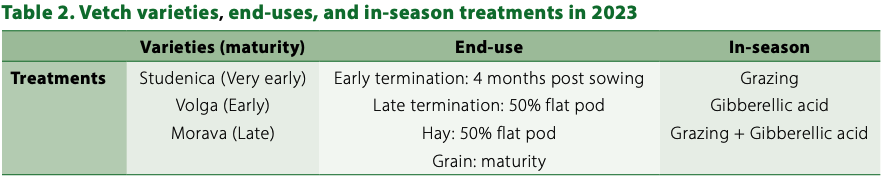
Treatments: Refer to Table 2. for 2023 treatments
Target plant density: Wheat: 130 plants/m²
Seeding equipment: Knife points, press wheels, 30cm row spacing
Sowing date: Ouyen – 15 May 2024, Kinnabulla – 6 May 2024
Replicates: Four
Harvest date: Ouyen – 21 November 2024, Kinnabulla – 1 December 2024
Trial average yield: Ouyen – 2.2t/ha, Kinnabulla – 3.2t/ha
Trial Inputs
Fertiliser: 60kg/ha Granulock Supreme Z @ sowing
Weeds, pests, and diseases were managed as per best practice.
Method
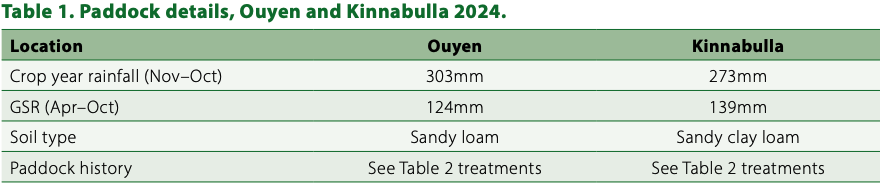
Two replicated field trials were sown at Ouyen and Kinnabulla (Table 1) using a complete randomised block trial design in 2023 (Year 1). As a growth promoter, gibberellic acid (GA) was applied mid-June when the vetch was at eight node, targeting about four weeks before grazing. The grazing treatment was carried out just before canopy closure during mid-July for both sites. Early termination timing was undertaken four months after sowing for all varieties irrespective of growth stage, whereas the late termination timing and hay cut timing were determined by variety maturity. Termination or hay cut timing were when the vetch reached 50 per cent flat pod formation. Soil sampling was carried out at each site before sowing in Year 1 to determine baseline soil moisture and soil mineral N levels.
Post‑harvest and pre-sowing soil tests were carried out in Year 1 and 2 per plot to determine soil mineral N and plant available water (PAW) to a depth of one metre and segmented into depths of 0–10cm, 10–40cm, 40–70cm and 70–100cm.
In Year 2, both trials were sown to Scepter wheat on 15 May at Ouyen and 6 May at Kinnabulla. Assessments carried out in Year 2 included soil moisture, soil N, NDVI, biomass, grain yield, and quality.
Results & Interpretation
Soil moisture and soil mineral N
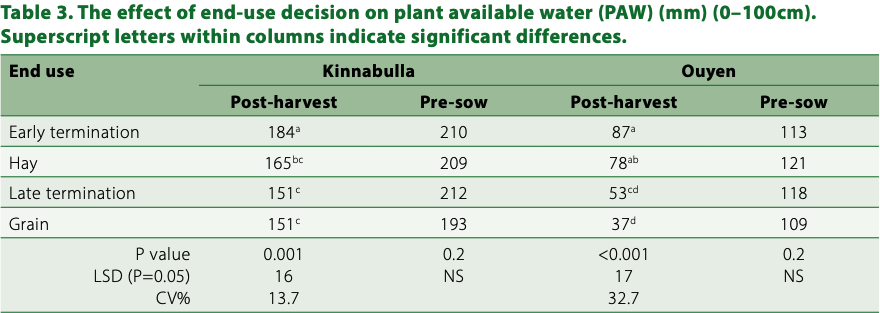
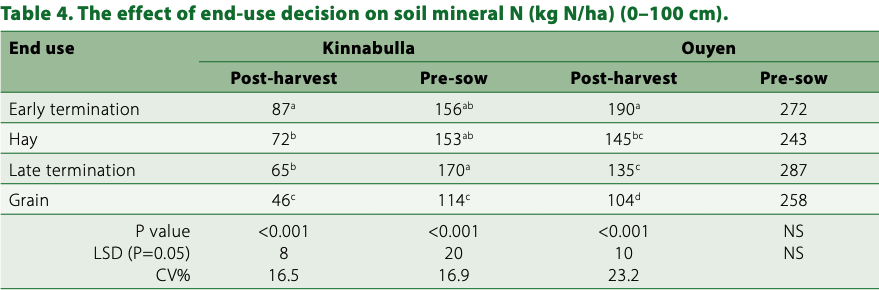
PAW and soil mineral N were lowest following the vetch grain harvest treatments, as shown by post‑harvest soil sampling (Tables 3 and 4). The early termination timing treatment produced the highest soil N content, which was unexpected given the large differences in biomass produced from the two termination timings. However, measurements taken closer to sowing showed a higher level of mineralisation in the late termination timing at Kinnabulla. By contrast, the grain treatment at Kinnabulla produced the lowest soil mineral N. Differences in PAW close to sowing were insignificant; likely due to higher-than-average rainfall between harvest and sowing (November to March) at both sites.
Significantly higher soil mineral N was detected following harvest for the earlier termination timing treatments across both sites, and this is likely due to increased time for soil mineralisation (Farquharson et al., 2022), whereas soil mineral N for the late termination and hay treatments at the pre-sowing measurement timing were relatively lower and similar (Table 3). With 3–6t/DM/ha of biomass removed in the hay cut treatments, a large difference in soil mineral N for these treatment plots would be expected. This demonstrates that time is needed for fixed N to break down into available soil mineral N.
When measured prior to sowing in the following year, the amount of N in the later termination timing treatment had increased, but not to the expected amount. A substantial amount of vetch stubble was still present at the time of sowing the subsequent crop in Year 2, and it is likely extra time is needed to realise full N mineralisation through biomass breakdown.
Wheat yield and quality
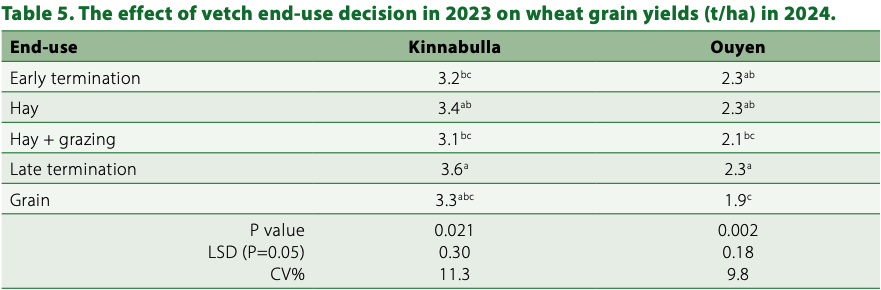
Of all the end-use treatments, the late termination and hay end-uses of vetch in Year 1 were the only treatments to consistently show improved wheat yields in Year 2 (Table 5). Early termination and grain end-use legacy effects on yield were inconsistent, showing no trends at the two sites. The hay treatment was not expected to have a significant legacy effect on yield, as 3–6t/DM/ha of biomass removed is likely to result in less mineralisation compared to the brown manure treatments. This is consistent with observations reported previously in other studies (Grain Orana Alliance, 2024; Browne et al., 2012).
There was no significant difference between treatments in grain protein which averaged 10.2 per cent at Kinnabulla and 11.6 per cent at Ouyen. Year 2 wheat grain quality was not affected by Year 1 end-use at either site, with no evidence of haying-off or low screenings (data not shown).
Commercial Practice and On Farm Profitability
Producing vetch hay in 2023 followed by wheat in 2024 was the most profitable option, compared with brown manure vetch or vetch grown for seed (Figure 2). This was due to high hay yields in 2023 when the Ouyen site yielded 4.9t/DM/ha, resulting in a gross margin of $1334/ha, and the site at Kinnabulla yielded 6.2t/DM/ha resulting in a gross margin of $1825/ha for Year 1. Growing vetch seed was the second most profitable outcome at both sites. Both brown manure timings had the lowest gross margin due to having no income in Year 1.

Although brown manure was not profitable in this trial, it is still an important option in a rotation. Brown manure vetch can be an excellent way to deal with problem weeds and can provide ground cover over summer (note: $160/ha was used in this gross margin for brown manure production costs; however, these costs can vary and if end-use is decided mid-season, costs can be significantly higher as more expensive inputs may be used for a hay or grain crop).
This research illustrates the impact of vetch end-use decisions on soil nitrogen, soil moisture, and the subsequent wheat crop’s yield and quality. Early termination of vetch resulted in higher soil N content post-harvest, presumably due to a longer opportunity for soil N mineralisation. However, the late termination and hay end-use treatments consistently improved wheat yields, demonstrating their potential for long-term soil fertility benefits. The findings of this research illustrate the importance of including vetch within a cropping rotation and provides practical insights for growers aiming to optimise vetch management. BCG will continue to explore the effects of vetch end-use on subsequent crops.
References
Ferrier D., Watson L., and Peoples M., 2012, 2012 BCG Season Research Results, ‘Vetch Termination: Finding a Compromise’ pp 49–53. <https://www.bcg.org.au/research-article/vetch-terminationfinding-a-compromise/> [accessed on 7 October 2024]
Farquharson EA., Ballard RA., Herridge DF., Ryder MH., Denton MD., Webster A., Yates RJ., Seymour NP., Deaker RJ., Hartley E., Gemmel LG., Hackney B., O’Hara GW., 2022. GRDC, Inoculating Legumes: Practice and Science. <https://grdc.com.au/resources-and-publications/all-publications/publications/2023/inoculating-legumes-practice-and-science> [accessed on 7 October 2024]
Browne C., Hunt J., and McBeath T., 2012, 2012 BCG Season Research Results, ‘Break crops pay in the Victorian Mallee’ pp 42–48. <https://www.bcg.org.au/research-article/break-crops-pay-in-the-mallee/> [accessed on 17 January 2024]
Grain Orana Alliance, 2024, ‘Quantifying the legacy impacts of a range of alternate break crops on subsequent crop performance – Wellington 2021–2023’. <https://www.grainorana.com.au/documents?download=184> [accessed on 18 January 2024]
Acknowledgements
This research was funded by GRDC as part of the ‘NGN – Vetch agronomy for the lower Vic Mallee’ project (BWD2304-001SAX). We thank Linc Lehmann and Scott Anderson for hosting the trials.
Thank you to Dr Yolanda Plowman, BCG, and Harm van Rees, Cropfacts, for providing a technical review of this article.