Take Home Messages
- This GRDC-funded project focuses on connecting crop agronomy practices to maximising yield potential.
- Modern genetics and advanced crop management are delivering higher water use efficiency, achieving transpiration efficiencies greater than 25kg/ha/mm and evaporation losses of less than 60mm.
- Current farming systems and genetics demonstrate robust performance and adaptability to in‑season variations in yield potential.
Aim
Factorial field experiments were conducted to evaluate differences in growth and canopy development by using tactical agronomy levers – sowing date, nitrogen, and variety – to modify crop growth conditions during the critical period for grain number and yield determination. The aim is to assess the effectiveness of tactical agronomy in improving yield profitability across diverse seasonal conditions.
Background
A new GRDC project (CSP2404-020RTX – Profitable Yield Frontiers) is focused on supporting tactical agronomy decisions in low to medium rainfall zones to achieve water-limited yield potentials. In these rainfall zones, early-season decisions often account for most of the crop expenditure. While higher inputs or adjusted timings can influence yield under different seasonal scenarios, knowing when and how to react, and the likely return, is challenging. Agronomic interventions must address the fundamentals of crop growth to deliver a yield response. Beyond sowing date, genetics, and nitrogen (N), opportunities to influence yield potential in-season are limited. Our goal is to develop a responsive agronomic system that increases yields without significantly raising risk or costs. We conducted a series of experiments to:
- Link tactical agronomy to physiological changes in the critical period and yield.
- Identify key benchmarks (crop and soil traits) for actionable decisions during the season.
- Lift water-limited yield potential in low to medium rainfall zones.
In 2024 – a season defined by summer rainfall, a late break, low in-season rainfall, and September frost stress – our work focused on understanding the crop canopy and how this influenced grain yield formation during the critical period, and refining agronomic benchmarks. This will help better position crops for success and adapt to seasonal water supply fluctuations.
Paddock Details
Location: Nullawil
Crop year rainfall (Nov–Oct): 361mm
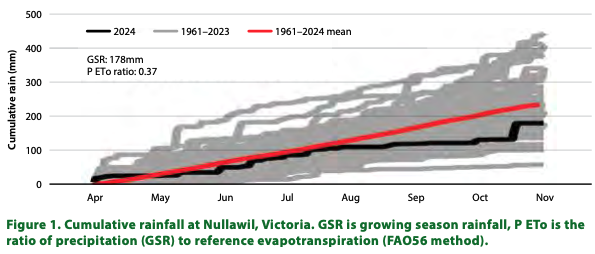
GSR (Apr–Oct): 178mm
Soil type: Loamy clay
Paddock history: Vetch brown manure
Trial Details
Crop type/s: Winter barley (AGTB1007, AGTB1009, AGT1010), spring barley (Neo, Cyclops, Beast), wheat (Shotgun, Rockstar) and winter wheat (Mohawk)
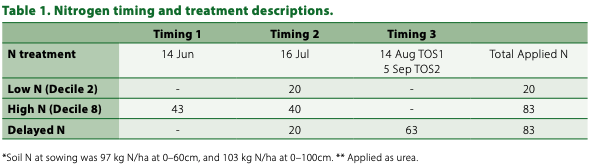
Treatments: Refer to Table 1
Target plant density: 150 plants/m²
Seeding equipment: Knife points, press wheels, 30cm row spacing
Sowing date: 2 May 2024 (time of sowing 1), 4 June 2024 (time of sowing 2)
Replicates: Four
Harvest date: 22 November 2024
Trial Inputs
Trial managed as per best practice with varying nitrogen treatments (Table 1).
Trial Inputs
A factorial small plot experiment was carried out in 2024 to create different canopy structures, using sowing date, genetics and nitrogen (N).
Supplementary water (30mm) was applied to treatments at the start of the critical period (flag leaf emergence) to determine the value of extra water and the response of different agronomy strategies. The latest genetics – including Shotgun wheat, Neo barley, and varieties of differing phenology and architecture – were included in these experiments. Sowing date and emergence targets were aimed at 25 April to 10 May, and a later emergence of three weeks later (or with the break).
N was seasonally adjusted to achieve two levels of yield aspiration based on anticipated seasonal rainfall outlooks: a more conservative Decile 2–3, and a more aggressive Decile 7–8. These were applied as split applications before stem elongation. A third treatment was applied to Neo barley and Shotgun wheat only where low N levels were applied before stem elongation and then topped up to the higher N strategy (Table 1).
Varieties
Winter barley – AGTB1007, AGTB1009, AGT1010
Spring barley – Neo, Cyclops, Beast
Wheat – Shotgun, Rockstar
Winter wheat – Mohawk
Sowing and emergence dates
Sow date 1: 2 May (15 May emergence)
Sow date 2: 4 June (17 June emergence)
Irrigation timing (flag leaf emergence)
Sow date 1: 15 August
Sow date 2: 5 September
Future of the Trial
Overall results
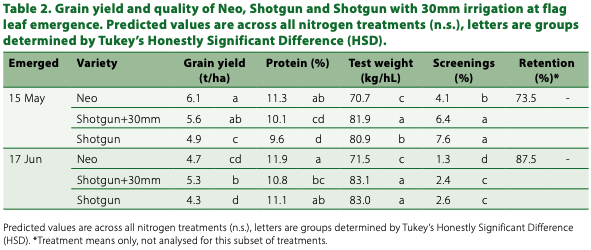
Time of sowing, species, and genotype were the main agronomic factors driving yield in 2024 at this site. The yield difference between wheat and barley was most pronounced at Early sowing with yield declining from 6.1t/ha to 4.7t/ha in Neo barley from delayed emergence, and from 4.9t/ha to 4.3t/ha in Shotgun wheat. The influence of nitrogen strategy was negligible in 2024 for grain yield, although there is evidence of smaller grain at higher N rates in Neo (data not shown), and N significantly influenced grain protein.
Water use efficiency
Growing season rainfall in 2024 was close to average until August, which was followed by a dry finish (Figure 2). Rainfall supplied 37 per cent of the moisture estimated to have been lost by soil evaporation and crop transpiration (FAO56 method); we applied extra water at flag leaf emergence to evaluate the best agronomic system for converting rainfall into water. Soil and water data analysis for Plant Available Water (PAW) is currently under analysis, but farmers and agronomists will understand methods such as the ‘French and Schultz’ approach. We estimate water use as 25 per cent of November–April rainfall, plus growing season rainfall (April–October), subtracting 60mm for evaporation losses. Current benchmarks for transpiration efficiency are 26kg/ha/mm, which helped estimate a water-limited yield potential of 5.75t/ha in 2024. Early-sown spring barley consistently achieved 100 per cent of potential, while wheat reached about 85 per cent. Further analysis to calculate how much water was lost to evaporation and how much used for transpiration will help identify areas for improvement.
Applying extra water to wheat in the critical period
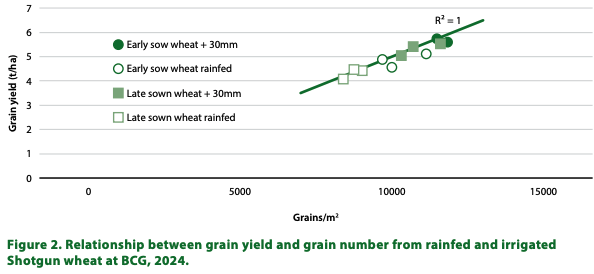
Applying 30mm of water at the start of the critical period increased yield by 0.7t/ha for early sowing and 1t/ha for later sowing, without reducing protein levels. This equates to 23kg/ha/mm for early sowing and 33kg/ha/mm for later sowing, indicating that transpiration efficiency during the critical period can exceed current benchmarks.
The observed treatment yield differences were primarily driven by variations in grain number, underscoring the project’s focus on crop agronomy to target the growth stages most important for grain number determination. This critical period, occurring in the 30 days prior to flowering, will be a central focus of the project to optimise management practices and maximise yield potential.
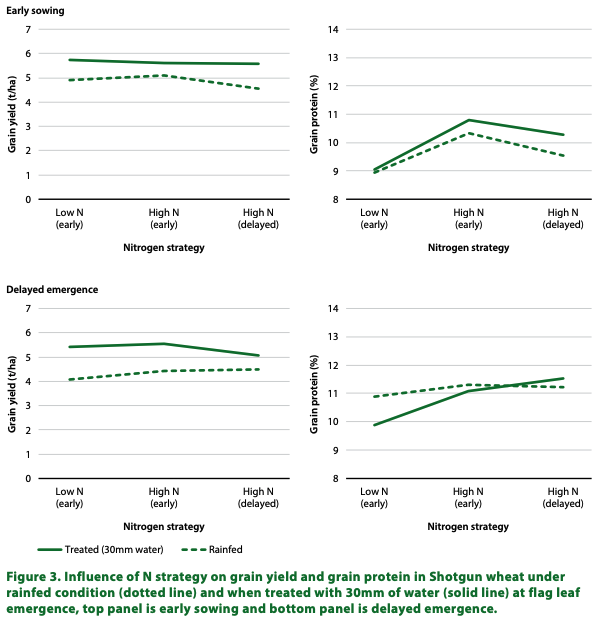
Additional water did not alter the yield response to N at either early or delayed sowing. There was limited evidence of haying-off or negative effects from high N application. Interestingly, protein levels improved, with better N recovery and higher protein and yield when extra water was applied. The lack of yield response to N suggests that N was not a major tactical lever at this site, likely due to the strong legume history meeting N demands. While applying high N rates was not economically justified in this scenario, growers can be reassured that high residual soil N and high N applications did not negatively impact yield or protein under dry spring conditions in the new cultivar.
Other insights: New early sowing options (winter wheat and barley performance)
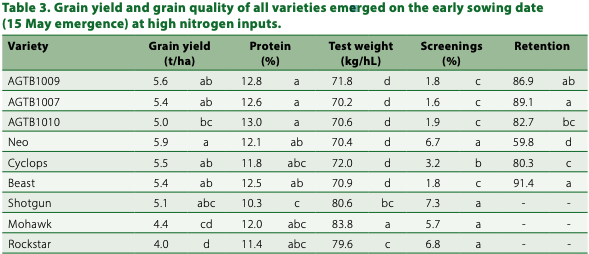
Barley yields ranged from 5t/ha to 5.9 t/ha from earlier sowing at high N; importantly new winter barleys AGTB1009 and AGTB1010 achieved similar yield to the highest yielding commercially available spring barley varieties Neo, Cyclops, and Beast (Table 3). This is an exciting step forward in genetics for earlier planting and a more than 1t/ha improvement on Mohawk (winter wheat). Shotgun performed similarly to spring barley. Grain quality parameters of most relevance were screenings which were higher in all wheats, and Neo barley.
Commercial Practice and On-Farm Profitability
The results emphasise the critical impact of sowing date, species, and genotype on yield outcomes, with minimal influence from nitrogen strategies under the conditions studied at this site on legume residue. Differences in grain number and the improved transpiration efficiency achieved with additional water, highlight opportunities for further yield gains. The absence of significant yield responses – or negative outcomes – to tactical agronomy and their interaction with additional water, suggests current farming systems and new genetics are robust. Growers can have confidence in the resilience of modern cultivars and their ability to adapt and perform across varying seasonal conditions
Acknowledgements
The research undertaken as part of this project is made possible by the significant contributions of growers through both trial cooperation and the support of the GRDC, and the authors would like to thank them for their continued support. We thank the technical teams who deliver the experiments for our projects. GRDC Project CSP2404-020RTX is a collaboration between CSIRO, AgCommunicators, AIREP, EPAG Research, SARDI, the University of Adelaide, FAR Australia, Frontier Farming Systems, Hart Field Site Group, Elders, BCG, and Ag Insights Consulting
BCG sincerely thanks the Watts family for generously hosting the trial site at Nullawil and for their support throughout the project.