Take Home Messages
- Deep sowing with long coleoptile varieties can improve crop establishment by accessing subsoil moisture at deeper depths, offering a valuable tool for managing late rainfall breaks and seasonal variability.
- Optimised agronomic practices, including sowing depth and press wheel pressure, are essential for maximising the benefits of long coleoptile varieties.
- This trial provides crucial insights to help growers effectively integrate these varieties into cropping programs in preparation for future high-yielding long coleoptile wheat options.
Aim
To investigate the integration of long coleoptile wheat varieties into Australian farming systems under varying agronomic practices.
Background
It is well understood that delaying sowing of a wheat crop can result in a grain yield penalty (Murray, 2015). However, in current farming systems the ability to sow early and on-time relies heavily on timely seasonal breaks. Shifting long-term climate patterns of increased summer rainfall and a late break will increase challenges relating to sowing decisions (Flohr et al., 2021). Optimising agronomic practices and sowing depth to capitalise on increased stored summer rainfall below the top 10cm could be a powerful tool for growers in managing these challenges.
Coleoptile length in wheat varieties is gaining attention due to the possibility of maximising farm output by strategically choosing varieties based on the trait. The coleoptile is a sheath that protects the shoot as it emerges, allowing longer coleoptile varieties to be sown deeper than conventional varieties (GRDC GroundCover, 2023). Because of breeding efforts, dwarfing genes of many current varieties have decreased the length of the coleoptile (Rebetzke et al., 2022), restricting the depth that varieties can be sown, and in turn, reducing the flexibility of sowing strategy for growers. Two wheat dwarfing genes, Rht18 and Rht13, which result in a longer coleoptile length have been identified. These genes are being bred into new varieties (GRDC Groundcover, 2023)
Substantial work has been invested in identifying and sourcing the genetics to breed longer coleoptile varieties; the next challenge is to identify how best to use long coleoptile varieties under different elements of agronomic management, such as sowing depth and press wheel pressure. The work outlined in this study was designed to deliver information to growers relating to the performance of long coleoptile varieties under various agronomic management to guide their adoption in farming enterprises.
Paddock Details
Location: Nullawil
Crop year rainfall (Nov–Oct): 361mm
GSR (Apr–Oct): 178mm
Soil type: Loamy clay
Paddock history: Vetch brown manure
Trial Details
Crop type: Wheat
Treatments: Refer to Table 1
Target plant density: 100 plants/m²
Seeding equipment: Knife points, press wheels, 30cm row spacing
Sowing date: 13 May 2024
Replicates: Four
Harvest date: 22 November 2024
Trial average yield: 3.42 t/ha
Trial Inputs
Trial managed as per best practice.
Trial Inputs
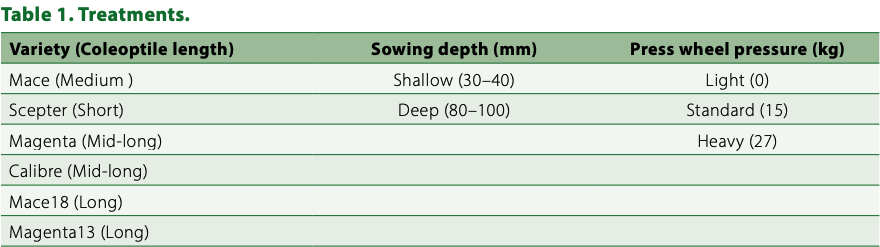
One field trial with four replicates was sown at Nullawil using a split plot trial design. The trial investigated the relationship between variety by sowing depth and by press wheel pressure. It incorporated six varieties, two sowing depths, and three press wheel pressures, combined creating a total of 36 treatments (Table 1).
Of the six varieties, four commercial lines were included: Scepter, which has a short coleoptile and is a popular variety in the region, Calibre, which has a mid-long coleoptile length, Magenta, which has a mid-long coleoptile, and Mace, which has a medium-length coleoptile. Two long coleoptile experimental varieties were also included: Mace18 which has been bred from Mace to contain the Rth18 gene for increased coleoptile length, and Magenta13, which has been bred from Magenta and contains the Rht13 gene (GRDC Groundcover, 2023). Two sowing depths were targeted: shallow which aimed for 30–40mm, and deep which aimed for 80–100mm. Three press wheel pressures were used: light, where press wheels were lifted all the way up so they just skimmed the surface, standard, where springs were released and gave 15kg of pressure, and heavy, where springs were fully tightened giving 27kg of pressure.
Assessments included soil temperature, soil moisture, soil matric potential, soil strength, emergence counts, NDVI, measurements of coleoptile length and sowing depth, emergence percentage, harvest index, grain yield, and grain quality.
Results and Interpretation
Treatment effect on plant density
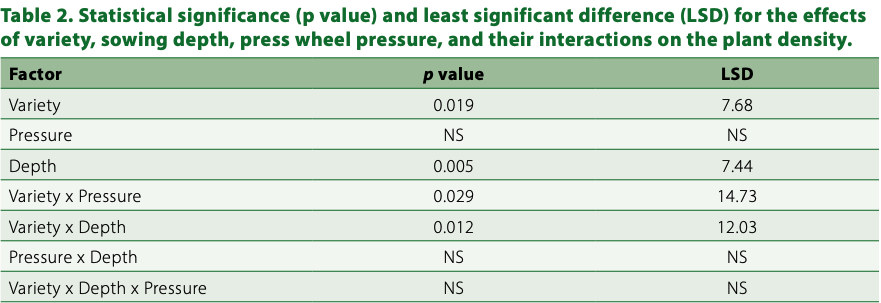
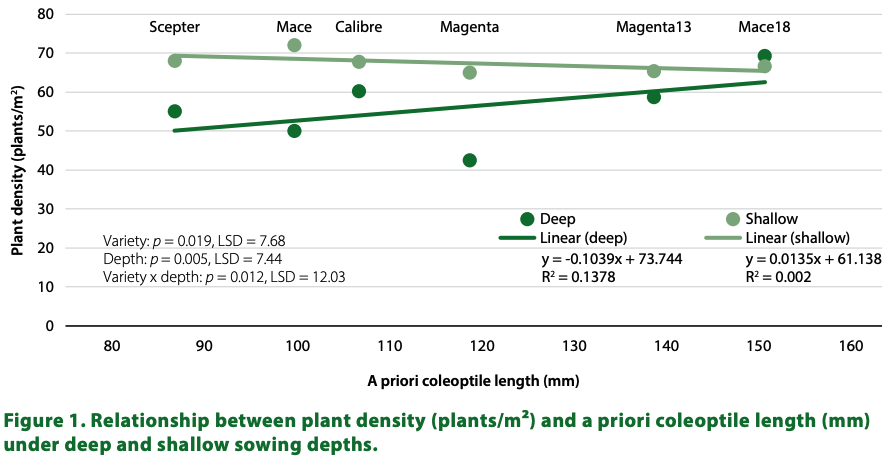
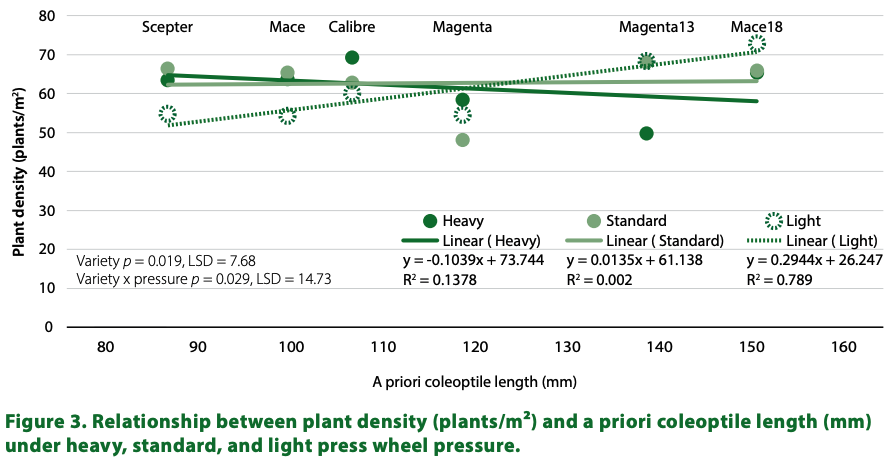
In this trial, plant density was influenced by variety, depth, and press wheel pressure, however there was significant variation in effect across treatments (Table 2). As standalone factors, variety and sowing depth had significant impacts on plant density (p = 0.019, LSD = 7.68, and p = 0.005, LSD = 7.44, respectively), and there were also significant interactions between variety and pressure, and variety and depth (p = 0.029, LSD = 14.73 and p = 0.012, LSD = 12.03, respectively).
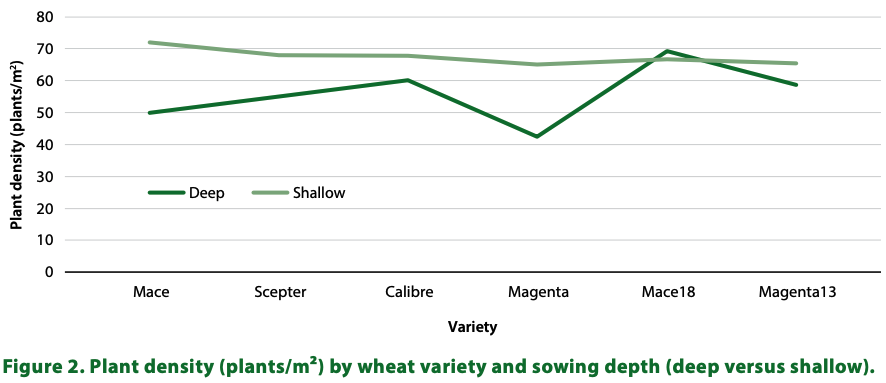
Long coleoptile varieties, such as Mace18 and Magenta13, offer advantages for crop establishment under deep sowing conditions. However, these benefits diminish with shallow sowing (Figures 1 and 2). For instance, Mace18 achieves significantly higher plant density (69 plants/m²) compared to shorter coleoptile varieties such as Mace (50 plants/m²) and Scepter (55 plants/m²) when sown deeply. A similar pattern was observed with Magenta13 (59 plants/m²), outperforming the shorter coleoptile variety Magenta (42 plants/m²). Essentially, under shallow sowing conditions, the data from this trial shows there is no added benefit from using a long coleoptile variety instead of a short coleoptile variety in terms of plant density.
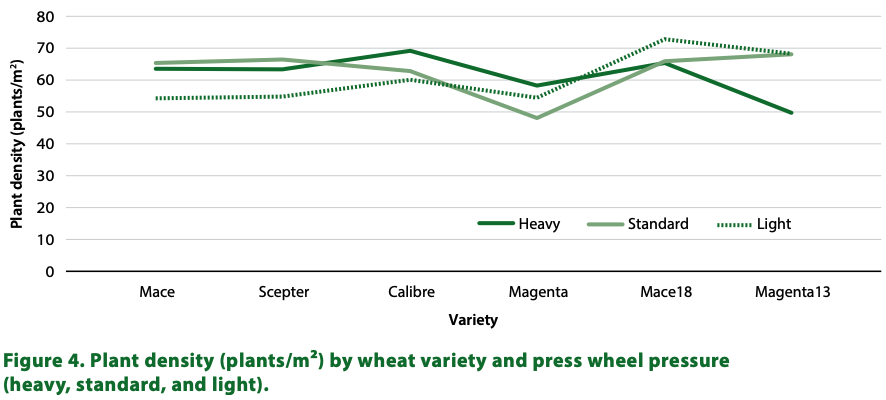
Plant density data also emphasised the increased importance of press wheel pressure when sowing deeper. In this trial, where subsoil moisture was adequate for good seed-moisture access, it was more important to have lighter press wheel pressure for longer coleoptile varieties; the benefits of the long coleoptile trait in these varieties were negated by heavier pressure. This is evident from the trends for Magenta13 and Mace18 (Figures 3 and 4) which show higher plant density under light press wheel pressure (68 plants/m² and 73 plants/m², respectively) compared to plant density achieved under heavy press wheel pressure (50 plants/m² and 65 plants/m², respectively).
This suggests that, if sowing deep, it’s important to optimise the press wheel pressure for soil type and environment to gain the full benefits of the long coleoptile technology; growers might need to experiment with alternative sowing approaches when sowing longer coleoptile varieties.
Grain yield
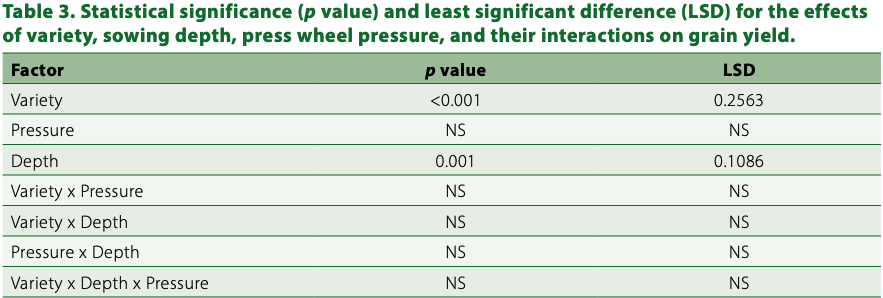
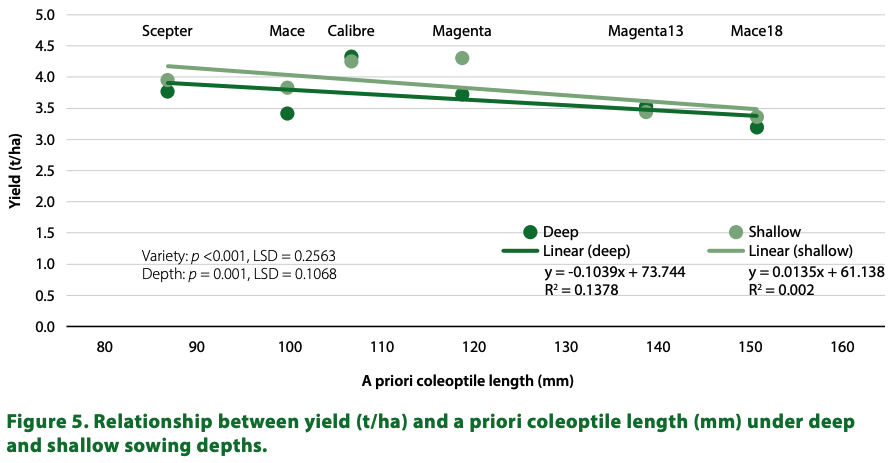
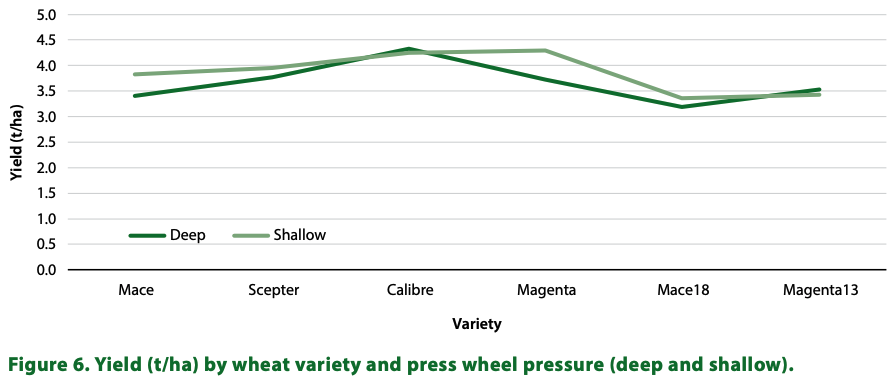
Yield was significantly influenced by variety and depth (p <0.001, LSD = 0.2563, p = 0.001, LSD = 0.1086 (Table 3). However, press wheel pressure did not yield significant results as either a standalone factor or an interaction.
Yield comparisons illustrate the importance of selecting the right variety and depth for yield optimisation (Figures 5 and 6). Among the long coleoptile varieties, yields for Mace18 and Magenta13 were generally significantly lower than most other varieties at both depths. Calibre produced significantly higher yields than many other varieties across most sowing depth and press wheel pressure treatments (Figure 3), achieving the highest yield of 4.6t/ha under heavy pressure and deep planting.
Commercial Practice and On-Farm Profitability
Yield penalties can be incurred in wheat crops from delayed sowing, which is sometimes a consideration due to late rainfall breaks. However, early and timely sowing can impose an additional risk through seasonal variability and unpredictable climate patterns. As such, deep sowing to access soil moisture stored at lower depths is a tool that can help ease the stress of making these decisions. Sowing long coleoptile varieties that are capable of emerging from lower sowing depths, allows them to access soil moisture and secure early season vigour.
Understanding how long coleoptile varieties perform across a range of agronomic management elements, such as sowing depth and press wheel pressure, is critical for deploying these tools in a way that will help growers optimise sowing activities. Data from this trial showed varied responses for both plant density and yield, in the long coleoptile varieties, Mace18 and Magenta13, emphasising the importance of variety and environment-specific management.
Three key findings arose from this trial. First, plant density was significantly influenced by variety, sowing depth, and pressure wheel pressure. The long coleoptile varieties, Mace18 and Magenta13, performed best under deep sown conditions, outperforming region-dominating varieties such as Scepter and Calibre. Second, the benefits of the long coleoptile varieties were lessened under heavier press wheel pressure. Third, yield was strongly affected by variety and sowing depth. Despite superior plant density in the long coleoptile varieties under certain conditions, they yielded no more than shorter varieties, with most shorter coleoptile varieties reaching significantly higher yields than both long coleoptile varieties under both press wheel pressures. It is important to note that the two long coleoptile varieties used in this trial have been bred for long coleoptile traits, not yield. The purpose of this work is to equip growers with knowledge about how best to adapt agronomic practices to include long coleoptile varieties in their cropping programs, so they are ready to respond when future high‑yielding long coleoptile varieties become available.
References
Flohr BM., Ouzman J., McBeath TM., Rebetzke GJ., Kirkegaard JA., Llewellyn RS., 2021, Agricultural Systems ‘Spatial analysis of the seasonal break and implications for crop establishment in southern Australia’. 190, p.103105
GRDC, 2023, GroundCover ‘Keen eyes define roles for long coleoptile wheats’, Accessed 15 January 2025. https://groundcover.grdc.com.au/crops/cereals/keen-eyes-define-roles-for-long-coleoptile-wheats
Murray J., 2015, 2015 BCG Season Research Results, ‘Wheat sowing time: finding an adaptable variety’ pp 40–48. Accessed 10 January 2025. https://www.bcg.org.au/research-article/wheat-sowing-timefinding-an-adaptable-variety/
Rebetzke G J., Rattey AR., Bovill WD., Richards RA., Brooks BJ., and Ellis M., 2022, Crop and Pasture Science, ‘Agronomic assessment of the durum Rht18 dwarfing gene in bread wheat’, 73: pp 325–36.
Acknowledgements
This research was funded by GRDC. The project is led by Dr Greg Rebetzke, CSIRO.
Thank you to Dr Greg Rebetzke for providing a technical review of this article. BCG would also like to acknowledge and thank Professor James Hunt, the University of Melbourne and CSIRO, and Dr Alec Zwart, CSIRO, for assisting with data analysis.
BCG sincerely thanks the Watts family for generously hosting the trial site at Nullawil and for their support throughout the project.