Take Home Messages
- The application of a wetting agent did not enhance soil moisture retention under the trial conditions.
- No measurable improvement in groundcover was observed post-application.
- The risk of wind erosion remained unchanged, indicating limited efficacy of the treatment in reducing soil degradation.
Aim
To assess the effectiveness of a wetting agent in improving crop emergence and establishment, thereby mitigating soil erosion in the Mallee.
Background
Drought continues to present a significant challenge in the Victorian Mallee. During dry periods, inadequate groundcover leaves soil vulnerable to wind erosion, negatively impacting soil health and crop potential. With climate change expected to exacerbate these issues, it is crucial to develop practical solutions that enhance soil resilience and integrate effectively into current farming practices.
Given the region’s reliance on variable rainfall and lack of irrigation infrastructure, effective water management is essential for successful crop establishment. To address these challenges, agronomic strategies such as the application of wetting agents in furrows are being explored. Wetting agents have the potential to enhance soil moisture retention, promote plant vigour, and increase crop biomass, which could enhance groundcover and reduce soil erosion.
Through plot trials, this project assessed the effectiveness of a commercially available wetting agent in enhancing crop biomass and groundcover. This evaluation seeks to identify practical solutions for mitigating soil erosion and improving soil health amidst frequent drought conditions in the Mallee.
Paddock Details
Location: Walpeup
Crop year rainfall (Nov–Oct): 266mm
GSR (Apr–Oct): 137mm
Soil type: Sandy loam
Trial Details
Crop type/s: Lentils (Hallmark)
Treatments: Commercially available wetting agent or nil control
Target plant density: 120 plants/m2
Seeding equipment: Knife points, press wheels, 30cm row spacing
Sowing date: 17 May 2024
Replicates: Four
Harvest date: 7 November 2024
Trial average yield: 0.82t/ha
Trial Inputs
Nutrition, weeds, insects, and disease were managed as per best practice
Method
A plot trial replicated four times was conducted at Walpeup using a randomised complete block design. Lentils were sown with a wetting agent applied in-furrow at 4L/ha per the product label, with an untreated control included for comparison. Soil sampling was conducted before sowing and at harvest to assess soil moisture. Establishment counts and biomass cuts at flowering were taken to examine crop establishment and groundcover. Yield data was also collected at harvest. A paired two‑sided t-test was used to analyse statistical differences between treatments.
Results & Interpretation
Soil moisture
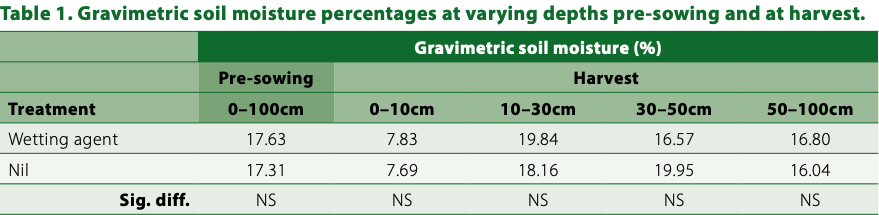
Rainfall leading up to sowing was minimal: Walpeup received 11mm in April and 12.8mm in May. Pre-sowing soil sampling revealed no significant differences between the treated and untreated plots across all measured depths, establishing a consistent baseline for comparison (Table 1). Soil sampling was repeated at harvest to assess the potential impact of the wetting agent on water retention. The post-harvest results showed no significant differences in soil moisture between the treated and untreated plots at any depth (Table 1). This suggests that under the low rainfall conditions of the trial, the wetting agent did not improve soil water retention.
Plant establishment and biomass
The wetting agent had no significant effect on plant establishment, with treated plots averaging 91.8 plants/m² compared to 95.5 plants/m² in untreated plots (Table 2). Biomass production at flowering was also similar across treatments, with both averaging 1.2t/ha. These results suggest the wetting agent did not enhance early crop development or groundcover, and consequently did not make the soil less vulnerable to the risk of wind erosion.
Grain yield
Grain yield followed a similar pattern, with no significant differences detected between treatments. Treated plots produced an average yield of 0.85t/ha, compared to 0.88t/ha in untreated plots (Table 2). These results demonstrate that the wetting agent did not enhance crop productivity, underscoring its limited effectiveness under the conditions of this trial.

Commercial Practice and On Farm Profitability
This trial demonstrated that the wetting agent did not improve soil moisture retention, groundcover, or yield, limiting its practical value for Mallee farmers during this season’s dry conditions. The absence of increased groundcover left soils exposed to wind erosion, underscoring the ongoing challenge of mitigating soil degradation in drought-prone environments.
Research into wetting agents has produced mixed results, with their effectiveness often influenced by environmental and agronomic factors. For instance, South Australian studies reported significant improvements in crop establishment for cereals grown in forest gravel soils when a commercially available wetting agent was applied (Davies et al., 2019). However, variables such as soil texture, crop type, and rainfall patterns likely contributed to the lack of measurable benefits observed in this trial.
References
Davies S., Betti G., Edwards T., McDonald G., Hall D., Anderson G., Scanlan C., Reynolds C., Walker J., Poulish G., Ward P., Krishnamurthy P., Micin S., Kerr R., Roper M., and Boyes T., 2019, GRDC Update Papers, ‘Ten years of managing water repellent soils research in Western Australia: A review of current progress and future opportunities’ pp 1–10. <http://www.grdc.com.au/resources-and-publications/grdcupdate-papers/tab-content/grdc-update-papers/2019/02/ten-years-of-managing-water-repellentsoils-research-in-western-australia-a-review-of-current-progress-and-future-opportunities>
Acknowledgements
This project is supported by the Mallee Catchment Management Authority, through funding from the Australian Government’s Future Drought Fund. BCG sincerely thanks Ross Stone for generously hosting the trial site at Walpeup and for support throughout the project.