Take Home Messages
- GIA Lightning, PBA Hallmark, GIA Thunder and ALB2321 were the best performing lentil varieties in the North Central region for 2024.
- PBA Coogee, PBA Taylor, PBA Wharton, and PBA Twilight were the best performing field pea varieties in terms of grain yield in the North Central region for 2024.
- The earlier time of sowing for field peas resulted in an extra 0.4t/ha of grain yield in comparison to the second time of sowing.
- Harvest timing is crucial in lentils to prevent yield loss from weather events.
Aim
To compare the performance of field pea and lentil varieties by time of sowing (TOS) in the North Central region.
Background
The need for profitable break crops in the crop rotation is increasing as farming systems in North Central Victoria continue to evolve. Traditionally, options have included vetch and canola, however global demand for pulses for human consumption combined with economic value have resulted in an increase in local production. This has led to a trend of sowing these crops in areas that are not as well suited. Newer lentil and field pea varieties are showing better adaptability to non-traditional areas with soil constraints such as acidity and salinity. It remains important to understand where various crops fit into the sowing program and overall farming system to maximise economic benefits.
Two trials established in the North Central region in 2024 are demonstrating pulse variety performance in areas where pulses are not widely grown. This work helps assess the possibility of including pulses such as lentils and field peas into more non-traditional areas and as a profitable crop option.
Paddock Details
Location: Mitiamo
Crop year rainfall (Nov–Oct): 467mm
GSR (Apr–Oct): 202mm
Soil type: Clay
Paddock history: Oaten hay (2023)
Trial Details
Crop type/s: Lentil and field pea varieties and breeding lines
Target plant density: Lentils: 120 plants/m2; Field peas: 40 plants/m2
Seeding equipment: Knife points, press wheels, 30cm row spacing
Sowing date: TOS 1: 26 April 2024, TOS 2: 24 May 2024
Replicates: Three
Harvest date: 5 December 2024
Trial average yield: Lentils: 0.5t/ha; Field peas: 1.6t/ha
Trial Inputs
Fertiliser: Granulock Supreme Z + Flutriafol (400mL/100kg) @ 60kg/ha at sowing
Seed was inoculated with Group EF rhizobia at sowing. Weeds, diseases, and pests managed as per best management practice.
Method
Two replicated field trials were sown using a complete randomised block trial design. Assessments included establishment counts, crop biomass (field peas only) at flowering (peak biomass 9 September), grain yield, and quality parameters. Plots were scored for percentage of pod loss/shattering before harvest.
Results & Interpretation
Both times of sowing established well. TOS 1 was dry sown after 20mm of rain earlier in the month and 2mm two days before sowing. The second time of sowing received 27mm of rain 14 days before sowing and follow up rain of 20mm seven days after sowing
Lentils
During flowering, the site experienced five frost events from 10 to 18 September. The site was harvested on 5 December following 49mm of rain in the final week of November and 15mm in the first four days of December. Strong winds were also experienced during these rain events, resulting in significant pod shatter and yield loss.
The best performing lentil varieties were GIA Thunder, GIA Lightning and PBA Hallmark at both times of sowing (Table 1).
The average grain yield was 0.5t/ha, with both times of sowing yielding similarly (0.04t/ha difference). The yield measured in this trial is lower compared to local grower yields, which were on average 1t/ha to 1.5t/ha, and included GIA Thunder. The lower yields in this trial are likely due to significant pod loss (dropping and shattering) before harvest, which highlights the impact of weather events and challenges around desiccation and timely harvest of lentil crops. Shattering scores were done six days before harvest and on the morning of harvest. Differences between the scores were minimal, highlighting most of the losses occurred in the first rain event. PBA Kelpie had 50 per cent shattering loss when scored before harvest which was the highest grain loss. PBA Ace, PBA Bolt, GIA Leader, GIA Lightning and ALB Terrier also had substantial pod shattering translating to approximately 30 per cent grain loss (data not shown).

Field peas
Hay yield results from the field peas resulted in differences between varieties and between the two times of sowing, with TOS1 yielding 0.5t DM/ha more in hay yield (TOS data not presented). PBA Coogee, PBA Butler, PBA Twilight, PBA Bondi, and PBA Taylor were the highest yielding varieties (for hay) when averaged out for both times of sowing (Figure 1).

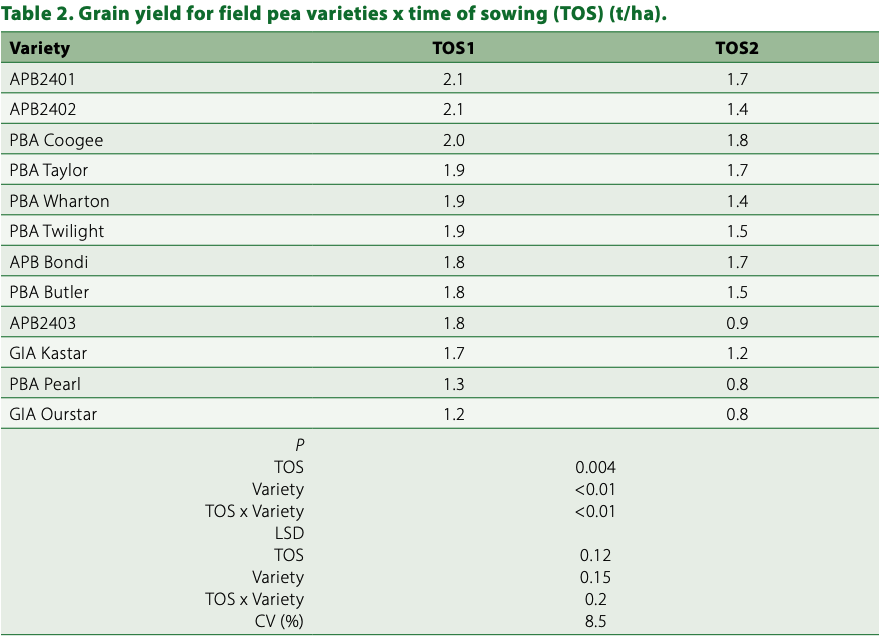
The field pea trial had an average grain yield of 1.6t/ha. TOS1 (1.8t/ha) yielded 0.4t/ha more than TOS2 (1.4t/ha).
The best performing field pea varieties for grain yield were two breeding lines, APB2401, APB2402 and commercial varieties PBA Coogee, PBA Taylor, PBA Wharton and PBA Twilight TOS1 only). There was a significant interaction between TOS and variety. PBA Coogee and PBA Taylor yielded the same when sown early and late. However, this was not the case for some varieties, such as PBA Pearl, GIA Ourstar and APB2403, which nearly doubled in yield when sown earlier compared to later. This indicates variety selection is an important consideration when sowing later.
PBA Pearl experienced high grain loss due to pod loss before harvest with shattering scores of 70 per cent when scored after the late November rain. This indicates PBA Pearl should be prioritised for harvesting before other field pea varieties.
Commercial Practice and On Farm Profitability
Final lentil yields were significantly affected by weather events before harvest, highlighting the importance of harvest timing for lentils. When growing multiple varieties of lentils, it would pay to harvest lentils more susceptible to pod loss, such as PBA Kelpie, before varieties which had less pod drop, such as GIA Thunder.
New varieties’ performance
ALB Terrier has a strong disease package (RMR to ASB) and typically has a high yield potential. It performed well in 2024, in NVT and in the Wimmera and Mallee, however this was not observed in this trial. ALB Terrier was highly sensitive to wet and windy conditions which caused pod drop. Based on this, it would be recommended to make it a top priority at harvest time if there is rainfall forecast. The Imidazolinone tolerance of this variety makes it suitable for use where weed control is a priority.
GIA Thunder is a small red lentil with IMI tolerance to Group B herbicides, high yield potential and suitability across a range of environments. GIA Lightning is also a small red lentil with IMI tolerance, has Improved adaptability to sandy soils, and performed well in 2024 at both times of sowing.
APB Bondi is a ‘kaspa type’ field pea released in 2024. It is mid flowering, mid maturity, and has good adaption to a broad range of environments including having moderate tolerance to high salinity. It performed well at both times of sowing and was not far from the top yielding varieties.
Key agronomic lessons
A year such as 2024 highlighted the benefits of sowing early for both lentils and field peas, where we measured on average an x and y % increase in yield for TOS1. It was particularly important for lentils, with some varieties being adversely affected by the weather at harvest. Late sowing risks are less pronounced when there is a favourable spring to follow, however the risk of heat and moisture stress would often be a limiting factor in this environment. Harvestability is another factor to consider when growing pulses, especially lentils, to maximise profitability.
Variety selection is crucial for managing soil salinity constraints, unique to this region and maximising returns from pulse crops. This data highlights the need to harvest pulses in particular, lentils prior to rain events.
Acknowledgements
This research was funded by GRDC and Agriculture Victoria as part of the Southern Pulse Agronomy project (DJP2105-006RTX), supported by BCG, Southern Farming Systems, Field Applied Research (FAR) Australia and Frontier Farming Systems.
Thank you to Audrey Delahunty, Agriculture Victoria, for providing a technical review of this article.
BCG sincerely thanks Adam Gould for hosting the trial site at Mitiamo and for support throughout the project.