Take Home Messages
- The impact of pressure wheel pressure on crop establishment depends on topsoil characteristics.
- Sowing shallow was most beneficial for crop establishment in 2024.
- High plant densities did not always translate to higher yield in 2024.
Aim
These trials aimed to evaluate the impact of sowing depth and press-wheel pressure on establishment and yield of canola sown on typical soils in the southern Mallee and northern Wimmera.
Background
Canola establishment can be challenging for growers in the Wimmera and Mallee, with various management, environmental, and genetic factors causing only 50 per cent of viable sown seed to establish (Porker et al., 2024). Poor establishment often has negative consequences for yield and in some cases can require resowing of crops, costing Australian growers an estimated $100–$200 million annually (Porker et al., 2024). This highlights the need for research into genetic and management strategies that can assist growers in improving canola establishment.
This is the second year of a three-year project funded by GRDC and led by CSIRO which investigates management by environment interactions, and the effects on canola establishment. As part of this project, BCG managed two trials of locally relevant treatments, determined through discussions with local advisors and grower advisory committees. In 2023, trials investigated the impact of seed size and sowing depth on canola establishment. Results showed shallow sowing and seed graded to a larger size produced significantly higher establishment but did not significantly affect yields. In 2024, the focus of these trials shifted toward other agronomic management practices that influence establishment, investigating the impact of press-wheel pressure and sowing depth.
Paddock Details
| Location | Nullawil (Mallee) | Murra Warra (Wimmera) |
| Crop year rainfall (Nov–Oct) | 305mm | 346mm |
| GSR (Apr–Oct) | 178mm | 146mm |
| Soil type | Clay loam | Self-mulching clay |
| Paddock history | Vetch brown manure | Lentil |
Trial Details
Crop type/s: Canola: 44Y94 CL + Hyola Regiment XC
Treatments: Refer to Table 1
Target plant density: Nullawil 40plants/m2; Murra Warra 50plants/m2
Seeding equipment: Knife points, press wheels, 30cm row spacing
Sowing date: Nullawil 13 May 2024; Murra Warra 3 May 2024
Replicates: Three
Harvest date: 7 November
Trial average yield: Nullawil 1.73t/ha; Murra Warra 1.46t/ha
Trial Inputs
Trials were managed as per best practice.
Method
Two replicated field trials were sown in the Mallee (Nullawil) and Wimmera (Murra Warra) growing regions using a split-split plot design. Assessments included soil moisture at sowing, emergence rate, establishment counts, soil strength (using a handheld penetrometer), and yield.

Results & Interpretation
Soil moisture at sowing
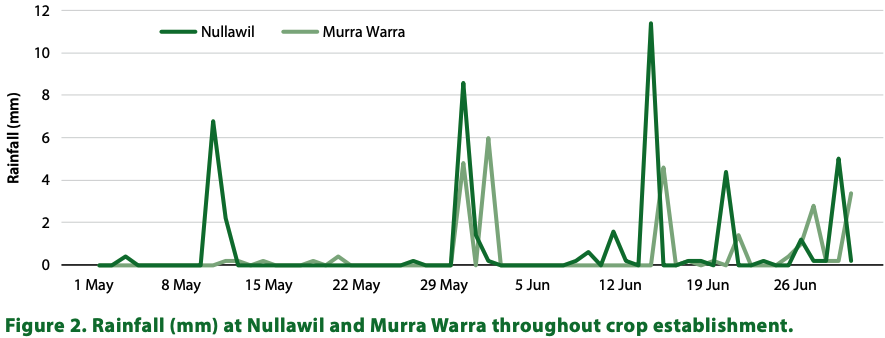
The Nullawil trial was sown on 5 May into 20–21 per cent gravimetric soil moisture after a 7mm rainfall event the previous day (Figure 1). Follow-up rain (5mm) did not occur until 30 May (Figure 2). The Murra Warra trial was sown dry on 3 May as the site had not received any rainfall for more than a month, however soil moisture was higher at the time of sowing (Figure 1). This is likely due to the heavier texture of the soil and greater water holding capacity. Similar to Nullawil, the Murra Warra site did not receive rain until 30 May (5mm).

Target sowing depths were set at 1cm for the shallow treatment and 3–4cm for the deep treatment. Final sowing depth was validated by removing plants and measuring the length of the hypocotyl. At Nullawil, target depths were successfully achieved. At the Murra Warra site, precise sowing depths were harder to achieve due to the poorly structured, self-mulching topsoil, so the shallow treatment was sown at 3cm and the deep treatment at 5cm.
Soil strength at sowing
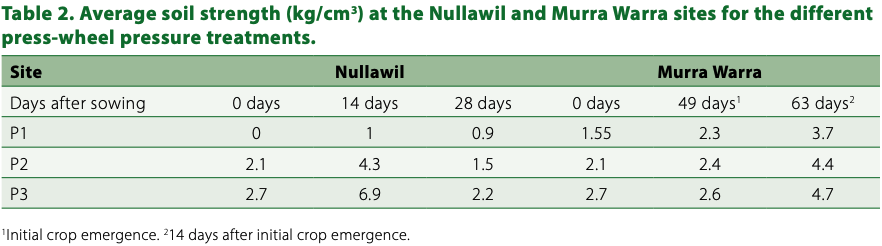
The impact of press-wheel pressure on soil strength varied between the two sites and soil types. At Nullawil, soil strength increased in the 14 days post-sowing as the sodic topsoil dried out, particularly for P2 and P3 treatments (Table 2). However, the soil strength decreased after 28 days post‑sowing, following rainfall (Table 2). By this time, the effect of press-wheel pressure had also dissipated and all treatments had a similar soil strength (Table 2). At Murra Warra, differences in soil strength between treatments were less apparent. Soil strength gradually increased after sowing and did not appear to react in the same way to rainfall as the Nullawil soil. This may be due to the self‑mulching clay topsoil at Murra Warra, where the soil continually breaks downs as it dries and cracks, before reforming when soil moisture increases.
Crop emergence
Differences in soil texture and soil moisture availability heavily influenced crop emergence, as neither site received rainfall for three weeks after sowing. The crop at Nullawil emerged immediately after the rain event in late May, likely due to the lighter soil texture which may have resulted in better access to soil moisture. Plant density two and three weeks post-sowing was significantly higher for nil and standard press-wheel pressure treatments, regardless of sowing depth (p<0.05) (Table 3).
In contrast, canola sown at Murra Warra did not emerge until late June, following several rainfall events, each delivering about 5mm of rain or less (Figure 2). This may be due to the heavier textured soil at the site, which can reduce soil moisture availability. Crop emergence at both six and seven weeks post-sowing (one and two weeks after initial emergence) was significantly affected by sowing depth (p<0.05) (Table 4). Shallow sown treatments were quicker to emerge. Six weeks following initial emergence, shallow sown treatments had a plant density similar to final establishment, whilst very few plants, if any, had emerged for deep sown treatments.
No significant differences were observed for emergence between varieties at both sites.


Crop establishment
The crop was considered established at the four leaf growth stage, about four weeks after sowing for the Nullawil crops and eight weeks after sowing for the Murra Warra crops. At Nullawil, crop establishment was significantly affected by sowing depth and pressure (p<0.05), although interactions between the two were not significant (Table 3). Shallow sowing resulted in significantly higher plant establishment, regardless of press-wheel pressure. The shallow sown with nil press-wheel pressure treatment resulted in the highest plant density of 57 plants/m2 , equal to 91 per cent of sown seed emerged (Figure 3). For both sowing depths, nil press-wheel pressure resulted in significantly higher plant densities. Heavy press-wheel pressure resulted in the lowest plant densities, meaning that only 53 per cent of seed sown for shallow treatments and 24 per cent of seed sown for deep treatments emerged.
This may be a result of the sodic topsoil the crop was sown into at Nullawil. At sowing the tyne system broke up the sodic hardpan which was then reset by the standard and heavy press-wheel pressure treatments. The resetting of this hardpan in combination with an absence of rainfall increased soil strength, and subsequently increased resistance to crop emergence (Table 2).
At Murra Warra, crop establishment was only significantly affected by sowing depth (p<0.05) (Table 4). Sowing shallow resulted in a significantly higher plant density of 60 plants/m2 averaged across press‑wheel treatments, whilst sowing deep resulted in a plant density less than half that, 29 plants/m2 . The deep sowing treatment was sown deeper at Murra Warra than Nullawil. This may have caused the large disparity in plant establishment for both sowing depths, as canola is limited by its relatively short hypocotyl which can cause seedlings to fail to emerge if sown too deep. There were no consistent patterns across press-wheel pressure treatments. Press-wheel pressure may not have affected crop establishment in the same way it did at Nullawil because of differences in topsoil and the length of time the crop stayed in the ground due to inadequate soil moisture. The self-mulching quality of the topsoil may have buffered the effects of the press-wheels, by swelling in response to rain and then shrinking and breaking down into smaller aggregates as it dried, reducing the soil strength of the press-wheel treatments. This is reflected in the penetrometer readings, where soil strength was relatively consistent across press-wheel pressure treatments (Table 2).
No significant differences were observed between plant densities of varieties at both sites.

Crop yield
At Murra Warra, shallow sown treatments produced a significantly higher yield, averaging 1.6t/ha (p<0.05), whilst deep sown treatments averaged 1.3t/ha (Table 5). Press-wheel pressure had no significant effect on yield.
Yields at the Nullawil site were significantly affected by pressure as well as depth pressure interactions (Table 5). Nil press-wheel pressure resulted in the highest yields of 1.93t/ha at shallow sowing depth and 2.01t/ha at deep sowing depth. Significance in depth by pressure interactions highlighted that canola may be best sown shallow if using a heavy press-wheel pressure, as sowing deep can result in a significantly lower yield.
Significant differences in yield may not have entirely been caused by significant differences in plant density. Canola can compensate for some yield loss when established at lower densities by putting out more branches and pods (GRDC, 2015). An example of this was seen for the shallow sown treatment at Nullawil, which resulted in significantly higher plant density but did not translate to significantly higher yields.
Other treatment effects, such as timing of emergence, may have also impacted yield. At Murra Warra, the emergence of deep sown treatments was delayed by one week, similar to the effect of sowing this treatment a week later. Previous studies have found that canola yield can decline with sowing date, ranging from 5 per cent to 12 per cent for each week sowing is delayed (Farre et al., 2002).
Yields were also significantly different by variety at both sites. At Nullawil, 44Y94 CL yielded higher, and at Murra Warra Regiment XC yielded higher (data not shown).

Commercial Practice and On Farm Profitability
Good crop establishment is essential to achieving good yields. Canola establishment can be sensitive to a range of soil and environmental factors, but there are several management decisions that enable growers to respond to expected conditions.
These trials have reinforced the importance of getting the basics right to successfully establish canola. Sow shallow (3cm or less) and into moisture where possible to ensure the crop is out of the ground quicker and at a vulnerable growth stage for a shorter period. Ensuring machinery is optimised to achieve target depth for the predominant soil types in the paddock is also important. Doing so can slow operations, but sowing deep seems to have the same effect as sowing later, reducing emergence rate and plant establishment, and potentially decreasing yield.
Whilst presswheel pressure had a significant impact on both plant density and yield at the Nullawil site, presswheel pressure by soil type interactions and effect on crop establishment needs to be studied further before more definitive guidelines can be created.
References
Porker K., McBeath T., Fletcher A., Nelson M., Goward L., Kirkegaard J., Ware A., Masters B., Jones T., Bucat J., and McMaster C., 2024, 2024 GRDC Update ‘Reducing risks to canola establishment under marginal conditions – defining the fundamentals’, <https://grdc.com.au/resources-and-publications/grdc-update-papers/tab-content/grdc-update-papers/2024/02/reducing-risks-to-canolaestablishment-under-marginal-conditions-defining-the-fundamentals>.
GRDC, 2015, ‘Grownotes, ‘Canola Section 3 Planting ’. <https://grdc.com.au/__data/assets/pdf_file/0029/369290/GrowNote-Canola-West-3-Planting.pdf>
Farre I., Robertson M., Walton G., and Asseng S., 2002, Australian Journal of Agricultural Research ‘Simulating phenology and yield response of canola to sowing date in Western Australia using the APSIM model’ 53, pp 1155–1164.
Acknowledgements
This research was made possible and funded by GRDC (CSP1907-001RTX), and led by Andrew Fletcher and Kenton Porker (CSIRO). Thank you to Ash Wallace of Agriculture Victoria for providing a technical review of this article.
BCG sincerely thanks David Jochinke and the Watts family for generously hosting the trials and for their support throughout the project.