Take Home Messages
- Seed depth uniformity increased with a disc seeder compared to a tyne seeder.
- There is evidence of fertiliser toxicity with some treatments, but without replication it is difficult to draw clear conclusions.
- Age of machinery is not a determinant of how accurately it can sow a crop. This is governed more by diligence to seeder setup and making sure other factors are accounted for, such as seed quality, potential for fertiliser toxicity and management of establishment pests.
Aim
To outline the fundamental aspects of seeder setup for successful crop establishment, and the associated agronomic techniques that can be used by growers.
Background
Growers throughout the Wimmera have identified poor crop establishment as a key area of concern, particularly where disc seeding systems are used in high stubble loads. This is an issue across the southern region, with growers at Kaniva, Toolondo, Rupanyup and Goroke National Grower Network (NGN) forums in 2023 all identifying crop establishment as important for crop success, and reporting issues in replicating successful establishment year on year.
Poor establishment at the start of the season creates ongoing problems with crop vigour, competition and weed management, that can continue throughout the season, ultimately impacting yields and profitability. A key consideration for growers is how to ensure good establishment and crop density, especially with high stubble loads.
To address these concerns, BCG helped deliver a seeder demonstration day at Murra Warra, to allow growers to discuss the fundamental components of seeder setup including air carts, seeder bars, and crop agronomy. They also demonstrated or witnessed the performance of locally owned equipment with growers giving an account of their equipment, and associated successes and challenges.
This report discusses the demonstration strips that were created, as well as outlining some of the fundamental crop establishment factors growers should consider when sowing crops. It is a preliminary report as the crop was not yet harvested at the time of compilation.
Paddock Details
Location: Murra Warra
Crop year rainfall (Nov–Oct): 345mm
GSR (Apr–Oct): 146mm
Soil type: Grey vertosol
Paddock history: 2023 Lentils
Trial Details
Crop type/s: Canola 44Y94
Treatments: Refer to table 1
Target plant density: 50 plants/m2
Sowing date: 10 April 2024
Replicates: Unreplicated demonstration
Harvest date: Not included in this report
Trial Inputs
Fertiliser: MAP at sowing – 40kg/ha or 80kg/ha, all other inputs farmer managed Herbicide: Farmer managed Insecticide: Farmer managed Fungicide: Farmer managed
Method
A seeder demonstration site was established in the Wimmera at Murra Warra. For the demonstration, local growers were invited to bring along equipment of different ages and configurations for discussion of performance, and to establish a canola crop for monitoring through the season (Table 1). All equipment was calibrated to sow 3kg/ha of seed, which was the rate required to establish 50 plants/m2 at the seed size provided (161,500 seeds/kg). Sowing depth was checked to ensure that seed from all equipment was placed at a similar depth.
On the day of the demonstration, each seeder conducted two passes, one with 40kg/ha of MAP fertiliser, the second with 80kg/ha MAP. All machines were single shoot only, so an assessment of fertiliser toxicity was possible. Treatments were not replicated.
During the season, assessments taken included: rate of plant establishment, final plant establishment counts, seed depth assessment, interplant spacing assessment, and grain yield as determined by grower equipment at harvest. Results for this final measure were not available at the time of reporting.
Performance of seeders in relation to crop establishment was compared, but could not be statistically analysed as lack of replication meant general trends were all that could be discussed.

Results & Interpretation
Season review
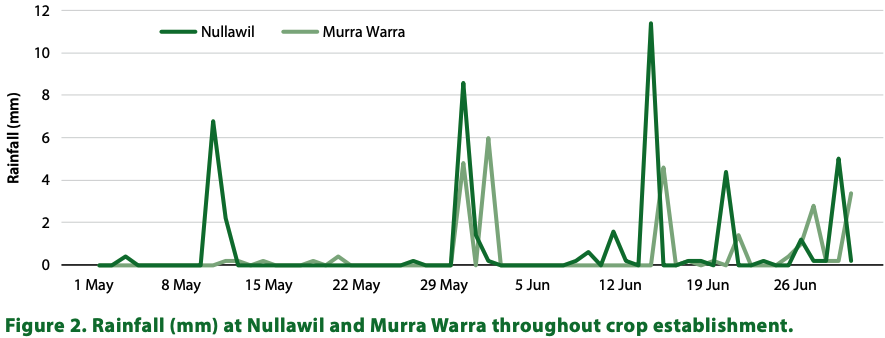
After above average rainfall in January, February and March were dry. In the lead up to sowing in April, small rain events were insufficient to promote good crop establishment apart from the areas where narrow windrows had been present up until three days before sowing. This resulted in strips of early emerging crop occurring at the site, likely due to the increased moisture just below the surface in these areas. For most of the trial however, adequate rainfall to promote successful establishment did not occur until 30 May (7.4mm), meaning the seed was in the ground for nearly two months before successful establishment. In-season rainfall post emergence was patchy and low, with monthly rainfall depicted in Figure 1. The largest rainfall event for the growing season occurred on 14 June (22mm); all other events were less than 10mm which on this soil type (grey vertosol) is not generally considered significant.

Seeder type and seed placement – depth
Seed depth was intended to be set at about 2.5cm for all seeders in the demonstration. Figure 2 shows this was achieved for most seeders, with the exception of the older John Deere 1830 seeder bar which was slightly deeper than other treatments at about 3.5cm. The shallowest placement came from the JD N540 disc machine, at about 1.8cm.
The small variation in placement between machines did not dramatically affect crop establishment although anecdotally – from site visits – it was thought the slightly deeper sown seed of the JD 1830 bar established more plants at an earlier time. This was not detected in final plant number assessments, and any early establishment of plants was concentrated to regions where more moisture had been retained as a result of stubble cover from the previous lentil crop.
When looking at the variation of depth from each machine, as indicated by the vertical spread of data in the box plot, Figure 2 shows greater depth control from using a disc machine compared to a tyne machine. Tyne machines in dry soil can move soil aggregates or clods, allowing seeds to drop deeper into the seed bed. Conversely, in hard soil beds, tynes can flick back out of the soil, resulting in shallower seed placement. This is not to suggest that disc seeders are always more suitable, as harder set soils may present more challenges for penetrating to a suitable depth with a disc machine.
Seeder type and rate of establishment
Rate of establishment after the breaking rain showed some slight variations across the range of equipment used. This was closely linked to seed depth control, with equipment that had smaller variations in seed depth (the vertical range of each boxplot in Figure 2) generally establishing crops quicker. This resulted in both the JD N540 disc machine and the Simplicity Territory tyne machine achieving final crop establishment about seven days faster than some other machines, which is a critical consideration for getting crops off to a good start.
While the JD 1830 may have had some plants in favourable areas come up sooner due to the deeper seeding depth, this was counteracted by the delay in establishment of canola in areas where the soil was likely dry – as indicated by slower emergence due to being deeper, and lower final plant numbers compared to other treatments. This highlights the importance of seed placement when sowing small‑seeded crops with small energy reserves. If they are sown too deep, they can run out of energy to emerge and establish their first leaves to allow photosynthesis, and oxygen and glucose production.
Only four treatments reached or exceeded the target plant population of 50 plants/m2 within four weeks of establishment. All treatments achieved at least 30 plants/m2 . Generally speaking, canola has the ability to compensate for lower than ideal numbers, due to increased branching, however this is most effective when crops are established on time or early. The crop establishing in mid-June would be considered late, and would be relying heavily on a favourable spring to achieve any major compensation of low numbers, which did not occur in 2024.

Seeder type and fertiliser effect on crop establishment
Final crop establishment was greatest in the Morris Quantum, JD N540 and Simplicity Territory strips. However, there also appeared to be a fertiliser effect, as all three showed a 10–25 per cent reduction in plant numbers when sown with the 80kg/ha MAP fertiliser rate. Most notably, the disc seeder had the largest reduction in plant numbers due to higher fertiliser rates (Figure 4).
This aligns with the understood workings of this type of seeding equipment. It has a more concentrated placement of seed and fertiliser within the drill row, positioning more fertiliser close to the seed. This fertiliser may cause toxicity by two key mechanisms. Osmotic effect draws moisture away from the seed to the fertiliser, which causes desiccation or burning of the seed, or ammonia is released, causing toxicity in the seed. Both effects are considered more likely in drier conditions, and their significance is influenced by the fertiliser or blend of fertilisers used.
The Horsch Sprinter and JD1830 seeder setups had the lowest plant establishment, but also the least variation between fertiliser rates. This suggests the higher variability in seed placement may improve fertiliser safety when sown with the seed in the conditions that were experienced.

Seeder type interplant distance
Interplant distance from all demonstrated seeders was highly variable, as would be expected from equipment that is not a precision planter. Only small differences were noted between machines, with the greatest variation in plant spacing in the strips sown with the JD1830 machine (Figure 5).
Whether this is a reflection of better seed placement by the newer machines, or a random occurrence cannot be determined from this demonstration alone. It is interesting to note how variable seed placement can be, and the potential impacts this can have on other agronomic considerations such as access to water and nutrition, prevalence of weeds, and the ability of the crop to set the best possible yield outcomes.

Commercial Practice and On Farm Profitability
The work has highlighted that the performance of all seeders is impacted by the weather conditions when it comes to successful crop establishment across large areas of the paddock. If the time is taken to set them up well, by calibrating seeding rate and correctly setting the sowing depth, machines of all ages and models can successfully place seed to establish a crop. This highlights the importance of the operator and the time they take to understand the way their equipment works and how to optimise their machine. This demonstration was in the circumstances of limited stubble, which alleviated many issues. On the day of the demonstration, machinery expert Brett Asphar highlighted that there is no right or wrong machine, but a need to understand the issue growers are trying to rectify, and work out which tool, or collection of tools, does this best. It is also important to make sure growers are doing all they can to get the fundamentals of crop establishment right, as these are often within the operator’s control.
The fundamentals of crop establishment To set a crop up for success, apart from rainfall which is beyond our control, there are some key factors to consider. The 5R’s of crop establishment are:
The right seed
- Make sure seed is of good quality and free from effects of frost, heat, disease, and adverse harvest weather, as much as possible.
- Conduct germination testing, and if concerned, vigour tests on seed, to know what the expected performance in the field should be. If lower than 90 per cent find an alternative seed source, if possible.
The right rate
- Use seed germination percentage, expected field establishment, seed weight, and target population to work out the correct sowing rate. These can all affect the sowing rate required to achieve optimal plant populations and support crop yield.
- Calibrate the air seeder to deliver the target seeding rate and check periodically to identify any issues with seeder performance.
The right placement
- Check seeding equipment for sowing depth, and uniformity of sowing depth across the seeder bar. Inconsistent sowing depth can be an indication of tyre inflation issues, point wear and tear, or incorrect adjustments to tynes or press wheels that adjust the intended sowing depth.
The right timing
- For the crop type being sown, where possible, target sowing windows that lead to the crop flowering at the optimal time.
- Consideration of marginal soil moisture may be necessary where follow up rain is not forecast.
- Dry sowing can offer logistical advantages but increases risks around whether the crop will get a breaking rain, pre-emergent herbicide performance, and wear and tear on equipment in abrasive soils. Consider your own business’s attitude to risk in making decisions around the right timing.
The right management
- Manage establishment pests and diseases in a timely fashion. Slugs, snails, and mice, as well as some insects, can seriously affect successful crop establishment and need diligent attention.
Harvest results are not yet available but will be collected and assessed to determine if any of the differences early in the season had any impact on outcomes at the end of the season. This information will be provided in an updated report.
Acknowledgements
This research was funded by GRDC as part of the ‘Optimised Crop Establishment through seeder setup in the Victorian Wimmera’ (BWD2310-001SAX).
Special thanks to site host David Jochinke and the Wallup Ag group whose members brought along a range of machinery for display on the day.
University of South Australia senior agricultural research engineer Jack Desbiolles also provided demonstration ideas and support.