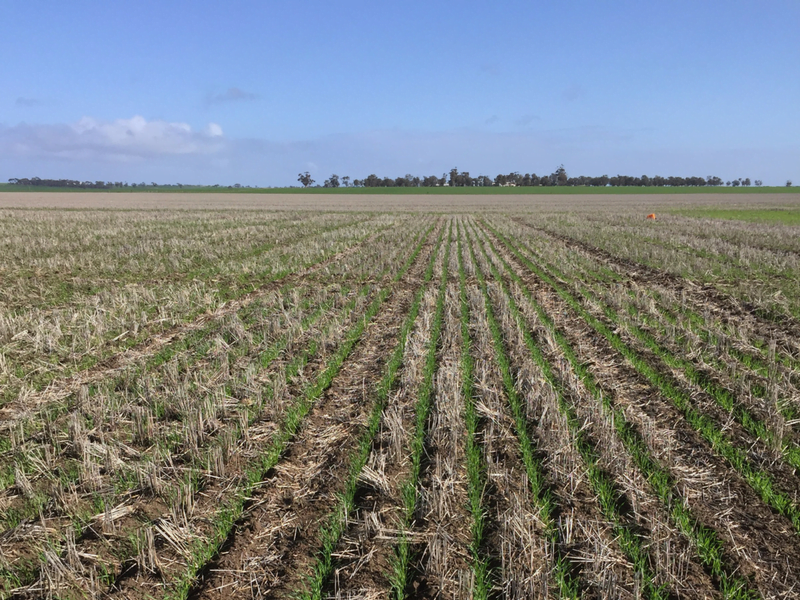


Army worms have recently been discovered in lentil and cereal crops in the Mallee and parts of the Wimmera.
Army worms are common caterpillar pests which are known to be most damaging to barley, particularly in spring. However, dry weather favours army worm population and while their preferred plant hosts are cereals and grass pastures, they are vicious eaters and when there natural food source is low they will turn to other forms of food and this year they seem to be targeting lentils.
In barley crops that are attacked near maturity, the larger Army worm larvae, which may have been in the crop for 6-8 weeks, chew through the stem just below the head (the last green material left on the plant) causing heads to be lopped and fall to the ground. Wheat and triticale have thicker stems and are less susceptible to head loss. In lentil crops, the stems appear to have been chewed off.
Generally the army worm larvae feed on the leaf margins of seedling and vegetative crops causing ‘scalloping’. Larger larvae consume greater volumes of leaves and seedlings may be completely defoliated.
Identification
Army worm larvae are identifiable by three parallel white stripes along their body. They are sometimes mistaken for native budworm (more prominent body hairs) and cutworms (stripes absent or indistinct).
Growers are reminded to monitor crops and spray where required. In spring, it is recommended to spray when the density of larvae exceeds 1 to 3 larvae per m2.
Being nocturnal, army worms can be hard to find during the day; on cloudy days you might be able to spot them on plants or hidden under clods of soil. They avoid sunlight, so most of their activity occurs during the night or overcast days. However, one Woomelang farmer recently shot this footage of army worm feeding during the day.
Control
Control of army worm is carried out with a synthetic pyrethroid (SP) insecticide.
Synthetic pyrethroids are registered for control of army worm in cereals as a foliar spray in spring. These same products are registered in lentils for the control of Helicoverpa punctigera.
While there are no direct label claims for the control of army worm in lentils, Pulse Australia has suggested SP use maybe considered as an option, but ensure that the use rate does not exceed the registered use rate and keep in mind crop maturity, likely harvest dates and withholding periods.
Spraying late in the afternoon or in the evening is most likely to be more effective as caterpillars will be active on plants during this time.
Further information about army worm is available on the cesar website at: https://www.cesaraustralia.com/sustainable-agriculture/pestnotes/insect/Armyworm and https://www.cesaraustralia.com/sustainable-agriculture/pestfacts-south-eastern/pestfacts-issue-no-8-27th-august-2015/impact-of-armyworm-caterpillars-ramps-up/
Acknowledgements: Bill Kimber (SARDI), Paul Umina (cesar), Gary McDonald (Cesar) and Sandra Hangertner (Cesar), Mary Raynes (Pulse Australia).