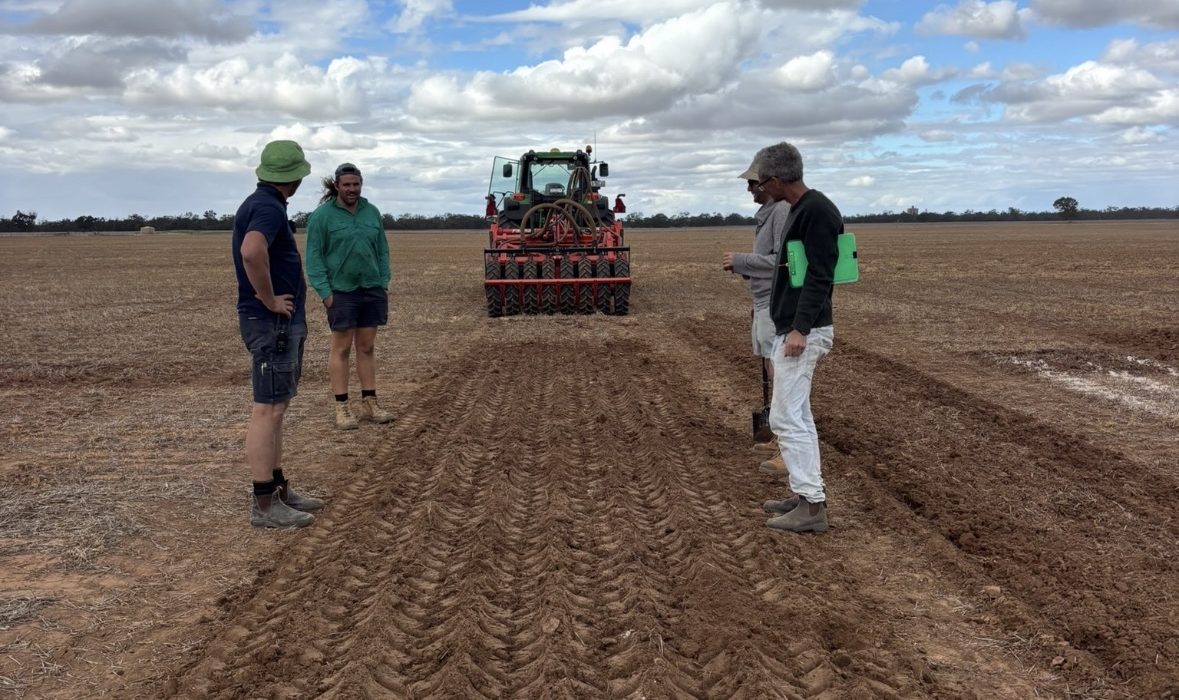

Last Wednesday, BCG established a deep ripping trial across the southern Mallee, commencing in Birchip’s west.
Deep ripping is a soil management technique that mechanically breaks up compacted soil by pulling narrow tines at a depth of up to 30cm. Interest in the practice has been growing across the region, particularly following previous research which demonstrated yield increases of up to 11% from shallow ripping and as much as 44% from deep ripping on sandy loam soils in low rainfall zones in Western Australia.1
However, the impact of deep ripping on heavier calcarosol soils which are widely encountered across Birchip and the southern Mallee remains less understood. This trial aims to address that gap.
The project is focused on developing and testing site specific, cost effective Innovative Soil Technologies (ISTs) to overcome key soil constraints in broadacre farming systems. BCG’s Senior Scientist James Nuttall is working closely with researchers from Adelaide University and Murdoch University to determine optimal ripping depths and gypsum application rates. Nuttall said “the aim is to apply high rates of gypsum to improve water dynamics, water into the soil profile and as a result, water used more effectively by the plant.”
A key component of the trial is investigating the use of gypsum to treat sodic soils, a common practice across the region’s heavy clay landscapes. Sodicity occurs when excess sodium weakens soil structure, causing clay particles to disperse when wet. This leads to reduced water infiltration, surface sealing, and restricted root growth.
Gypsum works to counteract this by supplying calcium, which replaces sodium in the soil and helps restore stable soil structure. The effectiveness of gypsum depends on several factors, including application rate, placement, and the ability for water to move through the soil profile.
The trial will compare different gypsum application methods, including micronised gypsum banded into rip lines versus traditional surface applications. Research will assess how effectively these approaches reduce sodicity, improve soil structure, and enhance water movement through the soil.
Several key hypotheses are being tested, including whether targeted gypsum placement can deliver faster and more cost effective improvements in soil condition, and whether these approaches are better suited to dryland farming systems where soil moisture is limited.
The findings of this trial will provide valuable insights for growers managing heavy clay soils, helping to improve productivity and resilience across the region. Follow along on our social media platforms for key updates on our work across the region @bcg_birchip
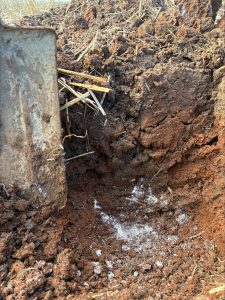
Senior Researcher James Nuttall dug a soil pit to demonstrate to growers where the gypsum had been placed in the soil profile following deep ripping:
This trial is hosted by local growers Lachy Barber, Lachy Foott and Tim McClelland. This trial is led by Adelaide University and Murdoch University. It is funded by the Commonwealth Government under their Climate Smart Program.
References:
[1] Is Soil Compaction Reucing Wheat Yields in the Victorian Mallee? Page 1
ChatBCG