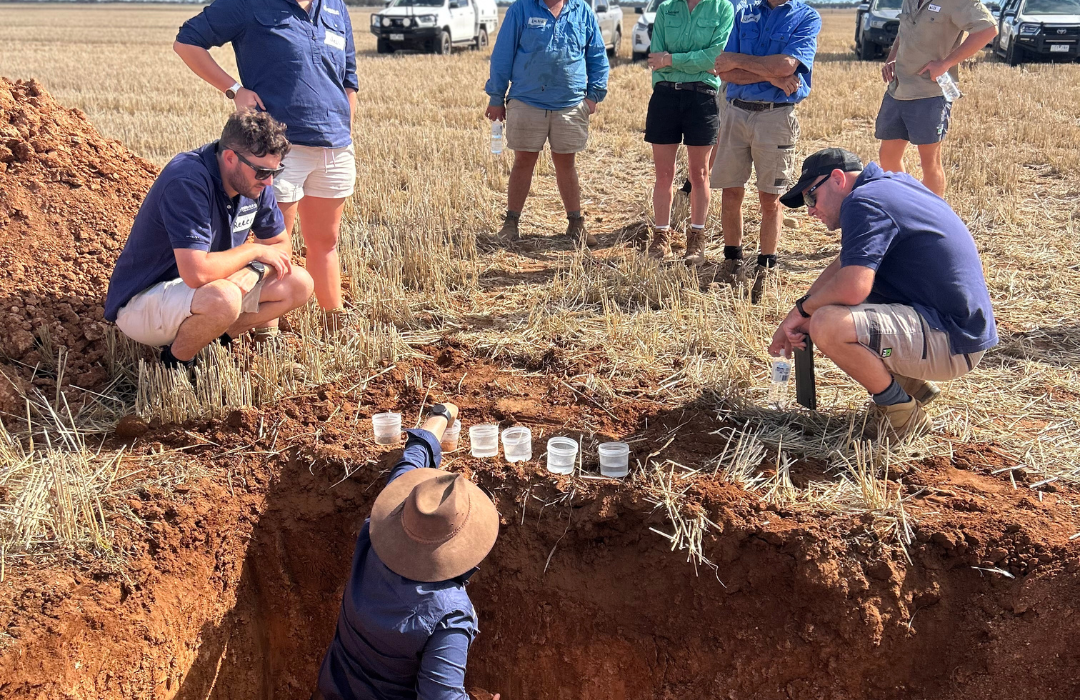

Growers and advisors from across the Mallee gathered in Berriwillock for a practical soil pit demonstration hosted by BCG.
Soil expert Dr Cassie Schefe encouraged local farmers to explore soil constraints, improve understanding of soil health, and discussed practical management strategies to enhance productivity and sustainability.
Participants explored how soil testing and targeted management can be used to address key constraints including compaction, sodicity, acidification, nutrient stratification and salinity. The soil pit provided a hands-on opportunity to interpret soil layers and discuss practical solutions.
Dr Schefe said the only way to accurately identify rooting depth in your paddock, is to grab a shovel and dig a soil pit. Local grower Charlie Cox was surprised the cereal roots from the 2025 season had grown to a 700mm depth.
Dr Schefe highlighted the importance of soil organic carbon (SOC) in maintaining productive and resilient farming systems. Across the Mallee, SOC levels typically range from 0.2 to 1.5 per cent and are closely linked to soil type, from sandy loams in the north to heavier clay soils in the south.
“We talk about building soil organic carbon, but we need to start by maintaining soil carbon levels” Dr Schefe said. “Organic carbon is present in soil within organic matter, which has a consistent ratio of nutrients that needs ongoing carbon and nitrogen inputs in production systems where nutrients are exported. If they are not replaced, organic matter is depleted, and subsequently so is soil carbon.”
“The best way we can get carbon into the soil is to grow healthy plants – that is to sow on time, feed it adequate nutrition and manage disease – which produces more biomass. And while burning stubbles has little effect on soil carbon in low rainfall environments, it will affect emissions and ideally, we want to retain as much groundcover as we can to protect soils.”
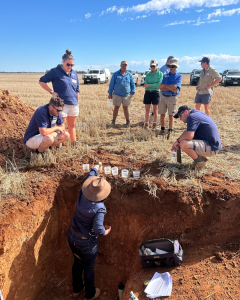
Growers in attendance were interested in deep ripping practices and amendment of sodicity. Dr Schefe conducted a slaking and dispersion test (pictured above) by placing small soil aggregates in rainwater, then observing for dispersion and slaking. This indicated the soil would respond to gypsum, to help alleviate sodicity and improve water infiltration in the soil profile. This proved useful information for the Simpson’s, whose paddock hosted this soil pit.
Dr Schefe encouraged growers to understand all the soil profile layers before attempting amelioration strategies. “Know whether you are just busting up compaction, or whether there are deeper issues. Deep ripping creates a highway for water. Large summer storms will be like dumping a bucket of water on there, everything on the sides of the furrow could collapse, fines can come together and water won’t infiltrate. Keeping stubble residues to fall into the gaps and applying adequate rates of gypsum ahead of ripping, when applicable, will help achieve the best outcomes for the following crop.”
BCG also highlighted its current research activities across both sandy and heavier soil types involving innovative soil technologies and stubble management, including trials investigating deep ripping, gypsum application methods, and other soil amelioration strategies.
The event also touched on the link between emissions and productivity, reinforcing the role of improved soil management. BCG continues to work with growers and industry to support the adoption of practices that protect and restore soil health across the Mallee region.
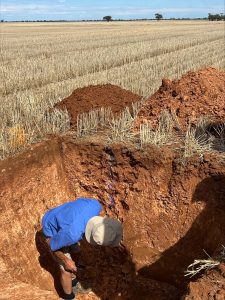
Local farmer Jamie Simpson interrogating the layers of the soil pit dug in his paddock.
BCG acknowledges the contribution of local growers Jamie and Will Simpson, who hosted the event and supported soil sampling and the soil pit demonstration.
This event was delivered through the Carbon Farming Outreach Program in collaboration with the Grower Group Alliance, with funding from the Australian Government’s Department of Climate Change, Energy, the Environment and Water. Additional support was provided through MCMA soil projects funded by the Natural Heritage Trust under the Climate Smart Agriculture Program.