

The wet cool conditions of spring 2016 highlighted the variability experienced in the agricultural industry.
With harvest now complete for many, taking some time to reflect on the busy 2016 season is highly advisable.
Phil O’Callaghan from ORM reminded GAPP members in 2015 “to concentrate on setting your system up for volatile rainfall, thus volatile incomes.”
Financially assessing the businesses position will assist in planning for this year’s season, and tax, while also providing the opportunity for medium and long term business decisions.
Risk is something all businesses face, whether it be the family farm, the butcher, the baker or the candle stick maker.
“All farms can be profitable if risk is managed appropriately,” explained Ed Hunt of Ed Hunt Ag Consulting at the Southern Mallee and Manangatang GAPP meetings in February 2016.
While risk is universal for farm businesses the extent and implications are all individual, as risk positions are varied according to soil types, enterprise mix, management, input variation, off farm income and current debt.
Calculating cost of production (COP) is just one financial measure that can provide insight as to which portions of the business are consistently generating a return thus helping in reducing risk.
COP is the total financial outlay made to produce a unit of commodity or undertake a service.
Therefore, COP includes all variable costs like crop inputs (e.g. herbicides) and overhead costs (including shire rates, electricity and depreciation).
Because of the nature of farming, we need to allocate COP according to the proportion of revenue earned from each commodity. This will insure that commodities like wool are not over allocated expenses, making the COP calculated on them unsustainable.
When considering costs like machinery depreciation, you should deliberate on how much of the total cost should only be allocated to the cropping proportion of your business. If spread evenly over the whole farm, livestock commodities would again unjustly be affect. You wouldn’t allocate shearers labour to wheat production, so why would you allocate header maintenance to wool production.
By calculating COP for the different commodities in your business, you are able to critically analyse the enterprise mix. If a commodity is consistently producing revenue below the COP, then the commodity will run at a loss long-term. While commodities that consistently produce above the COP, will over the long term produce a profit.
Understanding the COP of a commodity is also beneficial when it comes to marketing. It is much easier to sell a commodity when you understand what the cost of producing that item is.
By understanding the long term COP of a commodity, you can determine which commodities incur less fluctuations overtime, thus reducing risk. This may also cause a shift in your enterprise mix.
Ed Hunt demonstrated in figure 1 below, how farmers with varying enterprise mix can mitigate risk. While farm businesses with 100% cropping can produce the greatest return, they also have the risk of producing the greatest lost.
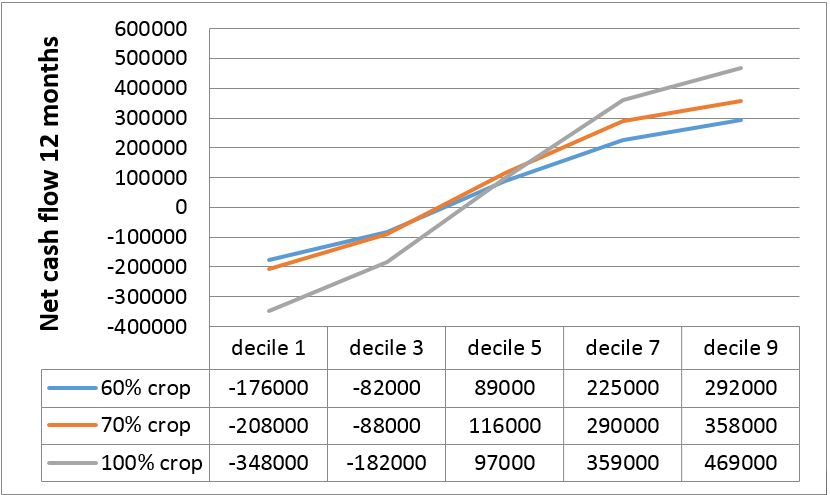
Figure 1. Ouyen farm net cash flow over 12 months for a Decile 1, 3, 5, 7, and 9 season with 80 per cent equity. Ed Hunt, Ed Hunt Ag Consulting.
Unfortunately for many in the agricultural industry they are price takers not makers. By understanding the COP of the different commodities in your business, you are able to mitigate some of the risk associated with a fluctuating market and seasons.