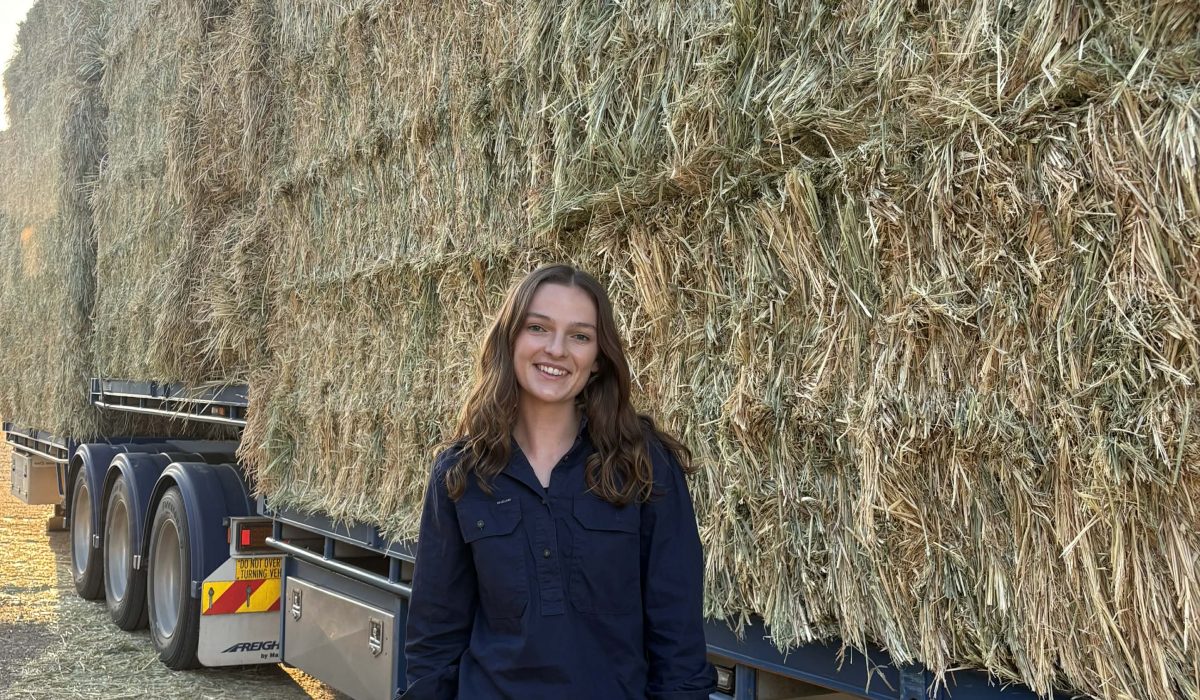
We caught up with Ella Lanyon. Ella and her family run a dryland broadacre operation, just north of Boort, with a predominant focus on vetch and oaten hay.
Tell us about yourself, where you grew up, how you came to the farm, and what your role is today.
I grew up on our family farm at Barraport, just north of Boort. After school I went to university to pursue medicine for a few years. During this time, I remained heavily involved in the farm, particularly the financial side of the business. Alongside my medical studies, I also began studying for a master’s degree in agriculture with a plan to balance a future career in medicine and farming. In 2024, my younger brother Griffin very unexpectedly passed away, and I made the decision to come home to the farm full-time. I haven’t looked back since, and today I manage our day-to-day operations alongside my dad, Josh.
What does your farm operation look like?
We run a dryland broadacre cropping operation producing lentils, barley, vetch and oaten hay. Alongside Dad and myself, we have two permanent staff who manage the transport side of the business. During busy periods, we also bring in casual staff when needed, with Mum and my two younger sisters stepping in to lend a hand.
We’re heading into sowing now, how is your program shaping up? Has it changed with the recent rains or increases in fuel and/or urea price?
Typically, we would start dry sowing vetch in early April, however we received 180mm of rain across the farm in early March and off the back of that, we will look to start around ANZAC Day.
Since the March rain, our focus has been spraying to maximise moisture conservation. While the moisture profile is as full as we’ve seen it at this time of year, we would still benefit from a couple of small showers to keep the surface moist and get the crop up. If that happens, we could be in for a good year!
Despite input prices, we are sticking to our normal rotation, in any given year legumes make up a third of our program, so increasing this wasn’t an option. Additionally, with the level of subsoil moisture, it is difficult to justify cutting back on urea because on paper the numbers still stack up. In the case of fuel, we are hoping we’ve secured enough to get us through the entirety of sowing.
Are there any practices or equipment that has made a difference to productivity or cost control on your farm?
One of the biggest costs we aim to control is unrealised profitability. Timeliness of activities across the year has a big influence on gross margins for our business. In recent years, we have seen some significant rainfall events during haymaking and harvest that have impacted both yield and quality. Given we can’t control or influence these events, we have focused on increasing the timeliness and efficiency of our operation.
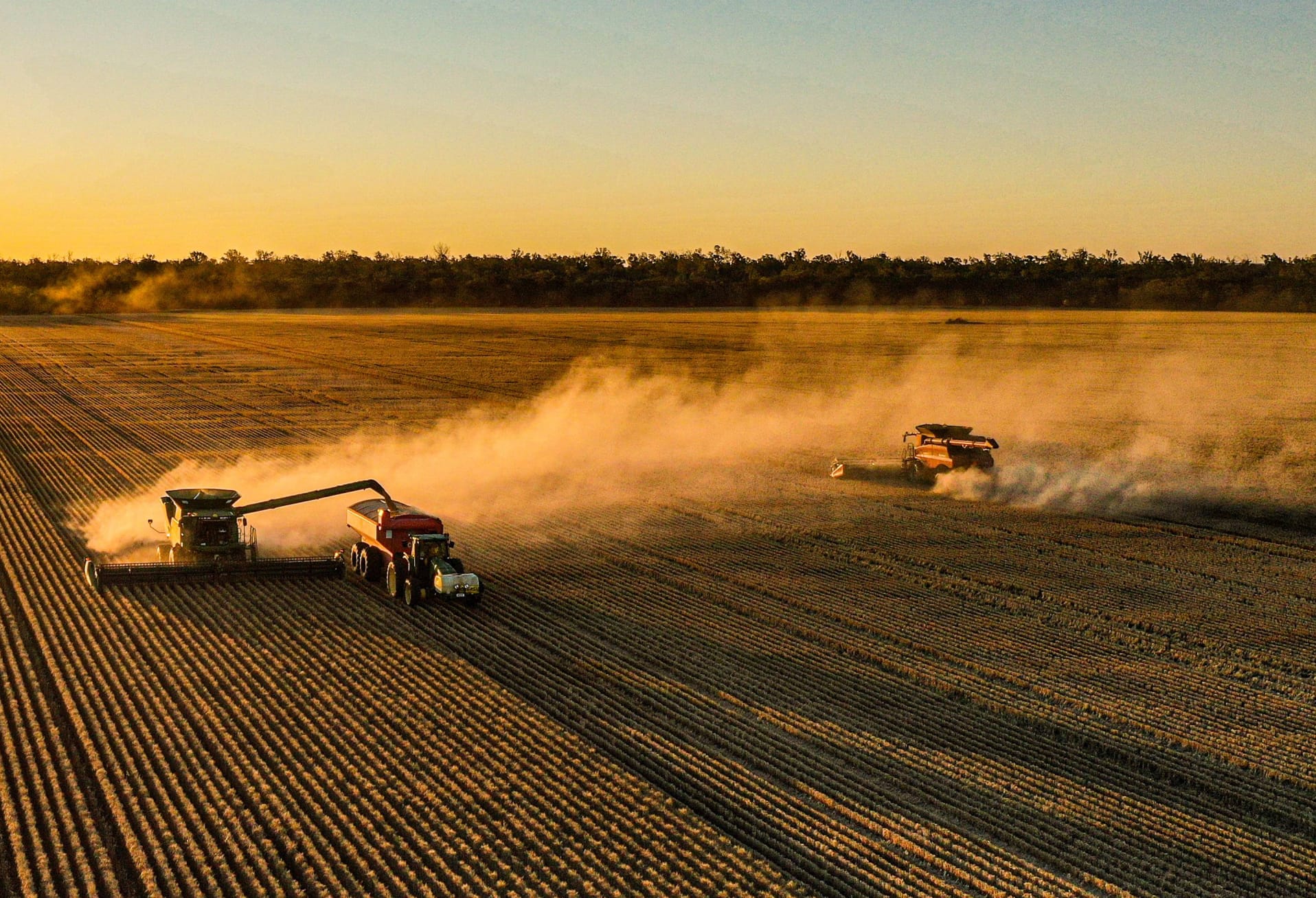
We have invested in on farm storage, silos and hay sheds, as well as in paddock storage in the form of a mother bin. This helps keep the headers moving and allows us to maintain hay quality.
This year, we have also invested in a larger seeder with the intention of improving sowing efficiency, allowing us to capitalise on our optimal sowing window and give the crops the best possible start.
Moisture preservation through summer weed control is also a major focus for us, we work hard to maintain as much as we possibly can.
More broadly, we carry out pretty much all operations ourselves which allows us to be timely and flexible. Having said that, we are happy to bring in a contract header or extra baler when seasonal conditions demand it.
Drought is an inevitable aspect of the climate we farm in. How is your farm business preparing for risk?
I am fortunate that I haven’t experienced a severe drought since I’ve been involved in the farm, but it has been well instilled to me that nothing should be taken for granted.
We make sure we are across our numbers, allowing us to maximise and capitalise on the good years with an awareness of what we can withstand. We do this with the mindset that if we don’t, the tough years will be tougher.
Our hay program allows us to conserve more moisture and reduces our spring rain requirement, that said, if spring rainfall is low and it doesn’t look like cereal crops are going to finish at their full potential,we have the capacity to cut everything for hay.
For us, improving resilience is an ongoing focus. We will continue to invest in learning, new technology and refining our practices.
This project was supported by the Australian Government’s Future Drought Fund.

The Victoria Drought Resilience Adoption and Innovation Hub is a state-wide collaboration of 10 organisations.
Led by the University of Melbourne and with headquarters at UM’s Dookie Campus, the Vic Hub is a Partnership between five farming organisations (Birchip Cropping Group, Food & Fibre Gippsland, Mallee Regional Innovation Centre, Riverine Plains and Southern Farming Systems), four universities (UM, Deakin, Federation and La Trobe), and the State Government (through Agriculture Victoria).
One of eight hubs established nationally under the Australian Government’s Future Drought Fund (FDF), the Vic Hub works to enhance the drought preparedness and resilience of Victoria’s agricultural industries, the environment and regional communities, encompassing broader agricultural innovation. Engaging with a range of industry and community stakeholders, the Vic Hub links research with community needs for sustainable outcomes.