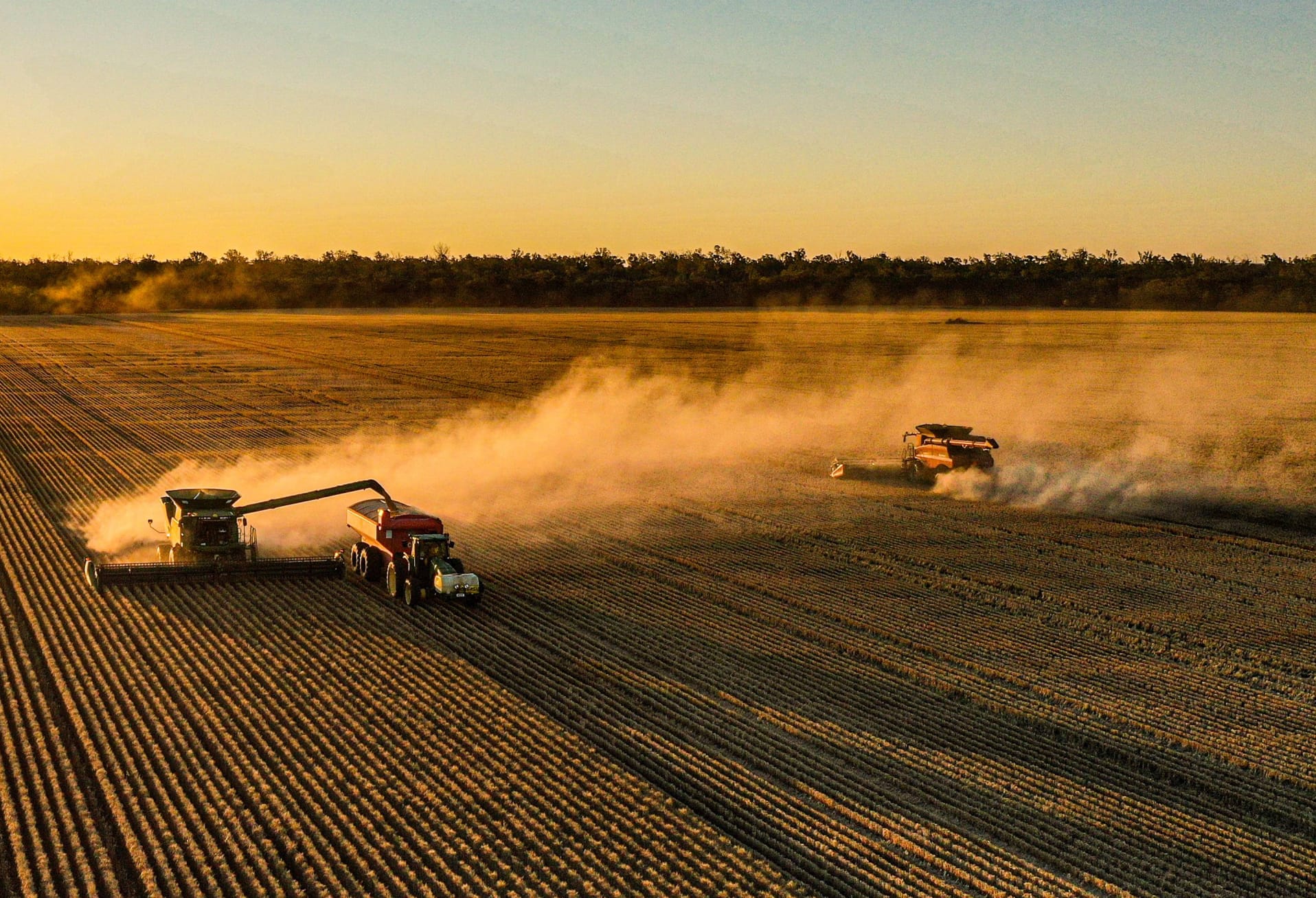
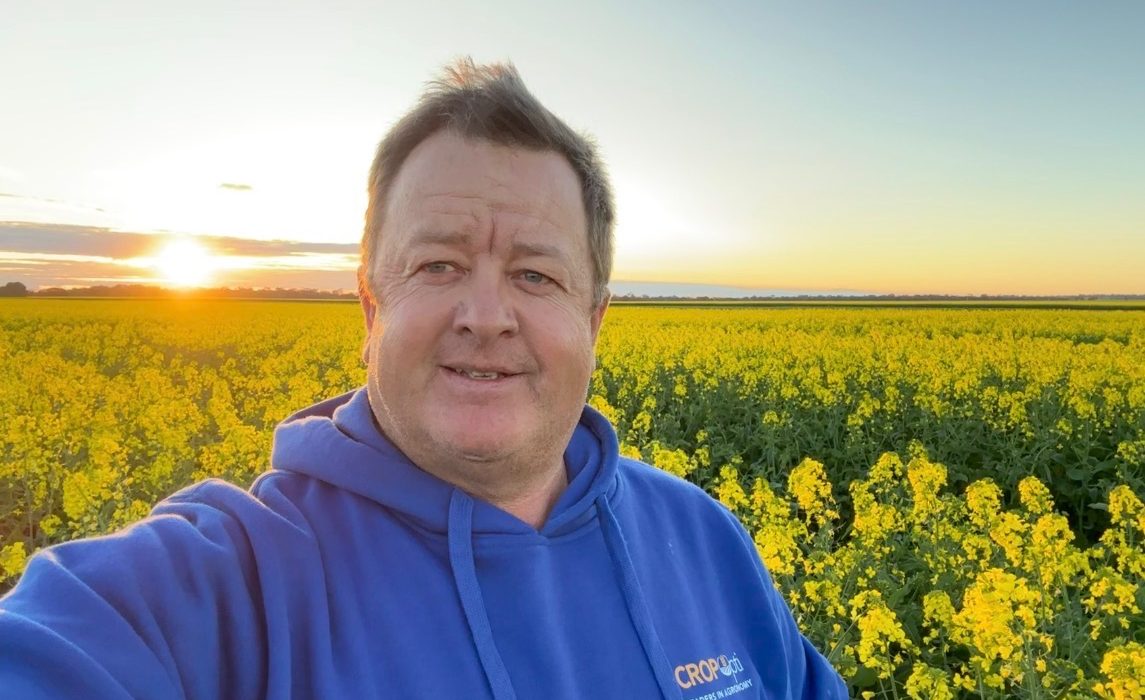

Gerard Bardell farms with his family on a dryland broadacre cropping property in the Wimmera region.
Gerard is the President of the Horsham Golf Club, which hosted this year’s BCG Young Farmer Network Ball. Passionate about both agriculture and his local community, Gerard enjoys balancing life on the farm with family and community involvement.
We caught up with Gerard to hear how the season is tracking, and what he’s keeping an eye on as spring approaches.
What’s your role on the farm and what does your farm operation look like?
We operate a second generation dryland broadacre farming business based at Vectis, about 8 km west of Horsham. Our cropping program spans the Vectis, Dahlen and Drung areas, with a strong focus on building a productive and resilient farming system.
Are there any practices or equipment that have made a difference to productivity or cost control on your farm?
Our system is based around zero-till (disc) farming with 12 metre controlled traffic, supported by a five year crop rotation of lentils, canola, barley, chickpeas and wheat. These practices have helped improve efficiency and soil management over time. This is also our third season using variable rate urea applications post-emergent, allowing us to be more efficient and better match nitrogen inputs to crop demand.
What have you done differently on the farm this year?
To be honest, we’ve mostly stuck to the plan. There was plenty of uncertainty and negativity leading into seeding around fertiliser and diesel prices, availability and the talk of a “super” El Niño, but we didn’t let that change our overall strategy.
How is disease pressure on your farm at the moment?
With a mild autumn and winter and minimal frosts, our crops are around two to three weeks ahead of where we’d normally expect them to be.
We’ve used flutriafol on the starter fertiliser in our barley, wheat and canola. Cereals have had one post-emergent fungicide application and remain relatively clean. Canola will receive a fungicide and liquid nitrogen at around 20 per cent flowering, with the need for a second fungicide still to be determined. Our pulse crops are also looking clean, with the lentil fungicide program set to begin at canopy closure.
How do you think the season will finish, and how do you feel about yield potential from this point on?
We’re expecting El Niño conditions to become more noticeable through spring, bringing warmer, drier conditions and an increased frost risk. Fortunately, we’ve gone into the critical spring period with a full soil moisture profile, which gives us confidence.
Our yield budgets have been based on a Decile 2 finish, and the crops will have enough Nitrogen to achieve that. If seasonal conditions allow, we’ll use liquid nitrogen strategically to top up wheat and canola where it’s needed.
This project was supported by the Australian Government’s Future Drought Fund.

The Victoria Drought Resilience Adoption and Innovation Hub is a state-wide collaboration of 10 organisations.
Led by the University of Melbourne and with headquarters at UM’s Dookie Campus, the Vic Hub is a Partnership between five farming organisations (Birchip Cropping Group, Food & Fibre Gippsland, Mallee Regional Innovation Centre, Riverine Plains and Southern Farming Systems), four universities (UM, Deakin, Federation and La Trobe), and the State Government (through Agriculture Victoria).
One of eight hubs established nationally under the Australian Government’s Future Drought Fund (FDF), the Vic Hub works to enhance the drought preparedness and resilience of Victoria’s agricultural industries, the environment and regional communities, encompassing broader agricultural innovation. Engaging with a range of industry and community stakeholders, the Vic Hub links research with community needs for sustainable outcomes.