This month we sat down with Hopetoun farmer, Lou White to chat about relocating to Brisbane while staying involved in the family farming business, how dry years and unpredictable seasons have shaped the operation, and how a need for better on-farm record keeping led to the development of AgriStack, a farm inventory management app designed to help manage hay, grain and fertiliser.
You can find out more about AgriStack here: https://agristackapp.com
Can you tell us a bit about yourself, where you grew up and how you came to be involved in the farm?
I grew up on our fifth-generation family farm west of Hopetoun. I lived on the farm until I was 16 then went away to Ballarat to boarding school to complete VCE. After finishing boarding school at the end of 2018, I deferred an Agribusiness course at Melbourne Uni and decided to come home to the family farm where I have worked for the past seven years. I have recently moved to Brisbane, but I am still involved remotely and fly back when needed to help during busy periods.
What does your farming operation look like today, and how have seasonal conditions, including drought and dry finishes, shaped the way the business operates?
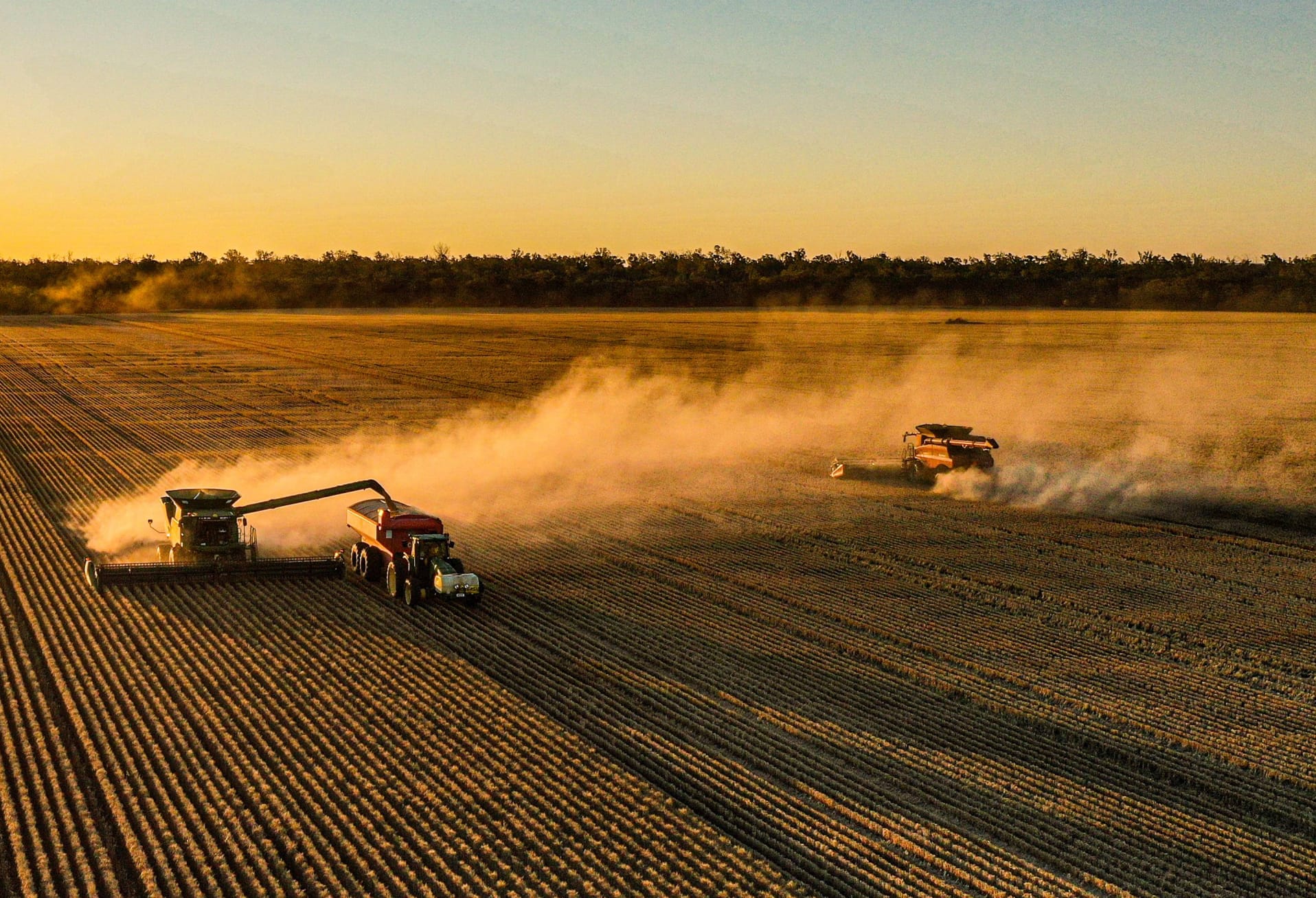
Our farming business produces wheat, barley, lentils, oaten hay and vetch hay. Hay has been a major part of our cropping program for a long time, originally introduced by my Dad as a way to manage the risk of unpredictable seasons and dry finishes in our area.
The day-to-day work is carried out by myself, my brother Sam, my dad Tom, and our full-time worker Mick. Mick has been with us for over 15 years and plays a big role in maintenance and engineering. I oversee the spray program, while Sam manages the sowing program, although we both help each other across these jobs. Dad manages grain and hay marketing, with input from Sam and myself, while still helping with practical jobs when needed. My pa, Kevin, has been here his whole life and still does a lot around the place. He keeps the yard in pristine condition, drives the roller during cropping, and makes sure tools go back where they belong. Mum, Michelle, runs the office and books, which is just as important as what happens out in the paddock. Nan is also always around to help with paddock runs, harvest lunches and smoko down at the workshop.
We also work closely with our neighbours, the Cooks, during hay season, sharing equipment and labour to manage the heavy workload. That partnership began when Dad and Ross Cook established Hopetoun Bulk Storage, which we still run today with two trucks carting hay and grain for both businesses.
In 2026, Sam and I will both be away from the farm for large parts of the year, so we have employed Will as a young full-time worker. Will grew up on a farm and is now helping with spraying and other paddock operations.
Where did the idea for AgriStack come from?
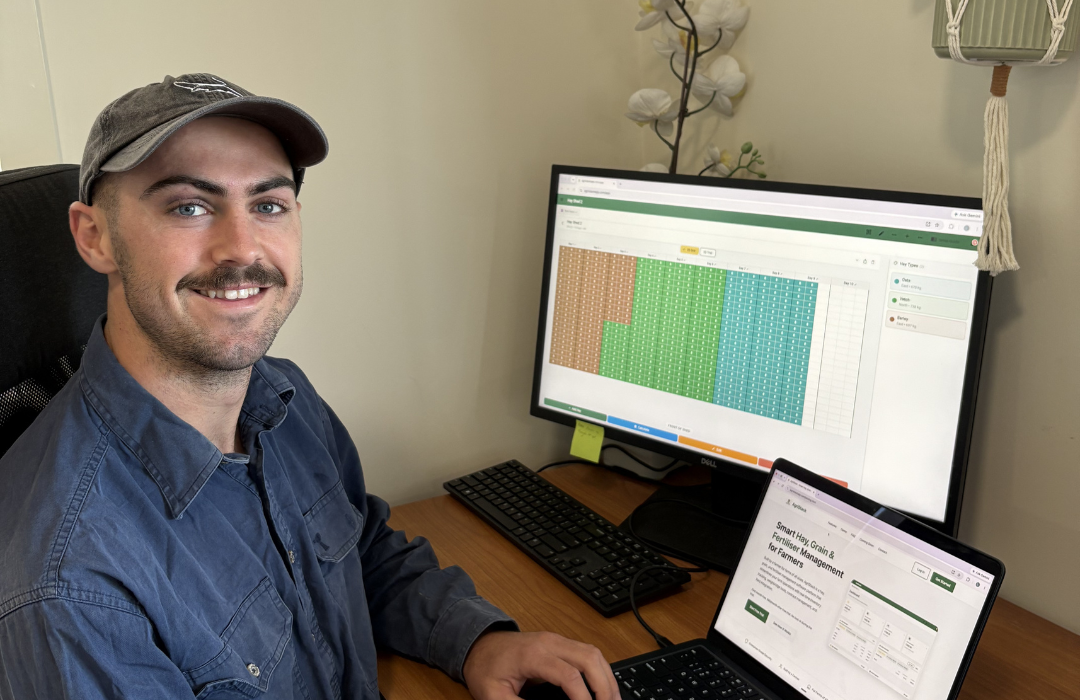
Since being on the farm, I’ve always liked to find areas of improvement to allow the farm to run as efficiently as possible. One area that I noticed was taking up a lot of time was record keeping, particularly with hay. Tracking how much hay was left in each shed, what had been sold, what was still available, what was contracted, and what had gone out on individual loads was all being done manually. I had always thought it would be useful to have a program or app that could streamline this process. After looking at other software options, I found they were often either too complicated for everyday farming use, not cost-effective unless you were a very large operation, or lacked the understanding of how the process of hay from paddock to end user actually works. That was the inspiration behind AgriStack. I started building a farm inventory management app that is designed by someone who is involved in the day-to-day movement of hay, grain and fertiliser on-farm. AgriStack is built to suit each farm’s needs, whether you want a simple way to track stock, or a more detailed system for managing sheds, contracts, tickets and invoicing
On our farm, we use AgriStack to track incoming loads of hay and grain during hay season and harvest. Each load of grain can be allocated to a storage from a phone, while hay bales can be drawn into digital shed plans. The shed plans are built as accurate bird’s-eye views and can be customised to match each shed’s size, layout and bale capacity. As hay is sold, we create buyer contracts in the app. For each outgoing load of hay or grain, the truck driver completes a weight ticket in AgriStack and allocates it to the relevant contract. This automatically deducts the load from the shed plan or grain storage, updates the contract, and keeps a live tally of what is still available. AgriStack can also connect with Xero, which means once a truck driver uploads a weight ticket, Mum can create a draft invoice in Xero with the click of a button and then submit it. Each worker on our farm has different access in the app, so if someone shifts grain from one silo to another, or takes fertiliser out of the shed for spreading, they can update it instantly from their phone.
As more customers start using AgriStack, I am continuing to receive feedback and identify areas for improvement. One of the next major focuses is weighbridge integration. We are currently installing a new weighbridge on our farm, and for the upcoming harvest I am looking to build a system that can move data directly from the weighbridge to storage inventory, streamlining the process even further.
What difference has AgriStack made to productivity and decision-making on your farm?
I think the biggest difference AgriStack has made on our farm is giving us the confidence to be able to sell hay or grain without worrying about overselling to customers or missing market opportunities because we are unsure of our stock levels.
It has also saved time by giving us live inventory updates. Instead of spending as much time checking hay sheds and grain silos to see what is left, we can see it in the app. This also helps our truck drivers, as they can look at the shed or silo plans and see exactly where a particular load needs to come from. It gives them confidence that they are collecting the right hay or grain.
It has also made things much easier in the office. Mum can access outgoing load tickets from her computer, create invoices quickly, and find customer and contract information in one place. This saves time chasing paper dockets, checking details, and manually matching loads to contracts.
Has spending time in Brisbane been important for experiencing life outside the farm and developing AgriStack?
Definitely. Spending time in Brisbane has given me the opportunity to explore interests I wouldn’t have had as much time for while working full-time on the farm, particularly developing, marketing and building AgriStack. It has also helped me see the farm from a different perspective. Still being involved in organising day-to-day operations remotely has shown me how important good communication, planning and clear systems are in running a farm. Relocating to Brisbane has also allowed me to meet new people and make connections in a new area.
This project was supported by the Australian Government’s Future Drought Fund.

The Victoria Drought Resilience Adoption and Innovation Hub is a state-wide collaboration of 10 organisations.
Led by the University of Melbourne and with headquarters at UM’s Dookie Campus, the Vic Hub is a Partnership between five farming organisations (Birchip Cropping Group, Food & Fibre Gippsland, Mallee Regional Innovation Centre, Riverine Plains and Southern Farming Systems), four universities (UM, Deakin, Federation and La Trobe), and the State Government (through Agriculture Victoria).
One of eight hubs established nationally under the Australian Government’s Future Drought Fund (FDF), the Vic Hub works to enhance the drought preparedness and resilience of Victoria’s agricultural industries, the environment and regional communities, encompassing broader agricultural innovation. Engaging with a range of industry and community stakeholders, the Vic Hub links research with community needs for sustainable outcomes.