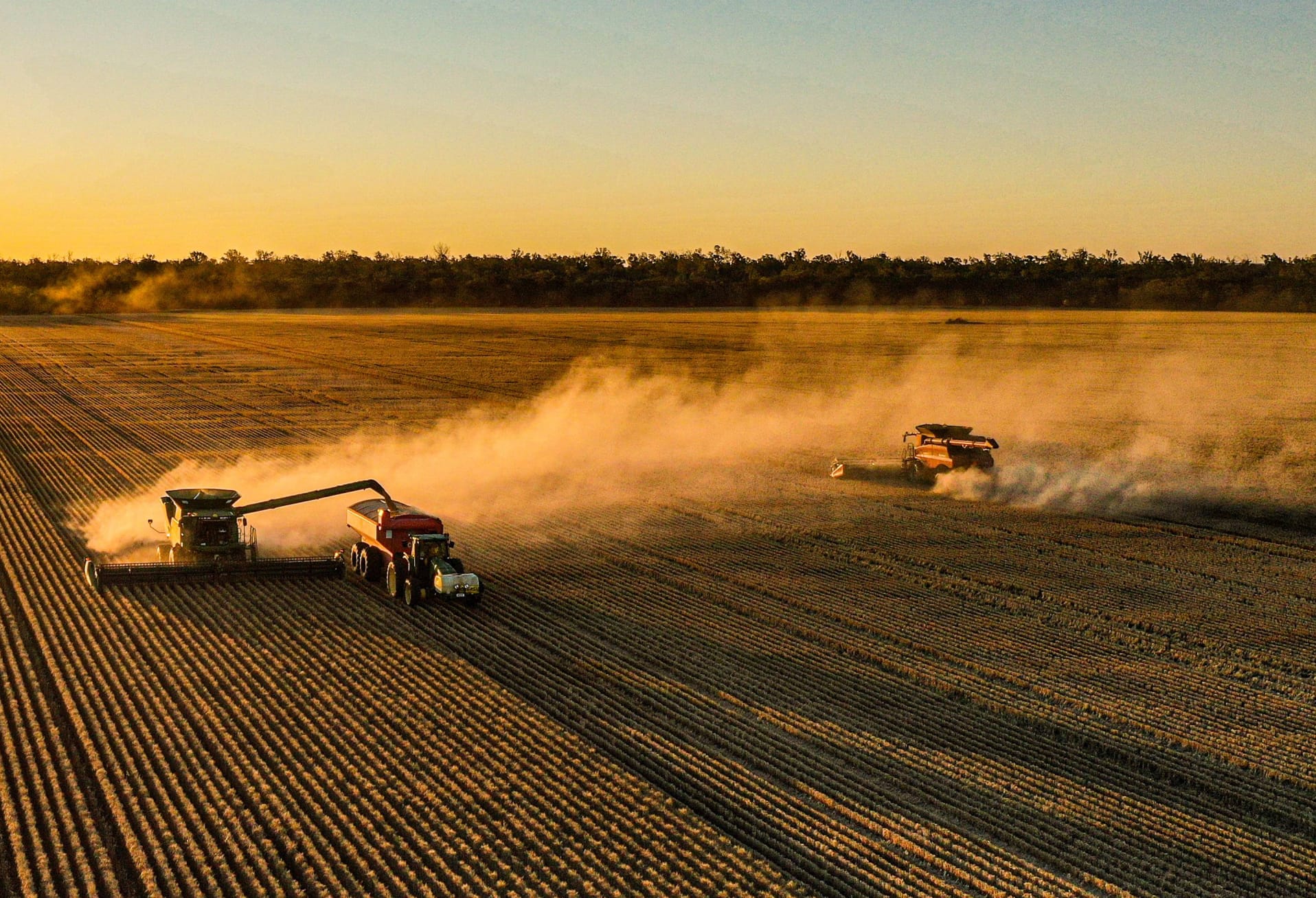


Harvest is all but complete throughout the Wimmera and Mallee and as Christmas is now behind us, our focus turns to 2018. While many are planning a summer get away, summer weeds may stand in the way.
Significant summer rainfall has already been registered across large parts of the cropping regions of Victoria, providing conducive conditions for summer weed germination and growth.
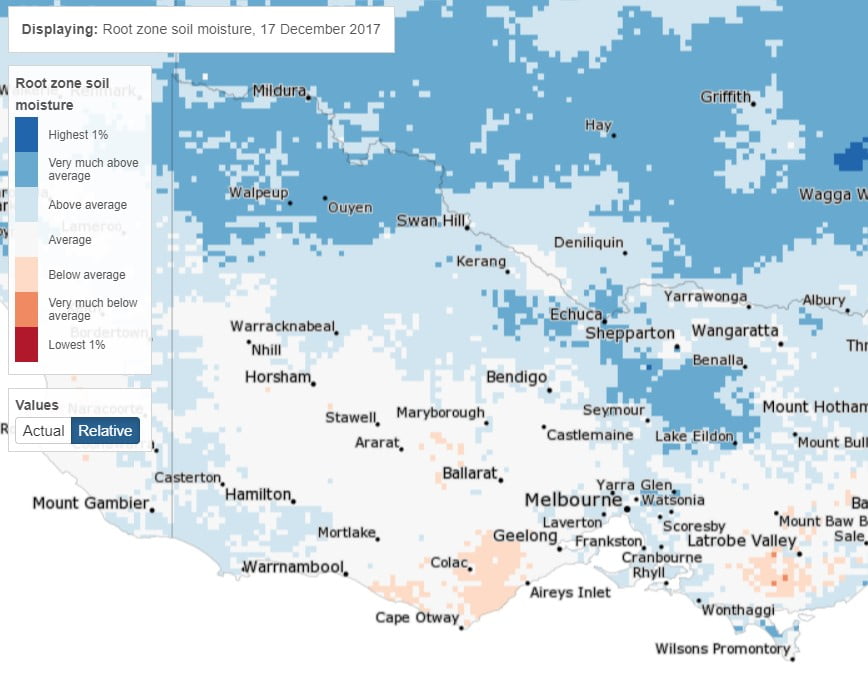
According to the BoM soil moisture map (December 17), soil moisture for the Wimmera and Mallee is average to above average for this time of the year, largely due to the high November rain. This is similar to this time last year, when soil moisture was average, even after the significant downpours experienced during spring 2016.
BCG researcher Claire Browne confirmed the saying that ‘moisture in the profile is money in the bank’. And while next year’s rainfall is unknown, soil moisture at the start of the season will be helpful.
This resonates with research conducted in 2010 to 2012 by NSW DPI and Central West Farming Systems.
“Research in Condobolin showed that for every dollar spent on summer weed control per hectare, there could be a return of up to approximately seven dollars per hectare,” Ms Browne enlightened.
“It also showed that summer weeds can extract moisture down to 1.2 metres, which is also the depth that the tap roots of crops can also extract from, noting that the majority of water was below 30cm.”
This is highly advantageous as it is well understood that water at depth can be valuable for dryland crops during the post-anthesis stage.
In this trial, four different spray timings were assessed for both water and nitrogen retention over the summer fallow period.
The nil spray treatment, no summer sprays with only a knockdown prior to sowing, resulted in a return of $1.90/ha. In the full spray treatment, with a zero tolerance to weeds and herbicide application approximately 10 days after a rain fall event, a $7.20/ha return was calculated. While in the delayed spray, which was approximately 24 days after a significant rainfall event, a return of $3.90/ha was recorded.
“This research demonstrates the importance of being timely with spray applications, because if can impact significantly on your bottom line,” Ms Browne said.
The resulting benefits to profitability in these scenarios came down to not only soil moisture available for the following crop, but residual nitrogen. Residual nitrogen where weeds were controlled was 69 and 45 kg N/ha higher in 2011 and 2012 respectively, than where weeds were not controlled.
This supports results from the Victorian component of the GRDC ‘Identifying farm scale opportunities to improve WUE: a national coordinated systems approach’ that was conducted by BCG, where there was consistent positive return on investment from summer weed control.
In this research, conducted from 2009 to 2012, a return on investment from summer weed management on the sandy paddock of $3.14/ha and on the clay paddock of $3.80/ha.
So, while taking a break after what has been a busy year is high on the priorities, remember that effective and efficient timing of summer weed control will be beneficial for the season to come.
For more information on this research contact the BCG office on 03 5492 2787.
This article was published in the Stock and Land, 28 December.