Take Home Messages
- Pioneer PY424GC achieved the highest yields in the Mallee, demonstrating strong performance in low rainfall environments.
- Pioneer PY421C, the top performing IMI variety, provided yield stability across multiple regions, highlighting its versatility in diverse conditions.
- InVigor LR 4540P and InVigor LR 5040P demonstrated competitive yields in the North Central and Wimmera regions, respectively
Aim
To compare the performance of canola varieties across the Mallee, Wimmera, and North Central Regions within the NVT for the 2024 season.
Background
The 2024 growing season presented several challenges for canola growers. A late break and subsequent patchy germination impacted crop establishment in many areas across the Mallee, North Central, and Wimmera regions. Dry conditions persisted throughout much of the season, and crops were hit by several significant frost events and high aphid pressure, all of which negatively influenced yields.
The frequent release of new canola varieties underscores the ongoing relevance of National Variety Trials (NVT). Many new varieties have limited multi-season data due to the rapid evolution of breeding programs, making varietal selection highly dependent on seasonal conditions.
Canola has an important role in herbicide rotation strategies, allowing growers to consider factors beyond yield, such as weed management benefits.
Trial Details
Crop type: Canola (varieties detailed in Figures 1–3)
Target plant density: 40 plants/m² (Mallee), 50 plants/m² (Wimmera and North Central)
Seeding equipment: Knife points, press wheels, 30cm row spacing
Replicates: Three
Trials were managed as per best practice. For individual trial details see <https://nvt.grdc.com.au>.
Location Details

Method
The research was conducted through the NVT program delivered by GRDC. The program involves a series of replicated trials across diverse locations and crop types. The trials are designed to evaluate the maximum yield potential of varieties under optimal conditions, ensuring minimal interference from pests, diseases, or nutrient limitations. This approach isolates genetic performance to provide reliable comparisons
Results & Interpretation
New Varieties Released in 2024
Clearfield tolerant
Pioneer PY327C is a new, early maturing hybrid canola designed for a shorter growing season and lower rainfall zones, with blackleg rating to be determined.
Glyphosate tolerant
DG Buller G is a new hybrid product that has an extended application window and greater range of rates with Optimum GLY® herbicide tolerant traits. It has early to mid-maturity and is suited to medium to high rainfall zones, with blackleg rating to be determined.
Pioneer PY428R is a new early to mid-season, hyper-yielding Roundup Ready® hybrid canola. It has a rating of R for blackleg and is suited for diverse conditions.
Triazine tolerant
Monola H524TT is a new early to mid-season maturing hybrid with good early vigour. This is Nuseed’s second monola hybrid and has oil and yield improvements.
Pioneer PY429T is a new hybrid canola that is early to midseason maturing. Developed from the Y series with the addition of the triazine tolerant trait, with blackleg rating to be determined.
Dual tolerance – Clearfield + Triazine
Nuseed Griffon TTI is Nuseed’s first dual herbicide resistance hybrid. It is an early to mid-season maturity canola with fast pod development for a shorter growing season. Blackleg disease rating of RMR.
Dual tolerance Glufosinate + Glyphosate
Invigor LR 3540P is suited to lower rainfall environments with early maturity and a blackleg rating of R. The chemical package includes use of TruFlex® and LibertyLink®.
InVigor LR 5040P is similar to Invigor LR 3540P with a mid-maturity, resistant blackleg rating and the same chemical package. It has a higher yield and oil package.

Yield Results
Mallee (Birchip)
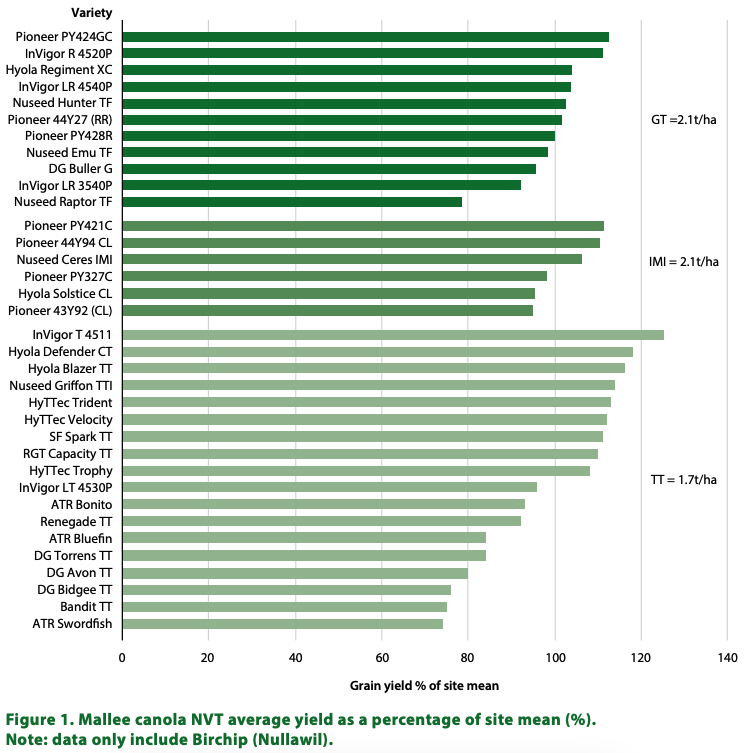
The highest yielding varieties in the Mallee region were Pioneer PY424GC (2.4t/ha), InVigor R 4520P (2.4t/ha), and Pioneer PY421C (2.4t/ha). On average, the highest performing chemical group was GT and IMI at 2.1t/ha (Figure 1).
TT Varieties: Average yields of 2.1t/ha. InVigor T 4511 was the highest performer for yield (2.2t/ha; 125 per cent of the site mean). Other high performing varieties included Hyola Defender CT, Hyola Blazer TTi, and Nuseed Griffon TTI. Yields ranged from 1.3t/ha to 2.2t/ha.
IMI Varieties: The highest yielding variety from the small group of IMI varieties was Pioneer PY421C (111 per cent of the site mean; 2.4t/ha). All varieties yielded closely ranging from 2t/ha to 2.4t/ha. Pioneer 44Y94 CL also performed well in the Mallee over three years (110 per cent of site mean).
North Central
GT Varieties: InVigor LR 4540P and DG Buller G were the highest yielding varieties (2.7t/ha). It is important to note that DG Buller G is a new variety, with just one year of NVT data. The next best was InVigor R 4520P yielding 2.7t/ha, followed by Nuseed Hunter TF which yielded 2.6t/ha.
IMI Varieties: The highest yielding variety was Pioneer PY421C (3.3t/ha).
TT Varieties: HyTTec Trifecta was the highest yielding at 2.5t/ha, followed by HyTTec Trident which yielded 2.4t/ha.

Wimmera
GT Varieties: The highest yielding variety was InVigor LR 4540P (2.3t/ha). As a new release for 2024, InVigor LR 5040P has shown promise across the Wimmera region. However, these results should be interpreted cautiously, as the variety has only been included in NVT data for a single season, and robust conclusions require multi-year performance data to account for seasonal variability. Nuseed Hunter TF was the second highest yielding GT variety in the Wimmera (2.2t/ha). It is also important to note that this data reflects findings from the single Horsham GT trial site.
IMI Varieties: The highest yielding IMI variety was Pioneer PY421C (2.9t/ha), followed by Pioneer 45Y95 (2.8t/ha).
TT Varieties: HyTTec Trophy, HyTTec Trident, and HyTTec Trifecta were the top performers (2.6t/ha). Other top performers included Pioneer PY429T (2.5t/ha).

Commercial Practice and On Farm Profitability
Canola can be highly profitable but poses significant risks in adverse seasons, such as 2024, when split germinations and frost significantly reduced yields. The increasing prevalence of dual herbicide tolerance varieties enhances flexibility in weed management strategies, offering benefits beyond yield potential, such as improved weed control and resistance management. We have also seen TruFlex® and Optimum GLY® incorporated to allow for greater flexibility with the spraying window.
Analysis of NVT canola results indicates most of the top-performing varieties across all regions and herbicide tolerance groups fall within the early to mid-maturity range (Table 6). Additional details on variety performance, maturity timing, and resistance packages are provided in Table 6. Clearfield (IMI) varieties demonstrated strong adaptability under challenging conditions, highlighting their suitability for a range of environments.
Glyphosate-tolerant (GT) varieties, while yielding higher overall, incurred increased input costs associated with herbicide applications along with a receival cost that fluctuates season to season. Historically, this cost has been about $10/t to $30/t, but discounts on GM canola were noted between $100/t and $130/t this harvest. Despite the additional costs, these varieties remain a valuable option for growers requiring flexibility in weed management or aiming to capitalise on high-yielding conditions.
TT varieties, although often associated with lower yields, offer a cost-effective option due to reduced herbicide costs and robust performance in less intensive systems. This makes them an attractive choice in specific environments or for growers prioritising cost management over yield maximisation.
The ongoing integration of dual tolerance varieties further enhances the options available to growers, enabling more tailored approaches to balancing yield potential, profitability, and herbicide management. Strategic varietal selection based on seasonal conditions and long-term goals is essential for maximising returns and managing risk.


Grain quality data was not available at the time of compiling this report.
NVT sites compromised by bird damage, pod shattering, chemical damage, or poor establishment are not released publicly. These results may become available in the ‘Quarantined trials report’ section of the website <https://nvt.grdc.com.au/trials/quarantined-trial-reports>.
References
GRDC, 2025, 2025 Victorian and Tasmanian Crop Sowing Guide, <https://grdc.com.au/resourcesand-publications/all-publications/nvt-crop-sowing-guides/vic-tas-crop-sowing-guide>. Accessed 23 December 2024.
GRDC, 2024, National Variety Trials yield data, <https://nvt.grdc.com.au/trial-results/>. Accessed 23 December 2024.
Acknowledgements
This trial was conducted through the National Variety Trial (NVT) program delivered by GRDC (BWD2401-002SAX).
This project received funding from the Australian Government’s Future Drought Fund.
Thank you to Rik Maatman, Nutrien Ag Solutions Birchip, for providing a technical review of this article.
BCG sincerely thanks Lucas Puckle (Hopetoun), the Watts family (Nullawil), Jon Whykes (Charlton), Anthony Lees (Diggora), Alex Foreward (Horsham), Alwyn and Jonathan Dyer (Kaniva), and Ollie Gabe (Minimay) for generously hosting the trial sites and for their support throughout the project.