Take Home Messages
- The top wheat varieties in the Mallee for 2024 were Calibre, Brumby, and Shotgun.
- The highest yielding varieties in North Central for 2024 were Calibre, Shotgun, Ballista, and LRPB Matador.
- The top varieties in the Wimmera in 2024 were Tomahawk CL Plus, Shotgun, and Calibre.
Aim
To compare the performance of new and existing wheat varieties in the Mallee, North Central and Wimmera NVT.
Background
The 2024 season began with high January rainfall across much of the Mallee, North Central and Wimmera. This weather pattern did not continue through the year, and by April and May many farmers were deliberating the best approach to their sowing program: whether to sow dry, or wait for the break to come. Like many growers across the regions, some National Variety Trials (NVTs) were dry sown (Table 1).
Variety choice remains a popular topic of discussion amongst growers. With breeders constantly bringing new varieties onto the market there is plenty to consider. Options available to growers include higher yields, improved disease resistance, herbicide tolerances, and variations in plant types and maturity timings, ensuring there is a fit for every farming system.
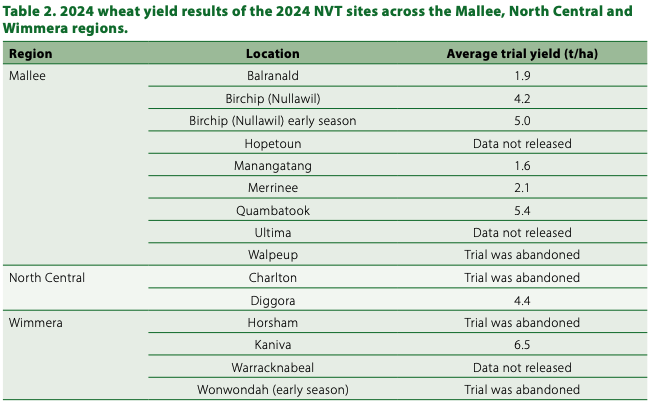
In 2024, BCG established two early season wheat trials, one in the Mallee and one in the Wimmera, as well as 13 main season wheat trials: eight in the Mallee, two in the North Central and three in the Wimmera (Table 1). These trials were about one-third breeding lines, and the rest released varieties.
The combination of NVT data, individual site reports. and multi-environmental trial analysis (MET) long-term data provides a useful tool for growers to determine which varieties are performing well and may be suitable for their farming system.
Trial Details
Crop type: Wheat, refer to Figures 1–3 for varieties
Target plant density: 130 plants/m2 (Mallee), 160 plants/m2 (North Central and Wimmera)
Seeding equipment: Knife points, press wheels, 30cm row spacing
Replicates: Three
Nutrition, weeds, insects and disease were managed as per best practice. For individual trial details see <https://nvt.grdc.com.au>.
The early season trial at Birchip was dry sown and received 10mm of supplementary water on 22 April.
The early season trial at Wonwondah was dry sown and received 10mm of supplementary water on 24 April.
Location Details

Method
This research was conducted through the NVT program delivered by GRDC. The program involves a series of replicated field trials that test varieties from different crop types in different locations. These trials aim to maximise genetic potential yield, rather than profitability. The sites receive multiple fungicide applications and are managed to ensure they are not nitrogen limited to avoid confounding factors when assessing the genetic potential of varieties. The data displayed in this article are a combination of NVT results, individual site reports, and multi-environmental trial analysis (MET) long‑term summaries. Variety performance is presented as the grain yield percentage of the site average, with MET data indicating performance in 2024, relative to the previous five years (2019–2023).
Results & Interpretation
New Varieties Released in 2024
Shotgun bred by Australian Grain Technologies (AGT) is an AH variety derived from Scepter. Agronomically, it is very similar to Scepter, with the same maturity and plant type, but with an increase in yield. Shotgun offers a similar disease package to Scepter, but with slight improvements for powdery mildew and stripe rust, with provisional ratings of S and MS respectively (Table 3).
RGT Ponsford is a new, mid-maturing wheat from RAGT Australia. This variety has a good disease package for rust, with ratings of MRMS for stripe rust, RMR for stem rust and MR for leaf rust, and a rating of MSS for Septoria (Table 3).
Boa is a new, quick-to-mid-maturing AH variety from LongReach Plant Breeders for high production and irrigation areas. It has two reduced height genes, which produce a plant with an erect growth habit, short canopy, and increased tillering to suit high production and irrigation systems.
Ironbark from AGT is a new variety derived from Beckom. It has a similar maturity, plant height, and canopy to Beckom, with improved yield and grain size. Ironbark carries the same aluminium and boron tolerance gene as Beckom and offers a step up in its stripe rust resistance with a provisional rating of MR compared to MRMS in Beckom.
Wallaroo is a new quick-maturing dual-purpose winter wheat from Trigall Australia. This maturity allows the opportunity to take advantage of an early break without the risk of frost damage, and make the most of available moisture. Wallaroo has good resistance to all three rusts, with ratings of R for leaf rust, a provisional rating of RMR for stem rust, and RMR for stripe rust (Table 3).
Brighton is an AH dual-purpose winter wheat from AGT, suitable for grazing and grain production. Derived from Beckom, it offers the same short plant height and acid soil tolerant genes. It has a quick‑to-mid winter maturity, slightly quicker than Illabo.
Lancelin from AGT is similar to Scepter in terms of maturity, yield, and its disease package, but is an Australian Soft (ASFT) classified wheat intended for export customers in the south-east Asian market. It requires a lower protein level making it suitable for those who have trouble achieving the higher protein required for hard bread wheat varieties.

Main Season Wheat
In the Mallee, the top yielding varieties over the past five years have been Shotgun, Ballista, Calibre, Vixen, RockStar and Tomahawk CL Plus (Figure 1), noting that the top variety in the Mallee trial, Shotgun, only has two years of NVT data. In 2024, the top varieties across the Mallee region as a percentage of the region mean were Calibre (110 per cent), Brumby (108 per cent), Shotgun (106 per cent), and LRPB Matador, Tomahawk CL Plus and Ballista (all 104 per cent). On an individual site basis, the top yielding variety was Calibre at Balranald (114 per cent) and Quambatook (111 per cent), Shotgun at Birchip (114 per cent), RockStar at Manangatang (114 per cent) and Brumby at Merrinee (111 per cent).
For the North Central trials, the only 2024 data is from Diggora (Figure 2). The top yielding wheat varieties in the North Central region over the past five years have been Shotgun, RockStar, Ballista, Boa, Ironbark, and Sunmaster (Figure 2). In that list are three new varieties (Shotgun, Boa, and Ironbark) which were released in 2024 and have only had two years in the NVT trials. The other varieties (RockStar, Ballista, and Sunmaster) all have five or more years of NVT data showing they are consistently high yielding varieties over numerous seasons. In 2024, Calibre was the top variety at Diggora, yielding 114 per cent of the site mean, followed by Shotgun at 112 per cent, Ballista at 109 per cent, and Boa, Ironbark and Sunmaster all yielding 108 per cent of the site mean. Of the Clearfield varieties, Sunblade CL Plus, Tomahawk CL Plus, and Dozer CL Plus averaged above the site mean at Diggora for 2024 and the region mean for the long-term 2019–2023 data.


The only 2024 data for the Wimmera region included in Figure 3 is from Kaniva. The long-term data from 2019 to 2023 have Shotgun, Calibre, Ballista, Boa, and RockStar as the highest yielding varieties in the Wimmera region. In that list are some new varieties (Shotgun and Boa) which were released this year and have only had two years in the NVT trials. The other varieties (Calibre, Ballista, and RockStar) all have five or more years of NVT data showing they are consistently high yielding varieties over numerous seasons. In the 2024 season for Kaniva, Tomahawk CL Plus was the highest yielding at 110 per cent of the site mean, followed by Shotgun (108 per cent), Calibre (107 per cent), and Boa, Genie, and Dozer CL Plus at 106 per cent of the site mean. The Clearfield varieties Tomahawk CL Plus and Dozer CL Plus yielded well in 2024 and, along with Sunblade CL Plus, are among the top performing varieties from 2019 to 2023.
Early Break Wheat
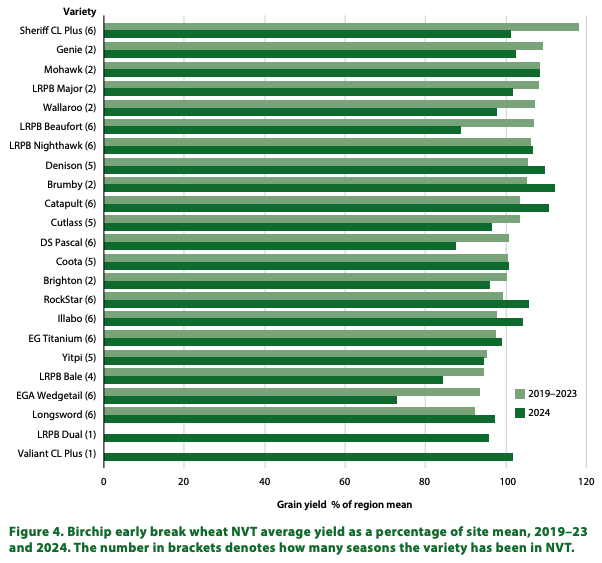
From 2019 to 2023, the top yielding wheat varieties in the early break wheat trial at Birchip have been Sheriff CL Plus, followed by Genie, Mohawk, LRPB Major, and Wallaroo, which have been in the NVT trials for two years. In 2024, the top varieties in terms of percentage of site mean were Brumby (112 per cent), Catapult (111 per cent), Denison (110 per cent) and Mohawk (108 per cent). The new dual‑purpose variety Wallaroo was one of the top performers in 2023, yielding at 107 per cent of the site mean, however it did not perform as well in 2024, yielding 98 per cent of the site mean. This variety is worth monitoring in the coming years to better understand its potential across different seasons.
Commercial Practice and On Farm Profitability
While Clearfield varieties are an important tool in weed management and have a place in rotations, they can often come with a yield penalty. The NVT program aims to manage trials in a best-practice situation which is not reality for growers. When looking at the yield data presented, consider the additional benefits of the herbicide tolerant varieties, and use them where they will have the biggest impact on weed control options. The top yielding Clearfield varieties across all regions are Tomahawk CL Plus, Sunblade CL Plus and Dozer CL Plus. Of these, Sunblade CL Plus is the only one with AH classification; both Tomahawk CL Plus and Dozer CL Plus carry an APW classification. These varieties are all yielding above the long-term region average, with the top Clearfield variety 5–9 per cent below the highest yielding variety in the main season wheat trials.
In years with numerous and severe frost events it is difficult to avoid frost damage, however frost avoidance strategies can be implemented, including variety choice. Targeting the optimal flowering period by sowing varieties within their optimal sowing window to decrease the risk of flowering during high-risk frost periods is important (DPIRD, 2024). This, combined with choosing varieties with different maturity timings to widen the flowering window, will help to reduce risk and minimise losses (GRDC, 2024).
Grain quality data from NVT was not available at the time of compiling this report.
NVT results compromised by frost and drought are not released publicly. They will be made available in the ‘Quarantined trials report’ section of the website <https://nvt.grdc.com.au/trials/quarantined-trial-reports>.
References
GRDC, 2024, National Variety Trials yield data, <https://nvt.grdc.com.au/>. Accessed 16 December 2024.
GRDC, 2024, 2025 Victorian and Tasmanian Crop Sowing Guide, <https://grdc.com.au/resources-andpublications/all-publications/nvt-crop-sowing-guides/vic-tas-crop-sowing-guide>. Accessed 6 January 2025.
DPIRD, 2024, The science of frost and frequently asked questions, <https://www.agric.wa.gov.au/frost/science-frost-and-frequently-asked-questions>. Accessed 6 January 2025.
GRDC, 2024, Crop and variety choice, <https://grdc.com.au/resources-and-publications/resources/frost-management/crop-and-variety-choice>. Accessed 6 January 2025.
GRDC, 2024, Disease Ratings, <https://nvt.grdc.com.au/nvt-disease-ratings>. Accessed 6 January 2025.
Acknowledgements
This trial was conducted through the National Variety Trial (NVT) program delivered by GRDC (BWD2401-002SAX).
This project received funding from the Australian Government’s Future Drought Fund.
Thank you to Harm van Rees, Cropfacts, for providing a technical review of this article.
BCG sincerely thanks Jake and David Lockhart (Balranald), the Watts family (Nullawil), Devon Mill (Hopetoun), Brad Plant (Manangatang), Matt Curtis (Merrinee), Ash and Bec Marshall (Quambatook), Warrick and Baden Grey (Ultima), Mick Pole (Walpeup), Jon Whykes (Charlton), Anthony Lees (Diggora), Karl Beddison (Horsham), Alwyn and Jonathan Dyer (Kaniva), and Geoff Morcom (Warracknabeal) for generously hosting the trial sites and for their support throughout the project.