Take Home Messages
- Patron was the highest yielding durum variety in the 2024 Kaniva NVT, continuing its long-term dominance over other varieties.
- Additional nitrogen application correlated with higher grain protein, however none of the nitrogen treatments tested, differentiated by timing and application rate, resulted in a protein content of 13 per cent (DR1 standard) for Patron.
- The most profitable nitrogen treatment was achieved by Nil nitrogen treated Patron.
Aim
To compare the performance of new and existing durum wheat varieties in the Wimmera NVT, and to identify the best nitrogen management strategy to achieve 13 per cent protein in durum wheat in 2024.
Background
Durum wheat is an important crop for human diets. It stands out from bread wheat due to its firm grain texture and high protein content (Sissons, 2008) and is grown for its excellent cooking qualities and suitability for pasta production (GRDC, 2017). In recent years advances have been made in improving the suitability of varieties for more marginal rainfall environments, with improved disease resistance helping to make it a competitive crop option.
Two key agronomic factors are important for the management of durum wheat: nitrogen (N) input and disease. It’s important that durum growers manage these factors effectively to meet quality standards and attract price premiums, alongside achieving high yields to make it a more profitable option than bread wheat.
The main driver of durum quality is grain protein, meaning it’s critical to get in-season application of N right. Applying N at the time of late flag emergence is shown to positively influence grain protein, however determining the optimal rate of urea to achieve 13 per cent protein for the DR1 standard can be challenging (McDonald and Hooper, 2013).
To support growers in maximising the profitability and quality of durum wheat production, a variety trial and N management trial were conducted. These trials aimed to provide practical guidance on selecting suitable varieties for marginal rainfall environments and determining optimal N application rates for achieving target protein levels.
Trial Details
Crop type/s: Durum wheat
Paddock details: Refer to Table 1
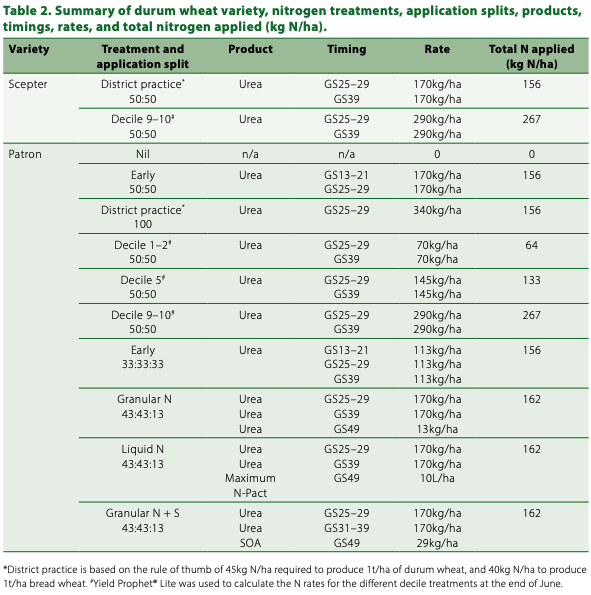
Treatments: Refer to Table 2
Target plant density: 130 plants/m²
Seeding equipment: Knife points, press wheels, 30cm row spacing
Replicates: Three (NVT), Six (N Management)
Method
Both the NVT and N management field trials were sown using a replicated random block trial design. Assessments included emergence scores, leaf tissue tests, head counts, grain yield, and quality parameters for the N management trial. Emergence scores, growth staging at flowering, as well as grain yield and quality parameters data, were collected in the NVT durum variety trial.


Trial Inputs
Fertiliser: Granulock Supreme Z + Flutriafol (400mL/100 kg) @ 60kg/ha at sowing for both trials.
In the durum NVT trial 220kg/ha of urea was applied as a split application (100kg/ha on 28 July (GS14), 60kg/ha on 31 July (GS21) and 60kg/ha on 14 August (GS31)).
See Table 2 for N rate information for the N Management trial. The different rates were applied on 17 July (GS13–21), 19 August (GS25–29), 6 September (GS39), 1 October (GS49).
Nutrition, weeds, insects and disease were managed as per best practice. For individual trial details see: <https://nvt.grdc.com.au/>.
Results and Interpretation
NVT durum varieties
Rainfall in November and December 2023 was significantly higher than the long-term average, while subsequent months generally experienced below-average rainfall, particularly from February to July 2024 (Figure 1). Across both 2024 and the longer term, most varieties performed consistently close to the regional mean, suggesting stability of most varieties over time (Figure 2). Patron was the highest yielding durum variety at Kaniva for the 2024 season, yielding 5.7t/ha and 111 per cent of the site mean. It remains the highest yielding on average between 2019 and 2023. The largest drop in 2024 compared to longer-term data was for DBA Mataroi, which decreased by an average of 7 per cent compared to past years. In contrast, Caparoi increased an average of 5 per cent compared to previous years.


Grain quality (protein) data was not available for the 2024 season at the time of writing this report, however long-term data for each variety is shown in Figure 3. DBA Bindaroi and Caparoi exhibited the highest mean protein percentages over the longer-term, suggesting superior suitability for achieving grain quality standards. On the other hand, Patron showed the lowest protein percentage among the varieties.

Nitrogen management
The starting soil nitrogen (N) at the site was 69kg N/ha to a depth of 100cm. The trial established well, with all treatments achieving an establishment score of 95 per cent. N treatment did not significantly influence the number of heads produced, however there was a significant difference between varieties, as shown in Figure 4, with the trial control Scepter producing 8 heads/m2 more than Patron (data not shown).
There were no significant differences in mean yield between varieties, however there was for N treatment (p = 0.009, LSD = 0.4452) (Figure 3). Yields were generally consistent across most N treatments, ranging from 5.3t/ha to 5.5t/ha, indicating little variation in the effect of treatments. The Patron 33:33:33 N early treatment produced the highest yield, whereas Patron 50:50 N D9–10 produced significantly lower yield than most other treatments, suggesting a negative effect of 267 units of N on grain yields. The high yields produced by the Patron 33:33:33 N early treatment suggest timing played a role in the early development of tillers and grain development.
Figure 5 illustrates the relationship between N application rates (N units/ha) and grain protein percentage across various treatments. As expected, grain protein percentage generally increased with the application of additional N. For example, Patron 50:50 N D9–10, which received 267 units of N, achieved the highest protein percentage (11.6 per cent), while the Patron Nil N treatment, receiving no N, showed the lowest protein percentage (9.8 per cent). These findings emphasise the important role of N management in optimising durum protein content. Despite these findings, however, treatments fell short of producing a level of protein that would meet the DR1 quality standard, which requires a protein content of at least 13 per cent (GrainCorp, 2024). Reasons for this are unclear; longer-term NVT data shows Patron has typically produced lower levels of protein compared to other varieties over time, hence this variety may have a limited response to N input. Considering rainfall throughout most of the 2024 growing season was lower than average, it is also possible that lower rainfall conditions led to lower recovery of N. Research on the link between water deficiency and grain protein in durum is inconsistent and requires further investigation (Flagella et al., 2010).


Commercial practice and On-Farm Profitability
Durum varieties
NVT results provide growers with an opportunity to compare the yield, grain quality, and rating of different varieties over the current year, as well as the previous five years. Growers can use this information as a guide to determine which varieties are performing well for their region.
Despite the higher rainfall in November and December 2023, below-average rainfall from February onwards likely had a substantial influence on crop performance. Patron was the highest-yielding durum variety at Kaniva in 2024, while DBA Mataroi recorded a 7 per cent decline in yield compared to its longer-term average. Although Patron was dominant for yield, it produced the lowest grain protein of all varieties in the trial; instead, the highest grain protein percentages were achieved by DBA Bindaroi and Caparoi.
Nitrogen management
An economic breakdown for each trial treatment is presented in Table 3. The highest partial gross margin (PGM) and gross income were achieved by the Patron Nil N treatment due to the absence of variable costs ($2227/ha for both). Among N application treatments, Patron 50:50 N D1–2 achieved a relatively high PGM ($1218/ha) with moderate N input (64 units), demonstrating a cost-effective balance between yield and input expenses. In contrast, treatments with higher N rates (for example, Patron 50:50 N D9–10 and Scepter 50:50 N BW D9–10) generated significant negative PGMs due to high variable costs, despite producing comparable or slightly higher yields. The highest yield (5.8t/ha) was achieved with Patron 33:33:33 N early treatment, but its PGM was only $44/ha due to high input costs. Data indicates the risk of diminishing financial returns with higher N inputs, suggesting lower to moderate N rates may optimise profitability while maintaining yields in this environment under conditions similar to the 2024 growing season.

References
Flagella Zina, Marcella M Giuliani, Luigia Giuzio, Chiara Volpi, and Stefania Masci, 2010, European Journal of Agronomy, ‘Influence of water deficit on durum wheat storage protein composition and technological quality’, 33: pp 197–207.
GrainCorp, 2024, ‘Durum Standards 2024–2025’, Accessed 23 January 2025. <https://grains.graincorp.com.au/wp-content/uploads/2022/10/Durum-Standards-2024_25.pdf>
GRDC, 2024, NVT Disease Ratings, Accessed 23 January 2025. <https://nvt.grdc.com.au/nvt-disease-ratings>
GRDC, 2014, ‘Durum quality and agronomy fact sheet’, Accessed 10 January 2025. <https://grdc.com.au/__data/assets/pdf_file/0030/165936/final-durum-quality-and-agronomy-fact-sheet-lr-pdf.pdf.pdf>
NSW Department of Primary Industries, 2024, ‘Winter crop variety sowing guide’, Accessed 23 January 2025. <https://www.dpi.nsw.gov.au/__data/assets/pdf_file/0003/1546050/2024-WCVSG-V1-WEB22Mar24.pdf>
Sissons Mike, 2008, ‘Role of durum wheat composition on the quality of pasta and bread’, Food, 2: pp 75–90.
Acknowledgements
This research was funded by GRDC through the National Variety Trial program as well as the Southern Australia Durum Growers Association (SADGA) and BCG members through their membership.
BCG sincerely thanks Alwyn and Jonathan Dyer for generously hosting the trial sites and for their support throughout the projects.