Take Home Messages
- CBA Captain was the highest yielding desi chickpea variety in both the Mallee and Wimmera.
- PBA Royal was the highest yielding kabuli chickpea variety in both the Mallee and Wimmera.
- PBA Jurien was the highest yielding variety of lupin.
Aim
To compare the performance of chickpea and lupin varieties in the Mallee and Wimmera regions.
Background
Chickpeas are a high value pulse crop well suited to medium rainfall areas of south-eastern Australia, they are used mainly for human consumption (Pulse Australia, 2015). Chickpeas generally leave less fixed nitrogen (N) behind for the following year’s crop compared to other legumes such as lentils and field peas (GRDC, 2018), however, they are still an important break crop in the Mallee and the Wimmera, particularly for the management of disease.
Lupins are a high protein legume often grown for on-farm livestock feed or sold to livestock feed manufacturers (Agriculture Victoria, 2024). Although lupin consumer markets are relatively small in comparison to other grains, Australia is the world’s largest producer of lupins and there is interest in growing this legume as an additional protein source for consumption in the future (CSIRO, 2024). Long-term regional comparison of varieties is therefore important for enabling growers to assess the most suitable option for their cropping systems.
The 2024 season began with much of the Wimmera and Mallee receiving high summer rainfall resulting in reasonable levels of available subsoil moisture. This led to growers starting off with an optimistic outlook for the year. However, the high rainfall did not continue, creating a challenging season for growers. The first challenge occurred with a later than ideal break in late May, which was variable and came in small amounts, causing patchy germination.
Throughout the season there were long periods of insufficient rainfall, as well as severe frost events at critical periods of grain formation. It should also be noted that October rainfall was generally ineffective at many of the sites as it occurred late in the month after crops had matured. Several trials were abandoned or quarantined in the 2024 NVT program because of these challenges.
This report presents results from the chickpea and lupin National Variety Trials (NVT) in the Mallee and Wimmera for the 2024 season. NVT data provides a snapshot of the performance of different varieties in different years/seasons. Growers can then use this information to guide cropping decisions. It is important to consider these results in the context of the season experienced, as results are presented from a single year.
Trial Details
Crop type/s: Desi and kabuli chickpea varieties; narrow leaf lupin varieties.
Target plant density: Desi chickpea 35 plants/m², kabuli chickpea 30 plants/m², lupins 45 plants/m²
Seeding equipment: Knife points, press wheels, 30cm row spacing.
Sowing date: Refer to Table 1
Replicates: Three
Paddock Details

Trial Inputs
Nutrition, weeds, insects, and disease were managed as per best practice.
Method
This research was conducted through the NVT program funded by the Grains Research and Development Corporation (GRDC). A series of replicated field trials was established in the Wimmera and Mallee to compare varieties of desi and kabuli chickpeas, as well as narrow leafed lupins. Grain yield and quality were assessed. The data displayed in this article is a combination of NVT results and multi-environment trial analysis (MET) long-term summaries; quality data was not available at the time of writing this report. Grain yield data is presented as a percentage of the site mean for the 2024 yield results and long-term averages.
Growers should use the MET analysis when comparing varieties as this encompasses more data over multiple seasons and is therefore more reliable. MET analyses and single site summaries can be found at <https://nvt.grdc.com.au/trials/results>.
Results & Interpretation
As a result of the season experienced, and some trials being abandoned or quarantined, yield data was only obtained from one site in each region for both desi and kabuli chickpeas. Yield data for lupins was only obtained from one site in the Mallee and was not available for the Wimmera. Caution should be taken when comparing the region averages of these crop types in 2024 as they are only from one trial site. Tables 2, 3, and 4 display this information.
Desi chickpeas
A region average of 1.32t/ha was recorded in the Mallee (Birchip) (Table 2). An average yield of 0.99t/ha was recorded in the Wimmera (Horsham). The Rainbow and Kaniva trials were abandoned.

In the Mallee, CBA Captain was the highest yielding variety at 110 per cent of the region mean in 2024 (Figure 1), possibly due to its more erect plant type and good-height-to-lowest-pod (SARDI, 2024). These traits provide easier harvesting, which has an impact because low biomass growth which was experienced this season inhibits grain collection by headers. This hypothesis should be supported with further data in the future. All other varieties produced relatively similar yields, which were lower than the site mean. Long-term data indicate PBA Striker has been a higher yielding variety for the past five years, however, this was not the case in 2024.

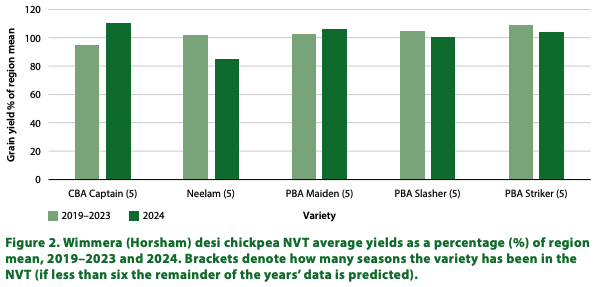
CBA Captain was also the highest yielding variety in the Wimmera, at 110 per cent of the region mean in 2024 (Figure 2). Neelam was the lowest yielding variety at 85 per cent of the region mean. Long‑term data shows Neelam’s yield has typically been more comparable to other varieties, unlike in 2024 when it lagged significantly. Conversely, the CBA Captain variety, which usually ranks at the lower end of yields, outperformed others and recorded the highest yield in 2024. As proposed in the Mallee findings, CBA Captain’s advantage this year might have been due to its more erect plant type, easing harvest operations.
Kabuli chickpeas
A region average of 1.18t/ha was recorded in the Mallee (Birchip) for kabuli chickpeas in 2024 (Table 3). In the Wimmera (Horsham), the region average was 0.91t/ha. Rainbow and Kaniva trials were abandoned.

Almaz and PBA Royal were the highest yielding varieties in the Mallee in 2024 at 107 and 109 per cent of the region mean, respectively (Figure 3), contrary to long-term data which shows Almaz as a lower yielding variety. However, Almaz has only been in the NVT for five seasons, so the remainder of the years’ data is predicted. PBA Monarch was the worst performer, achieving only 89 per cent of the region mean. PBA Royal has been a consistently high yield performer over the longer-term, and this continued in 2024. PBA Magnus has also been a high performer in past years and yielded close to the region mean this year. Like Almaz, PBA Magnus has only been in the trials for five years so remaining years’ data is predicted.

In the Wimmera, the highest yielding variety of kabuli chickpea was PBA Royal at 115 per cent of the region mean (Figure 4). PBA Magnus and Genesis 090 were the next two highest yielding varieties, while PBA Monarch yielded the lowest at 84 per cent of the region mean. Both PBA Royal and Genesis 090 have been strong performers against the other varieties over the longer-term and continued that performance in 2024. Comparing 2024 data to the long-term data, PBA Magnus performed better than it has in past years.

Narrow leafed lupins
A region average yield of 1.18t/ha was recorded in the Mallee (Hopetoun) for lupins in 2024 (Table 4). Yield data was obtained from one site, as the sites at Walpeup and Telopea Downs were quarantined.

PBA Jurien was the highest yielding variety of lupin in the Mallee, achieving 126 per cent of the region mean (Figure 5), and has been a high performer since 2019. The lowest yielding varieties were Rosemont (82 per cent of the region mean) and PBA Bateman (87 per cent). PBA Bateman has been a high performing variety since 2019, however, this season it was well below the average for the region.

Commercial Practice and On Farm Profitability
NVT is conducted primarily to compare variety performance in terms of yield potential under the same regional growing conditions, and this needs to be repeated over several seasons to ensure findings are robust. As such, growers should consider how many years of data is available when considering a variety.
Furthermore, growers should assess the variables of their own farming systems, such as rainfall, nutrition, disease, and soil constraints, and consider this information in conjunction with NVT data.
Several factors should be considered when choosing a chickpea or lupin variety. Aside from yield, the main factors to examine are flowering time, maturing time, seed size, herbicide tolerance, and disease resistance ratings. It is important to match the characteristics of a variety to the environment in which it is to be grown for mitigating risk, whilst maximising the benefits. For example, an early flowering and early maturing variety will be better suited to short growing season environments and will likely perform better than later flowering and maturing varieties grown under the same conditions.
Chickpeas
Chickpeas are a high value crop and can be profitable under the right seasonal conditions. Chickpeas are also an effective break crop for cereal-based farming systems.
Ascochyta blight is one of the key diseases affecting this crop. According to NVT data, chickpeas are moderately susceptible to this disease (GRDC, 2024). Growers should consider whether it is more beneficial to select a higher yielding variety rather than focus on marginal increases in disease resistance, however this should be discussed with an experienced advisor.
Lupins
Lupins are grown as break crops and mainly used as stock feed. They offer growers the opportunity to diversify crop rotations, whilst controlling disease and fixing soil nitrogen. Many of the higher yielding varieties also show higher resistance ratings to diseases such as anthracnose, cucumber mosaic virus and phomopsis (GRDC, 2024). Lupins have poor crop competition compared to other legumes, and limited options for post-emergence broad leaf control. Several varieties in the NVT trials are tolerant to metribuzin, which is an important consideration for agronomic management. For example, selecting PBA Bateman over Jenabillup provides the benefit of metribuzin tolerance, whilst maintaining yield potential.
Site results unavailable at the time of writing this report will be published within the ‘Quarantined trial reports’ section of the NVT website <https://nvt.grdc.com.au/trials/quarantined-trial-reports>.


References
Agriculture Victoria, 2024. Growing grains, pulses and cereals <https://agriculture.vic.gov.au/crops-andhorticulture/grains-pulses-and-cereals/growing-grains-pulses-and-cereals>, accessed 16/01/2025.
Agriculture Victoria, 2024. Growing lupin in Victoria <https://agriculture.vic.gov.au/crops-andhorticulture/grains-pulses-and-cereals/growing-grains-pulses-and-cereals/growing-lupin-in-victoria>, accessed 16/01/2025.
CSIRO, 2024, Next generation lupins <https://www.csiro.au/en/about/challenges-missions/futureprotein-mission/plant-protein-production/about-lupins>, accessed 16/01/2025.
GRDC, 2024, 2024 Victorian and Tasmanian Crop Sowing Data Summary, <https://nvt.grdc.com. au/__data/assets/pdf_file/0024/595221/240318-2024-Vic-and-Tas-crop-sowing-data-summary-1. pdf?utm_source=website&utm_medium=download_button&utm_campaign=pdf_download&utm_ term=South&utm_content=Victorian%20and%20Tasmanian%20Crop%20Sowing%20Guide%20 Data%20Summary>, accessed 16/01/25.
GRDC, 2024, NVT Disease Ratings <https://nvt.grdc.com.au/nvt-disease-ratings>, accessed 16/01/2025.
GRDC, 2024, National Variety Trials yield data <https://nvt.grdc.com.au/>, accessed 16/01/2025.
Pulse Australia, 2015, Best management guide Chickpea production: southern and western region, <https://www.pulseaus.com.au/growing-pulses/bmp/chickpea/southern-guide>, accessed 16/01/2025.
Seymour N., McKenzie K., Krosch S., 2018, 2018 GRDC Update ‘How much nitrogen is fixed by pulse crops and what factors affect fixation?’ <https://grdc.com.au/resources-and-publications/grdc-updatepapers/tab-content/grdc-update-papers/2018/03/how-much-nitrogen-is-fixed-by-pulse-crops-andwhat-factors-affect-fixation>, accessed 16/01/2025.
Acknowledgements
This research was funded by GRDC as part of the National Variety Trials program (BWD2401-002SAX). This project received funding from the Australian Government’s Future Drought Fund.
Thank you to Dr Yolanda Plowman, BCG, and Dr Jason Brand, Frontier Farming Systems, for providing a technical review of this article.
BCG sincerely thanks the Watts family (Nullawil), Brett Fisher (Rainbow), Devon Mill (Hopetoun), Ross Stone (Walpeup), Jason Pymer (Horsham), Ben Crouch (Kaniva), and Michael Norton (Telopea Downs) for generously hosting the trial sites and for their support throughout the project.