Take Home Messages
- Goldie was the top yielding oat variety in the North Central region in 2024.
- The top yielding varieties in the Wimmera in 2024 were Bannister and Echidna.
- The top yielding varieties long-term in the North Central have been Koala, Bannister, and Goldie, which only includes four years of data.
Aim
To compare the performance of new and existing oat varieties in North Central and Wimmera NVT.
Background
The 2024 season began with high January rainfall across much of the North Central and Wimmera. This weather pattern did not continue, and by April and May, many farmers were deliberating the best approach to their sowing program: whether to sow dry, or wait for the break to come. Many growers across the regions started dry sowing in April and some National Variety Trials (NVT) were also sown dry.
Oats have a variety of end-uses, including grain for human consumption (milling) and as animal feed, or oaten hay. Oats with a range of end-uses are included in the NVT trials however no hay quality assessments were undertaken. The results presented below include only grain yield.
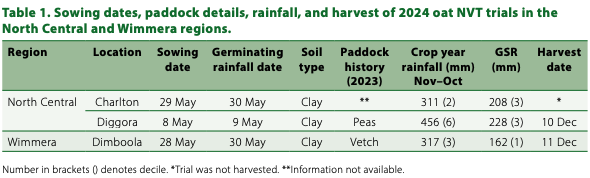
In 2024, BCG established three oat variety trials: two in the North Central and one in the Wimmera. These trials were about 15 per cent breeding lines and the rest released varieties.
The combination of NVT data, individual site reports, and multi-environmental trial analysis (MET) long-term data provides a useful tool for growers to determine which varieties are performing well and may be suitable for their farming system.
Trial Details
Crop type: Oat, refer to Figures 1–2 for varieties.
Target plant density: 160 plants/m2
Seeding equipment: Knife points, press wheels, 30cm row spacing
Replicates: Three
Nutrition, weeds, insects and disease were managed as per best practice. For individual trial details see <https://nvt.grdc.com.au/>.
Method
This research was conducted through the NVT program delivered by GRDC. The program involves a series of replicated field trials designed to test varieties from different crop types in different locations. These trials aim to maximise genetic potential yield, rather than profitability. The sites receive multiple fungicide applications and are managed to ensure they are not nitrogen limited, to avoid confounding factors when assessing the genetic potential of varieties. The data displayed in this article are a combination of NVT results, individual site reports and multi-environmental trial analysis (MET) long‑term summaries. Variety performance is presented as the grain yield percentage of the site average, with MET data indicating performance in 2024, relative to the previous five years (2019–2023).
Results & Interpretation
New varieties released in 2024
Minnie is a high yielding grain oat from Intergrain. It has a mid-to-slow maturity, similar to Bannister. Its short-to-medium plant height improves lodging tolerance and harvestability, but may make it unsuitable as a dual-purpose variety. This variety has been released in Western Australia, but will not be available in the eastern states until 2026.
Yield Results


For the North Central trials, the only data available for 2024 are from the Diggora site (Figure 1). The top yielding varieties from 2019 to 2023 are three milling/hay varieties: Koala, which yielded 109 per cent of the region mean, followed by Bannister and Goldie, at 107 per cent. Milling varieties Bilby, Minnie, and Williams, and the hay variety Archer, all yielded 102 per cent of the region mean in the long-term data. Echidna, the milling/feed grain variety, also yielded well at 103 per cent of the region mean. In 2024, Goldie was the standout variety, yielding 124 per cent of the site mean for Diggora. Other milling/hay varieties, Bannister and Koala performed well, at 112 per cent of the site mean. Milling variety Minnie was the other top yielding variety at Diggora in 2024, yielding 114 per cent of the site mean.

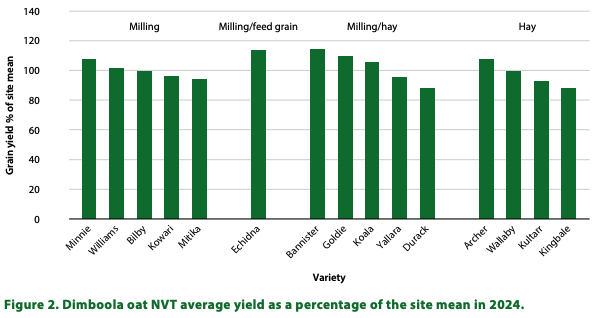
As the first year of oat trials in the Wimmera region, there is no long-term data to compare with 2024 results, so interpret these results with caution because they do not represent a variety’s performance over different seasonal conditions. Of the 15 varieties, five are milling varieties, one is milling/feed grain, five are milling/hay and four are hay varieties (Figure 2). For this range of end-uses, grain yield is the data being collected in this trial. Two of the milling varieties yielded above the site mean: Minnie (107 per cent) and Williams (101 per cent). The only milling/feed grain included in the trial was Echidna, which was the second highest yielding in the trial at 113 per cent of the site mean. The top yielding dual-purpose varieties as a percentage of the site mean were Bannister (114 per cent), Goldie (109 per cent), and Koala (105 per cent). Archer, a hay oat, was among the top yielding varieties at 107 per cent of the site mean for grain yield.
Commercial Practice and On Farm Profitability
Global demand for milling oats continues to grow as the population becomes more health conscious and seeks alternative grains with added nutritional benefits. The markets for oat milk, oat noodles, and oat healthcare products are also on the rise, helping to increase the export oat market. Compared with feed oats, milling oats have a $60/t advantage across all regions (The Weekly Times, 2024).
Oats can be a lower risk crop when compared with other options. Selecting a dual-purpose oat variety can be a good way to spread risk on the farm. It can support decision making during the year based on seasonal conditions, and provide an alternative market for hay, if necessary. This allows growers to evaluate which is more profitable: cutting for hay or harvesting the grain. Oats also have a lower frost risk when compared with wheat and barley. If frost is a concern, consider zoning property based on frost risk, and choosing a lower risk crop such as oats for zones identified as high risk.
Grain quality data from NVT was not available at the time of compiling this report.
NVT results were compromised by frost and drought are not released publicly. They will be made available within the ‘Quarantined trials report’ section of the website <https://nvt.grdc.com.au/trials/quarantined-trial-reports>.
References
GRDC, 2024, National Variety Trials yield data, <http://nvt.grdc.com.au/>. Accessed 9 January 2025.
GRDC, 2024, 2025 Victorian and Tasmanian Crop Sowing Guide, <https://grdc.com.au/resources-andpublications/all-publications/nvt-crop-sowing-guides/vic-tas-crop-sowing-guide>. Accessed 9 January 2025.
GRDC, 2024, Disease Ratings, <https://nvt.grdc.com.au/nvt-disease-ratings>. Accessed 9 January 2025.
DPIRD, 2024, Western Australian oat industry, <https://www.agric.wa.gov.au/hay-production/westernaustralian-oat-industry>. Accessed 9 January 2025.
Agriculture Victoria, 2024, Growing oats in Victoria, <https://agriculture.vic.gov.au/crops-andhorticulture/grains-pulses-and-cereals/growing-grains-pulses-and-cereals/growing-oats-in-victoria>. Accessed 9 January 2025.
GRDC, 2024, GrowNotes, ‘Oats Section 2 Pre-planting’, <https://grdc.com.au/__data/assets/pdf_file/0023/370562/GrowNote-Oats-West-02-Pre-planting.pdf>. Accessed 9 January 2025. GRDC, 2022, 2022
GRDC Update ‘Growing a future for oats’, <https://grdc.com.au/resources-andpublications/grdc-update-papers/tab-content/grdc-update-papers/2022/03/growing-a-future-foroats>. Accessed 9 January 2025
Acknowledgements
This trial was conducted through the National Variety Trial (NVT) program delivered by GRDC (BWD2401-002SAX).
This project received funding from the Australian Government’s Future Drought Fund.
Thank you to Harm van Rees, Cropfacts, for providing a technical review of this article.
BCG sincerely thanks Jon Whykes (Charlton), Anthony Lees (Diggora), and John Polack (Dimboola) for generously hosting the trial sites and for their support throughout the project.