This research has been superseded by “Using sowing direction and row spacing for weed management in the Mallee”
TAKE HOME MESSAGES
- Yields were increased by 0.4t/ha (15%) in barley and 0.2t/ha (10%) in wheat at Horsham in 2014 by sowing east/west. Sowing direction did not alter grain quality.
- Varietal characteristics (maturity, height and growth habit) were not found to influence the yield response.
- Similar findings have been found in NSW, in the presence of weeds, and WA, with or without weeds.
BACKGROUND
Since the adoption of GPS guided operations, and the move away from a circular progression around the paddock, the sowing direction used is commonly determined by the shape of that paddock. This is due to the preference for long runs, which require fewer turns, thus making operations more time-efficient. Previous research carried out in Western Australia showed that an east/west orientation allowed the crop to intercept 30% more light, resulting in higher yields than crops sown in a north/south direction. This also had a direct impact of weed biomass as less light was available for the weeds lower in the canopy. Although a lot of the work done in WA was in the presence of weeds, they also found in a weed free situation that wheat and barley yields were 24-30% higher when sown east-west which was largely attributed the 11-18% higher water content measured in the inter-row of east/west crops at late flowering ( Pathan et. al., 2006 ).
Research carried out in NSW also demonstrated the benefit of east/west sowing on weed competition, with a 40% reduction in weed biomass production. However, in the absence of weeds, north/south sowing out-yielded east/west by six to seven percent in what could be deemed a higher yielding environment (Gardner et. al., 2013 ).
This variation in results, and the lack of work carried out in Victoria, led to the establishment of a trial in Horsham to investigate the impact of sowing direction on wheat and barley yields, but in the absence of weeds.
AIM
To determine whether sowing direction influences wheat and barley grain yields in the southern grains region.
TRIAL DETAILS
Location: Horsham
Soil type: Clay – with sub soil constraints
GSR (Apr-Oct): 172mm
Crop types: Barley – Fathom, La Trobe, Oxford, Westminster Wheat – Grenade CL Plus, LRPB Lancer, LRPB Phantom, Shield
Sowing date: 16 May
Seeding equipment: Knife points, press wheels, 30cm row spacing
Target plant density: 130 plants/m²
Harvest dates: 13 November (barley) and 28 November (wheat)
Trial average yield: 2.8t/ha barley, 1.9t/ha wheat
TRIAL INPUTS
Fertiliser: Granulock Supreme Z @ 50kg/ha at sowing followed by urea @ 90kg/ha applied at GS14 and GS37 (total 180kg/ha).
Pests and weeds were controlled to best management practice.
METHOD
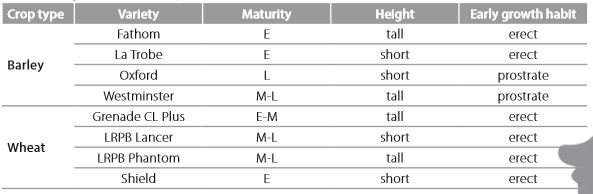
Wheat and barley varieties were sown in a complete randomised block design (Table 1) with 36m long plots, sown north/south and east/west, with each block being replicated four times. The varieties were specifically chosen so that a variation in maturity and height could be assessed for each crop (Table 1.). Biomass assessments were taken at flowering in each variety. Crop biomass was measured using normalised difference vegetative index (NDVI) at GS32 and GS65 with a hand held GreenSeeker® crop sensor. Grain yield was measured with a plot harvester and grain analysis (protein, moisture, test weight and screenings) was completed on all grain samples.
Table 1. Crop details of barley and wheat varieties used in this trial.
RESULTS AND INTERPRETATION
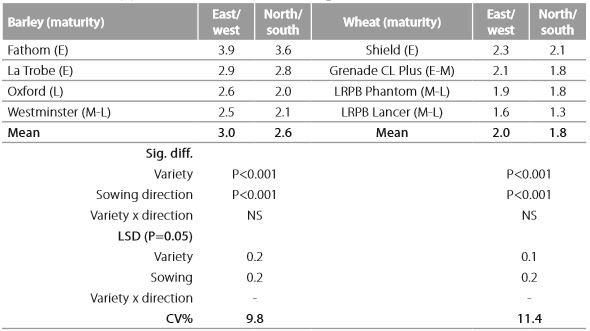
Barley yields for the east/west sown crops were significantly higher (on average 0.4t/ha) than their north/south sown counterparts with La Trobe the only variety not showing a significant yield difference as a result of sowing direction (Table 1). Wheat had a similar result to barley, with yields from east/west sowing increasing by an average of 0.2t/ha (Table 2). In both cases however, all varieties behaved the same with sowing direction (a yield decline for north/south), and as such there is no interaction, meaning the growth habit or maturity of the varieties did not change how strongly they were influenced by sowing direction.
A potential explanation for why east/west sowing out-yielded north/south so significantly in both wheat and barley may lie in the limited rainfall and dry spring conditions experienced in 2014 at the Horsham site. East/west sown crops would have the ability to shade the inter-row more effectively, which may have meant the inter-row area remained cooler and therefore retained more moisture later into the season. This additional moisture could then be transferred into extra yield. This correlates strongly to work carried out in WA ( Pathan et. al., 2006 ).
The different maturities of varieties used significantly influenced their yield potential. In the case of this trial, the earlier the crop matured, the greater the yield (Table 2). This is a reflection on the season. It also helps explain why the barley did so much better than wheat.
Grain quality was not affected by sowing direction in both wheat and barley, although later maturing wheat varieties had higher screenings (P<0.001).This is a reflection of the season rather than sowing direction.
In a mid-season (GS32) assessment sowing direction directly affected the growth of barley. NDVI readings showed that the east/west plots had a higher biomass than the north/south. This early advantage in growth could also help to explain the yield advantage, however, by flowering, sowing direction did not result in greater biomass in either wheat or barley.
Table 2. Mean barley yield for each variety and sowing direction (t/ha).
COMMERCIAL PRACTICE
In this trial, sowing either wheat or barley east/west increased yields by up to 15% in barley and 10% in wheat.
When sown east/west, shading/cooling of the inter row could translate into a yield benefit in a season with a dry finish by helping moisture conservation. In addition, east/west sowing may also allow the crop to achieve greater light interception and be more competitive with weeds.
It is however important to note that not a lot of work on sowing direction in broadacre crops has been done in our environment. The variation in results between this trial and those conducted elsewhere highlights that there is merit in carrying out further work. This should be done both in the presence and absence of weeds and in different yield environments, to determine if results are repeatable over varying seasons and in a more southern environment like the Wimmera.
ON-FARM PROFITABILITY
Before changing the direction in which paddocks are sown, it is important to take into consideration the length of the paddock, as it may not be economical to change current practice. More turning can result in increased fuel consumption and lengthen sowing time, which in turn extends the sowing window, increasing the crop’s exposure to heat stress in spring. Weed populations and burdens in the paddock should also be considered: changing the sowing direction could be an option as a weed suppression method independent of herbicides.
REFERENCES
Gardner, M.; Mortell, P.; Morphett, S. (2013). Using row orientation, row spacing and variety selection as weed management tools – Bithramere 2012. Northern Grains Region Trial Results 2013.
Pathan, S.; Hashem, A.; Wilkins, N.; Borger, C. (2006) East-west crop row orientation improves wheat and barley grain yields. Agribusiness crop updates. The University of Western Australia.
ACKNOWLEDGEMENTS
This project was jointly funded through the GRDC’s ‘Advancing Profitable Farming Systems’ (BWD00024) project and Agritech Rural, Horsham.