

The BCG team have been busy taking dry matter assessments to coincide with widespread hay cutting occurring across the Wimmera and Mallee.
With the help of a drying oven or two, we have been able to ‘bale up’ the preliminary yield results for you.
A trial was established at Curyo in the Southern Mallee with funding from BCG members and AgriFutures, looking at hay production across different sowing times and varieties.
Targeting export quality hay, the trial was sown to target 320 plants/m2 using splitter boots which equated to a sowing rate of 100-160kg/ha depending on seed size.
Varieties chosen for the trial ranged from newly released to longstanding with differences in maturity and typical end use purpose (Table 1).
Table 1. Variety characteristics (source: 2021 Victorian Winter Crop Sowing Guide)
| Variety | Maturity | End use | Height |
| Bannister | Mid | Milling | Tall dwarf |
| Brusher | Early Mid | Hay/Grazing/Feed grain | Tall |
| Carrolup | Early Mid | Milling | Mid tall |
| Durack | Early | Milling | Tall |
| Koorabup | Early Mid | Hay | Mid tall |
| Mulgara | Early Mid | Hay/Feed grain | Tall |
| Wintaroo | Mid | Hay/Grazing | Tall |
| Yallara | Early Mid | Milling | Mid tall |
The first sowing time was 5 May and the second sowing time was 28 May. Cuts were taken at “beer can” height from plots at growth stage Z71 (just after flowering).
Results
Analysis of yields showed a significant difference between varieties (Figure 1). Wintaroo yielded highest, averaging 8.2t/ha, followed by Yallara, Koorabup and Mulgara.
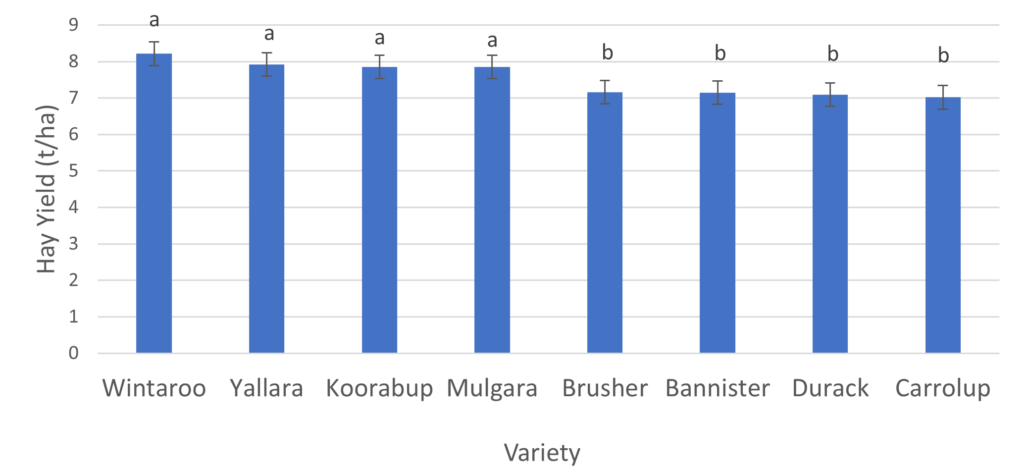
Figure 1. Curyo mean hay yield (t/ha) across two sowing times by variety. Error bars indicate LSD. Var P<0.001, LSD 0.6t/ha, CV 8.5%
Yield results showed no significant interaction between sowing time and variety treatments suggesting that time of sowing had no impact on varietal performance (Table 2). However, there was an average yield benefit of 1.2t/ha from sowing earlier. Early May yields averaged 8.1t/ha across varieties, while end of May yields averaged 6.9t/ha (TOS P<0.001, LSD 0.3t/ha).
Table 2. Hay yield (t/ha) and cut date of varieties at different sowing times. TOS x Var P=0.378, NS
| Variety | TOS1 | TOS2 | ||
| Hay yield (t/ha) | Cut date | Hay yield (t/ha) | Cut date | |
| Bannister | 8.0 | 25-Sep | 6.3 | 5-Oct |
| Brusher | 7.6 | 21-Sep | 6.8 | 5-Oct |
| Carrolup | 7.6 | 21-Sep | 6.5 | 5-Oct |
| Durack | 8.1 | 14-Sep | 6.1 | 25-Sep |
| Koorabup | 8.3 | 25-Sep | 7.4 | 5-Oct |
| Mulgara | 8.7 | 21-Sep | 7.0 | 6-Oct |
| Wintaroo | 8.3 | 29-Sep | 8.1 | 7-Oct |
| Yallara | 8.5 | 21-Sep | 7.3 | 5-Oct |
In addition to yield data, BCG has collected measurements on plant heights, lodging and the effects of PGR application. Quality assessments are now underway.
At the time of writing, we are also cutting oaten hay in the Wimmera as part of the Agrifutures funded National Oaten Hay Agronomy project.
We look forward to sharing these results in the 2020 BCG Season Research Results publication early in the new year.
The National Oat Breeding Program – Oat Breeding Newsletter for 2020 has been released and will be available on their website.