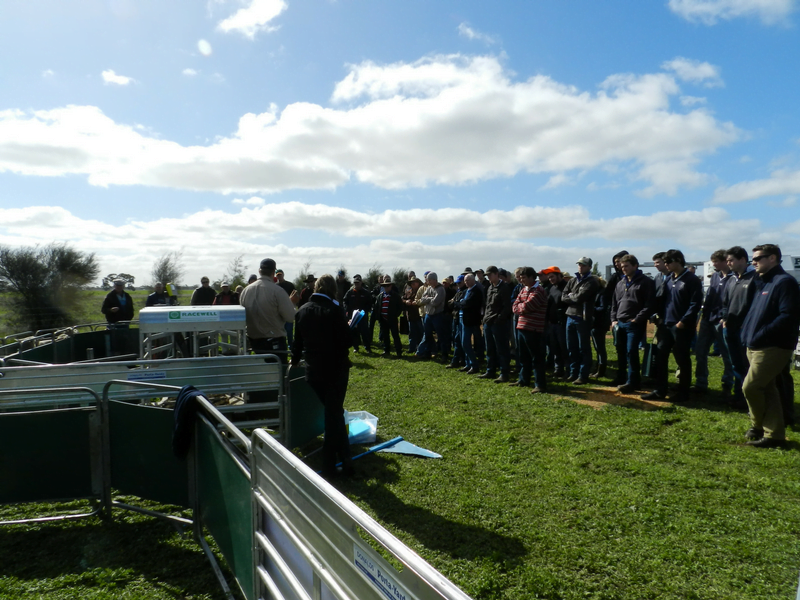

At the recent BCG Main Field Day near Birchip, farmers heard how using electronic identification (eID) systems and data driven decision making is helping producers like Cam Nicholson, Joel Donnan, and Tim Johnson working with clients, turn information into action to manage genetics, growth, and profitability.
Using eIDs for wool management
Cam Nicholson shared how eIDs have become a powerful tool for monitoring wool quality and productivity within his flock. “We’ve been using eIDs to track fleece weights, micron, and staple length for each animal,” he said. “It’s given us a clearer picture of which bloodlines are producing the wool we want.”
Cam emphasised the importance of using the data to guide decisions rather than collecting it for the sake of it. “It’s easy to get lost in the numbers,” he admitted. “But when you can match an animal’s eID to its wool test and see the results over time, that’s when you start making real progress.”
“When we first started, fleece weights ranged from 2.5 to 6.5 kilos and bodyweights from 30 to 55 kilos – differences you’d never pick by eye,” he said. “Now we can see which animals are truly performing.”
Over five years, this flock has gained about 5% in productivity each year, effectively doubling profitability in a decade. Weaning rates have also lifted from 90% to 125% by applying selection pressure on fertility and other key traits. “In dry years, we just run them through and draft off the best. It’s one of the most powerful tools we’ve got. You start to see the gap between your best and average performers – and you can actually do something about it.”
Building better meat flocks through data
Anden Stud at Woomelang breeds White Suffolk and UltraWhite rams, running both stud and commercial operations. While the commercial flock provides a solid production base, Joel Donnan explained that the stud work is where real progress is made through genetic selection and data use.
“Within our stud breeding enterprise, we collect a lot of data,” he said. “But it’s how we use it that gives us the most benefit.
Using eID tags, Joel can now link growth rates, muscle and fat measurements, and breeding records directly to individual animals. This allows him to calculate Australian Sheep Breeding Values (ASBVs), a measure of an animal’s genetic potential.
Joel explained that eIDs make it easier to match genetic data with on-farm performance. “We can see which sires are producing the lambs that grow fast and convert feed efficiently,” he said. “That means we can make breeding decisions based on facts, not just visual assessment.”
A simple on farm trial
To demonstrate, Joel shared a small scale trial comparing two sires; one with higher growth ASBVs and one lower, over a mob of commercial Merino ewes. The lambs were tagged, recorded, and managed identically to ensure accurate comparisons.
Weaning weights and follow-up weights were taken 54 days apart. The eID system allowed every animal’s performance to be tracked and analysed automatically.
“We can see daily weight gains from one mob versus the other based on sire genetics,” Joel said. “Without eIDs, they’d all look the same but the data shows which animals are really performing.”
The results were striking. Lambs sired by the higher-growth ram averaged 3.7 kg heavier than those by the lower-growth sire. Converted to carcass weight, that equated to a 31 kg total gain across 47 lambs, roughly $311 extra in returns at $10/kg. Scaled up to 1,000 lambs, that’s a $6,600 difference simply by choosing the right ram.
“It shows how data like ASBVs and eIDs help us make genetic and economic gains we couldn’t see before,” Donnan said.
From data to decisions: The BreedELITE approach
Tim Johnson, co-founder of BreedELITE, emphasised that while technology is powerful, it only delivers value if it drives better decisions.
“eID tech and data provide zero potential if they’re not used to make decisions,” he said. “Otherwise, it just becomes an expensive paperweight in the shed.”
Tim encouraged producers to think of data collection as part of a system, starting from what is question (the goals), through to collection, then collation, and finally a decision to act on. The key is to start with clear goals, usually, identifying the most profitable sheep.
A good system, he explained, should save time, stress, and money – not create more work. It enables producers to “do more with less” – more with the same labour, land, and flock, often with lower input costs.
Quality data and simple systems
The session outlined several principles for effective data use:
- Collect good data – decisions are only as strong as the information behind them.
- Keep it all in one place – think about integration across tools. If possible, avoid the chaos of separate tag, scale, and software systems.
- Record individual animal data – not just mob averages – to track lifetime performance.
- Ensure data is comparable – animals must be managed the same way for fair comparisons.
- Look at multiple traits – growth, reproduction, wool, and more – to reveal real profit trends.
Decision areas for profit
Tim described three main decision areas that data can improve;
- Selection – objective selection and culling decisions, choosing which rams or ewes to breed from
- Breeding – determining pairings to advance genetic goals, and track growth and productivity accurately to identify the most profitable animals and genetics.
- Management – making feeding, health, and culling decisions. Improve efficiency and profitability without increasing input costs.
The ultimate goal is to exploit flock variability. Even in seemingly uniform mobs, the most profitable animals can outperform the least by 150-300%. Identifying and breeding from those top performers can transform farm profitability without increasing input costs.
He posed a simple question: “What if every sheep was as good as your top 30%?” The answer, he said, is potentially tens of thousands of dollars in extra profit, straight to the bottom line.
Scaling up without the headaches
Tim also noted that while farmers can achieve genetic and production gains without eIDs, technology makes it far more efficient. The key is to choose systems that can grow with the business and not lock producers into limited hardware or software.
“There’s never a perfect time to start,” he said. “Just pick a date – say marking time – and commit. Even if you’re just collecting data at first, it becomes an insurance policy for the future.”
He likened inefficient systems to “pulling a cart with square wheels.” A small adjustment, like introducing eID-based weighing or drafting, can lift productivity or labour efficiency by 30-40% almost immediately.
Practical tips for producers
Tim’s practical advice for anyone starting out:
- Start simple – measure one or two traits first.
- Trial before you buy – test systems on your own farm to see what suits.
- Focus on goals – know what decisions you want to inform.
- Store data securely and centrally.
Bringing it back to farm profitability
Joel’s own trial illustrates how this works in practice. Using eIDs and ASBVs, he could prove a measurable production advantage from one sire line over another – something invisible to the naked eye.
By using accurate data and consistent management, the Anden Stud team has more confidence to select sires and cull ewes based on performance, not just appearance or reputation.
“It saves you keeping that beautiful-looking ewe that hasn’t raised a lamb for two years,” Donnan joked. “With the eID, the data’s right there – you can see it and make the call.”
Looking ahead
Despite the focus on technology, speakers stressed that data doesn’t replace good stockmanship. Visual assessment still matters for structure, confirmation, and market appeal. The aim is to combine the art of breeding with the science of data.
As Tim put it, “Most of your money is made in the middle 80% of the flock – not the outliers. Individual animal data helps you find where the real profit lies.”
With innovations such as DNA parentage and even AI-based lamb recognition emerging, the potential for precision breeding continues to grow. But all speakers agreed that the first step is simply starting to record and use data consistently.
“The next drought, the next regulation, the next market opportunity – it’ll all come down to data,” Tim said. “You can’t get lifetime records overnight, so the sooner you start, the better.”
Or as Joel summed up: “Keeping it simple is the key. eIDs have done wonders for our selection – and they’re helping us breed better sheep, faster.”
Across the board, the message was clear – eIDs aren’t just for compliance. They’re a tool for smarter management.
“Once you see the numbers clearly, you stop guessing and start managing,” Cam Nicholson said.
The session closed by encouraging farmers to see eIDs as a long-term investment: “It’s about giving yourself the information you need to breed better sheep and run a more productive business.”
The BCG Main Field Day session was a part of the Meat & Livestock Australia, Producer Demonstration Site project called ‘Realising Benefits from Sheep eIDs’ – a collaboration between Southern Farming Systems and Birchip Cropping Group.