
In farming, you’re always learning, pivoting, or trying new things. Is that why people stay in the field for so long? It’s always interesting, and forever moving in a new direction. There‘s new science, new varieties, updated machinery – you name it.
We asked 10 farmers across the region what they have learnt from last year, and what they will be implementing into their farming practices this year.
This is what they said:
Danny Conlan, Sea Lake Farmer/Agronomist
“I am hoping to conduct more soil tests. I want to understand the soil profile more and the variability across my paddocks.”
Georgie Warne, Warne Farmer
“We’ve got a new agronomist heading into the 2026 season, I’m excited for fresh perspective and new ideas. I can’t wait to see where it leads and what new things I will be trying on the farm.”
Joe Lockhart, Wedderburn Farmer
“The most obvious change on our farm this year was the purchase of a Reefinator. We have several paddocks with a lot of rocks, which were hard on machinery and challenging to crop. We’re hopeful that this investment will help increase our arable hectares and smooth out some of the rougher areas of the paddocks this season.”
Gerad Bardell, Vectis Farmer
With a decile 2 growing season rainfall, no subsoil moisture and heavy frost on the 11th November, the crops held up remarkably well in 2025 which is testament to modern agronomy, varieties and a long, cool finish.
“We plan to be cautiously optimistic for season 2026. At this stage we are sticking to our rotation which includes lentils, canola, barley, chickpeas and wheat. Varieties will stay the same, but we will transition from Maximus to NeoCL. Base P rates will be used with the majority of N applied tactically in crop. Soil tests are currently underway to validate these assumptions.”
Harley Mott, Turrif Farmer
“We have added a second camera spot spraying system to our summer spraying program. We are now getting increased hectares per hour with it and saving up to 80% of chemical per pass. It takes the pressure off the summer spraying program as it allows us to go in early and only spray what has emerged.
It allows us to spot spray problem weeds in certain crops. E.g. Wild Radish in lentils.
With input costs always on the rise, it pays for itself pretty quickly.”
Brett Hosking, Quambatook Farmer
“In 2026, we’re deliberately sharpening our focus on timeliness, from getting crops in earlier where conditions allow to tightening spray decisions and harvest logistics, because that’s where we see the biggest gains in productivity and cost control.”
Terry Cox, Boigbeat Farmer
“In 2025, our small team started the day with a morning meeting over coffee. It sounds really simple and they are often only 10 minutes, but it made a massive difference to our communication and safety. The jobs that needed to get done got done. That is something we will continue.”
Tim Rethus, Vectis Farmer
“Last year, we soil sampled every field doing two zones in most paddocks. This gave more detailed information about the starting point of the soils, and meant that we could refine and tailor fertiliser plans to each paddock. We will continue the soil sampling this year.
I’ve has removed a barley variety from the mix, I used to grow two varieties of barley (Neo and Spinnaker), but we will just stick with Neo this year. I’m going to swap out a portion of barley to grow milling oats instead.”
It’s important to also reflect and acknowledge that current practices are working and that it is okay to not always be chasing ‘the next big thing’. We spoke with Robbie Lee, Birchip Farmer, and Damon Bailey, Sea Lake Farmer, both were happy with the season result of 2025 and keeping most things the same in 2026.
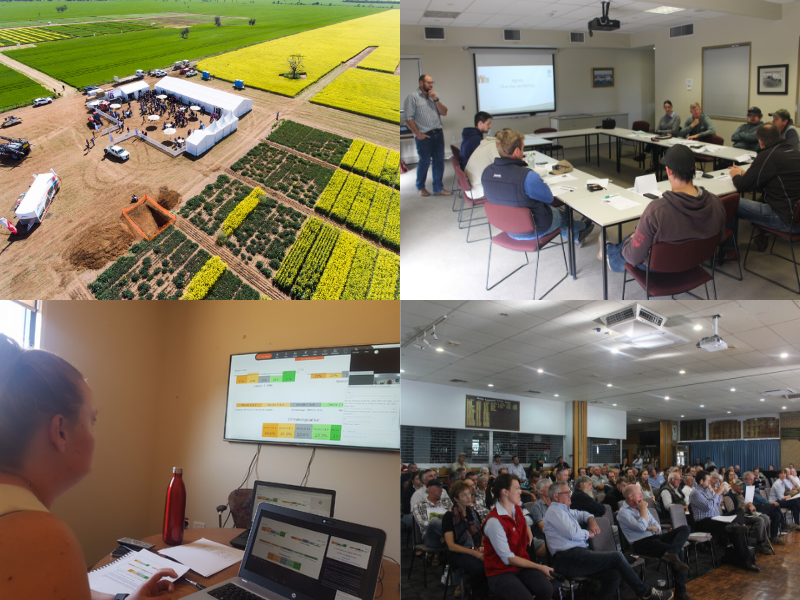
These on-farm insights directly inform how BCG shapes its research and extension priorities. We also asked Senior Managers Yolanda Plowman and Alicia Gault what the research and extension teams will be focusing on in 2026.
Yolanda Plowman – Senior Manager Research
“This year, our research program is expanding into several new areas while building on our core strengths. We are launching new soil-focused projects on sandy soils, heavy soils and soil amelioration techniques, alongside continuing our work on variety performance, nutrition and weed management. We’re also pushing into the next frontier of nitrogen management by testing alternative nitrogen products that move beyond conventional urea, including organic and enhanced-efficiency options. A key difference this year is our stronger focus on how agronomic decisions are actually made on farm, combining paddock data with modelling tools and behavioural (qualitative) insights to better support practical decision-making. In addition to nitrogen, phosphorus management will be a strong focus of our nutrition work in 2026.”
Alicia Gault, Senior Manager Extension and Communication
“In 2026, the BCG Extension team will be applying an economic lens to our extension programs. With the current landscape of rising input costs and tight margins, our focus is on supporting north west Victorian farmers to make confident, well informed decisions that protect profitability and long term business resilience.”
Across all these conversations, one thing is clear: there’s no single right way to farm, but there is real value in reflecting, learning and making deliberate decisions. Whether it’s fine-tuning existing systems, investing in new technology, or choosing to stay the course, each decision is shaped by experience and data.
This is where BCG sits alongside growers – bringing research and extension together to support informed, practical decision-making. As we head into 2026, BCG will continue to listen, trial, learn and share, so farmers across north west Victoria can adapt with confidence, manage risk and build resilient farming businesses.
This article is supported by the Victoria Drought Resilience Adoption & Innovation Hub through funding from the Australian Government’s Future Drought Fund.

The Victoria Drought Resilience Adoption and Innovation Hub is a state-wide collaboration of 10 organisations.
Led by the University of Melbourne and with headquarters at UM’s Dookie Campus, the Vic Hub is a Partnership between five farming organisations (Birchip Cropping Group, Food & Fibre Gippsland, Mallee Regional Innovation Centre, Riverine Plains and Southern Farming Systems), four universities (UM, Deakin, Federation and La Trobe), and the State Government (through Agriculture Victoria).
One of eight hubs established nationally under the Australian Government’s Future Drought Fund (FDF), the Vic Hub works to enhance the drought preparedness and resilience of Victoria’s agricultural industries, the environment and regional communities, encompassing broader agricultural innovation. Engaging with a range of industry and community stakeholders, the Vic Hub links research with community needs for sustainable outcomes.