
Rain and Research
This week, as the region rejoiced in significant rainfall totals, the BCG team placed 270 pages of local research into the hands of members in the form of the 2025 Research Compendium.
I felt a genuine sense of pride as I read page after page of insights and research results from trials conducted right here in our region. They cover a broad sweep of topics: new genetics across all crop types, the latest thinking on farming systems, nutrition strategies and agronomic refinements. At the top of every article, the focus is on those clear, sharp, practical take-home messages.
While the Compendium is an invaluable resource, it is just the beginning. Throughout the year, the BCG team will be communicating key findings via strategically placed events, discussion groups and digital platforms.
Importantly, ChatBCG, destined to become a powerful tool enabling farmers to interact directly with BCG research outcomes, is now in place.
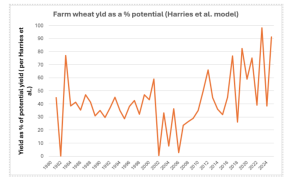
Figure 1. Yield achieved by Birchip farm as a percentage of potential yield (per Harries et al) Harm van Rees.
The above graph is generated from data derived from a farm not far from Birchip for the 2025 season. It provides a powerful example of what this farm was able to achieve, with the wheat crop reaching just over 90% of its water-limited yield potential.
This impressive outcome is one that, had the calculations been done, would have been replicated by farms across the region.
I would like to think that these results, reflecting as they do the strategic capability of growers, are a result of a broad network of research and agronomic support, for which BCG is largely responsible.
2026
BCG is excited by several new projects, focused particularly on soils and nutrient management which continue to shape both profitability and long-term sustainability.
BCG will be partnering with DEECA on a collaborative project focused on Phosphorus Use Efficiency, increasingly important in the face of the continuing significance of fertiliser costs. The aim is to extract more value from every unit applied. Understanding how phosphorus behaves in our soil types and farming systems will be critical in sharpening decision-making ability.
We are also taking on the GRDC-funded, CSIRO-led Sandy Soils Project across the northern Mallee, previously capably led by Michael Moodie and Frontier Farming Systems. Constraints on sandy soils remain one of the region’s biggest issues; this work will continue to explore practical, scalable strategies to lift productivity and resilience. We are grateful to Brad Plant, Peter Aikman and Mick Pole who host these trials.
In addition, BCG will lead a new Heavy Soil Amelioration Project, also in partnership with CSIRO, across the southern Mallee and Wimmera. Managing sodicity, compaction and other subsoil constraints is front-of-mind for many growers; this project will focus on measurable improvements that translate into real paddock gains but on a different soils in the Wimmera and northern Mallee landscapes.
Collectively, these initiatives represent a significant investment in soils-focused research across the region.
In other news, I warmly welcome our new BCG Board Chair, Brett Hosking, a farmer from Quambatook. Brett steps into the role following seven outstanding years of leadership from John Ferrier. John’s commitment to farmer-led, locally relevant research has helped shape BCG into the strong and independent organisation it is today.
I can also confirm that our 2026 Main Field Day will be held at Kinnabulla, spread across the properties of Trevor Grogan and the Rickard families including those of Jim, Eddie and Matt. We are grateful for their generosity in hosting what will no doubt be another outstanding opportunity to learn together.
A final thought: soil sampling conditions this year present a rather different aspect from our usual experiences!