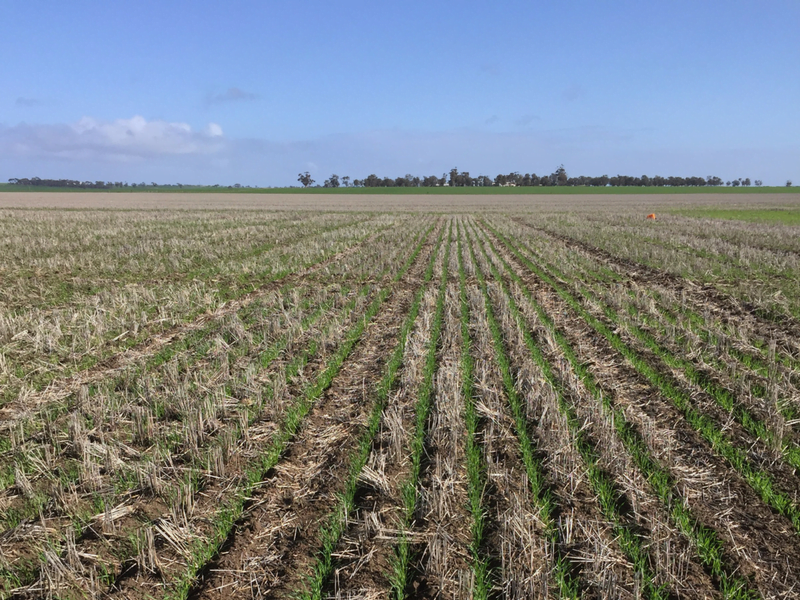
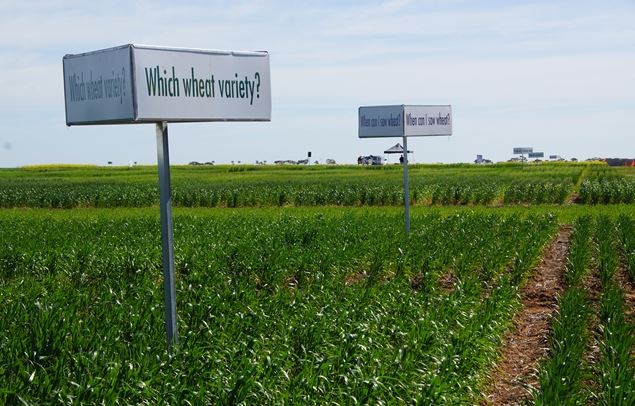

This paper reports on the performance of varieties at several BCG research sites in 2013.
AIM
To determine the performance of new and current wheat varieties in the Wimmera and Mallee
METHOD
Location: Kooloonong, Quambatook, Watchupga East, Nhill and Horsham
Replicates: Four
Target plant density: 130 plants/m²
Seeding equipment: BCG Gason parallelogram cone seeder (knife point, press wheels, 30cm row spacings)
All trials were managed to maximise yield (i.e. kept weed and disease free).
TRIAL DETAILS
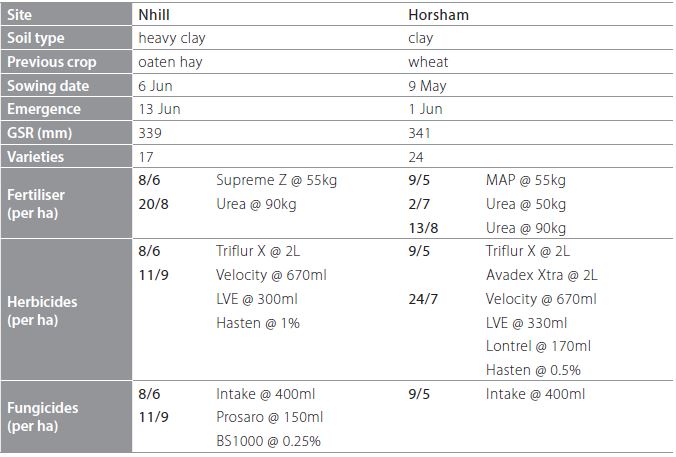
Table 1. List of the trial operations and applications at each of the BCG research sites.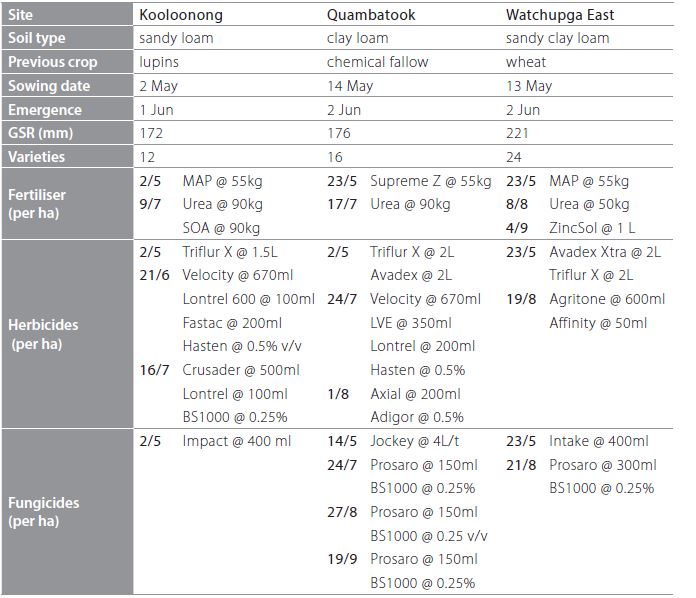
RESULTS AND INTERPRETATION
Kooloonong site (Mallee sand)
This site was dry sown in early May, mirroring what is typical for the region. After the first significant rainfall (7mm on 22 May) observations suggested that the soil was non-wetting as germination was not consistent across the trial within rows. Digging down into the row, it was evident that the soil was dry and seeds had not germinated in those areas. Meanwhile, just 10cm away, the soil was moist and seed had germinated. The prolonged period of dryness over summer and lupin stubble is likely to have contributed to this. Significant rainfall (32.5mm) on 1 June ensured all areas germinated thereafter.
Corack and Livingston established exceptionally well and looked the best throughout the season. Differences in maturity were most evident between both of these varieties and Yitpi, to the point that on October 24, Yitpi was the only variety that still had green stems and heads. With the dry finish to the season in the Mallee, Yitpi was expected to suffer as a result of being so late. However, only Corack and Livingston were significantly higher yielding. The mean grain protein across the site was 12.3 per cent (APW-H2 quality) and there was a strong yield dilution effect in the proteins (ie. higher yielding varieties had a lower protein than lower yielding varieties). Test weights were well above the minimum standard of 74kg/hl (mean test weight was 81kg/hl).
Watchupga East
This site was dry sown into wheat stubble in mid-May. While some varieties suffered from yellow leaf spot (YLS), they managed to grow out of it. Similar to other trials in 2013, Yitpi was again notably later than all the other varieties in this trial. It was one of the latest varieties to produce a head and flower.
August was particularly dry and many of the varieties had begun to lose potential when 22mm of rain fell between 15-17 September. At the time, most of the varieties were flowering, so crops were still able to respond to the rainfall.
Corack topped the yields at the site, followed by Mace, Shield and Cobra. Axe was the worst
performing variety. The mean grain protein of all the varieties was 10.9%, and similar to other sites, test weights exceeded 80kg/hl. All the varieties achieved ASW quality, however Corack would still have been the most profitable variety to grow despite it being limited to APW classification.
Quambatook
At this site wheat varieties were sown into marginal moisture on a chemical fallow that had been grazed during the fallow period. Even though the stubble load was reduced, there was still a low to medium level of infection of YLS. Fungicide (Prosaro®) was applied at three stages during the season which significantly reduced the level of YLS infection in those susceptible varieties. Later in the season, it was evident that crown rot had infected the crop with up to 20-25 per cent dead heads across varieties. Emu Rock and Mace performed exceptionally well and were the only varieties to be significantly higher than the site mean.
The number of ’dead heads’ counted prior to harvest suggested that the Emu Rock was less affected than other varieties, most notably Scout, Yitpi, Phantom and Wallup. This could be attributed to the difference in maturity with earlier varieties potentially escaping some of the late infection of crown rot, similar to the way barley can escape major losses.
Note: The number of Prosaro applications used in this trial exceeds the label maximum of only two applications. The third application was applied to prevent any late infection and to keep the fungicide constantly protecting the crop.
Nhill
Cobra performed exceptionally well at Nhill, being the only variety to yield significantly higher than all the other varieties. This site experienced average to above average rainfall for most of the season which made accessibility to the site, and timely spraying and top-dressing, a challenge. The trial was sown later (6 June) than most crops in the region. There was very low disease pressure at the site but a preventative fungicide spray was applied.
The site produced grain of mostly ASW quality; the mean grain protein being 8.3 per cent. It was apparent from the results that the site needed more nitrogen to meet yield and quality potential. Test weights were exceptional; the mean of all varieties being 82kg/hl.
Horsham
The Horsham site received nearly identical rainfall to Nhill. Cobra performed well, topping the yields. Corack, Dart, Derrimut, Lincoln, Magenta, Scout and Trojan also yielded significantly higher than the mean of all the varieties. While Dart’s performance is somewhat inconsistent with its performance at other sites, Corack, Scout and Trojan have consistently performed well. There was very low disease pressure at the site. A preventative fungicide spray was applied.
In terms of grain quality, the site had mostly APW with the mean grain protein being 10.9%. Test weights exceptional with the mean of all varieties being 82kg/hl.
Table 2. Summary of the yield results at each BCG research site (% = yields expressed as a percentage of site mean, shaded cells denote significantly higher than the site mean). 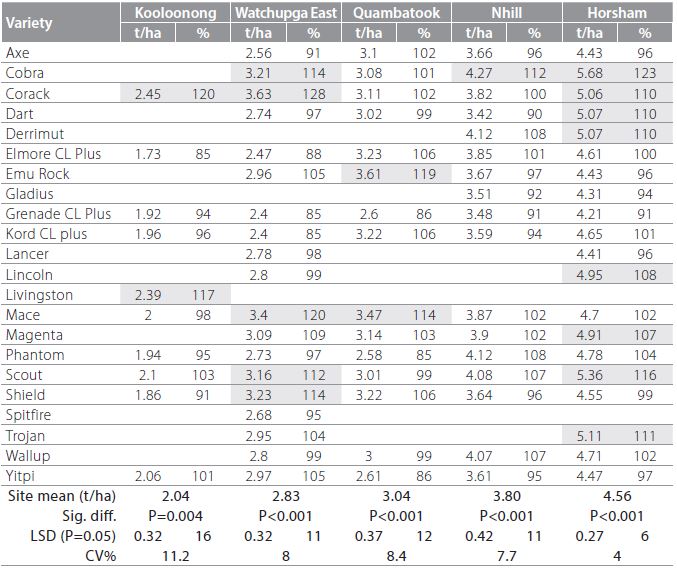
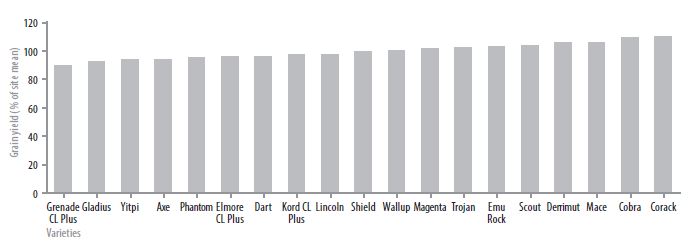
the various BCG research sites.
COMMERCIAL PRACTICE
It can become very easy to fall into the trap of changing varieties every season, especially when variety performances vary from year to year. While yield is a major driver of profitability, disease, frost, sprouting and quality still need to be considered. When choosing a variety that could be suitable to your farming system, be sure to compare it over a number of seasons compared to your current variety. You may find the suitability of a variety is only evident after growing it for two to three years compared to growing it for one.
Of the varieties compared, Corack and Mace have dominated yields consistently in the Mallee (both BCG trials and NVT) over the past three seasons. As a hard variety, Mace has the potential to be more profitable than Corack (APW). However both are very good varieties. Mace requires careful monitoring for stripe rust and developing a fungicide strategy is important to avoid any impact on its performance.
Trojan (another APW) probably has good adaptability to medium-higher rainfall areas, particularly in the Riverina and North Central/East. The performance of Cobra in the BCG trials was not so consistent with the NVT so comparisons over another season would be advised to ensure this is not a unique occurrence.
REFERENCES
SARDI 2014 wheat sowing guide
DEPI winter crop summary 2013
ACKNOWLEDGMENTS
The BCG variety trials were funded by BCG members. The National Variety Trials (NVT) are funded by growers and the Australian Government through GRDC.
ADDITIONAL INFORMATION
2013 CHAIRMAN’S WELCOME | THE YEAR THAT WAS 2013 – FARMING FOR TOMORROW | A SUMMARY OF WHEAT VARIETIES IN 2013 | 2013 RESEARCH SITES | 2013 SITE DESCRIPTIONS | BCG RESEARCH METHODOLOGY | GUIDELINES FOR INTERPRETING SOIL TEST RESULTS | 2013 GRAIN PRICES | 2013 BOARD, STAFF AND COMMITTEE | ACRONYMS AND ABBREVIATIONS | CEREAL GROWTH STAGE CHART | DISCLAIMER