
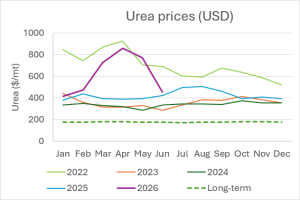
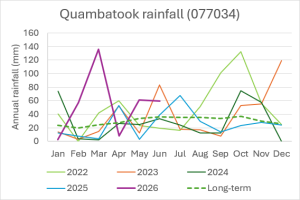
Based on recent surveys conducted as part of the RiskWi$e project, we know that almost half of the growers surveyed (nearly 300) said that they had a low comfort level when making N decisions (Brown el al, 2026). Nitrogen decisions are overlaid with levels of complexity; so far, 2026 has given growers in the region more than enough volatility to respond to when pulling the trigger on nitrogen decisions in the way of unexpectedly high rainfall early in the season, and eye-wateringly high urea prices as a result of geopolitical unrest, as illustrated in the graphs below. Sometimes, when we only consider long term averages in decision-making, we forget that annualised volatility is usually very high across multiple factors that affect the decision, and this probably explains the generally high level of discomfort when it comes to nitrogen decisions. Responding to volatility early in the year resulted in shifts for many growers in terms of reworking crop rotation plans and prioritising some paddocks for top-dressing over others.
Now that the time to top-dress is here for many growers, it’s important to reflect on the tools that are available to support nitrogen decisions, and choose one that aligns with your ‘management style’, as well as the trade-offs for each tool. Yield Prophet and Yield Prophet Lite are reliable tools for growers who are more ‘active’ in their nitrogen management; these tools match nitrogen input to the water-limited potential yield for a given season. Yield Prophet requires accurate input data for soil chemistry and water, and is a good match for more ‘active’ nitrogen managers who like to stay across yield predictions as the season evolves. However, some growers may be uninterested, or unable, to collect the necessary data to ensure the quality of the tool’s output. In these instances, a more ‘passive’ approach to N management can be employed, such as through the use of N Banks, a simpler, more ‘passive’ way that capitalises on year-to-year soil nitrogen carry-over to support crop growth. N Banks make nitrogen management easy, but in years such as this one, there’s potential to miss out on the upside considering where yield potentials might be heading. It’s up to you to decide if your priority is to simply protect yourself from slipping into the downside by putting out sufficient nitrogen to hit your target yield, or chase the potential upside through large nitrogen investments; either way, decisions are best supported with data and tools, because making better decisions doesn’t happen by accident.
_________________________________________________________________________________