

BCG is partnering the National Centre for Farmer Health (NCFH) in a new project examining how exposure to organophosphates (a chemical group in many insecticides) effect levels of a particular enzyme in the blood of farmers who are regularly exposed to farm chemicals.
Launched in April this year, the cholinesterase assessment project involves farmers and spray contractors from across the Mallee, Wimmera and Western District having their blood enzyme levels monitored and farm spraying activities recorded. Information collected from the blood tests will help researchers better understand how levels of an enzyme called cholinesterase can be accurately measured in the field, and how are these levels changing according to chemical use and organophosphate exposure throughout the year.
Cholinesterase (ko-li-nes-ter-ace) is one of many important enzymes needed for the proper functioning of the nervous systems of humans, other vertebrates and insects. Cholinesterase inhibiting products such as organophosphates (OPs) and carbamates (CMs) work by inhibiting cholinesterase in insect pests, but can also be poisonous, or toxic, to humans in some situations.
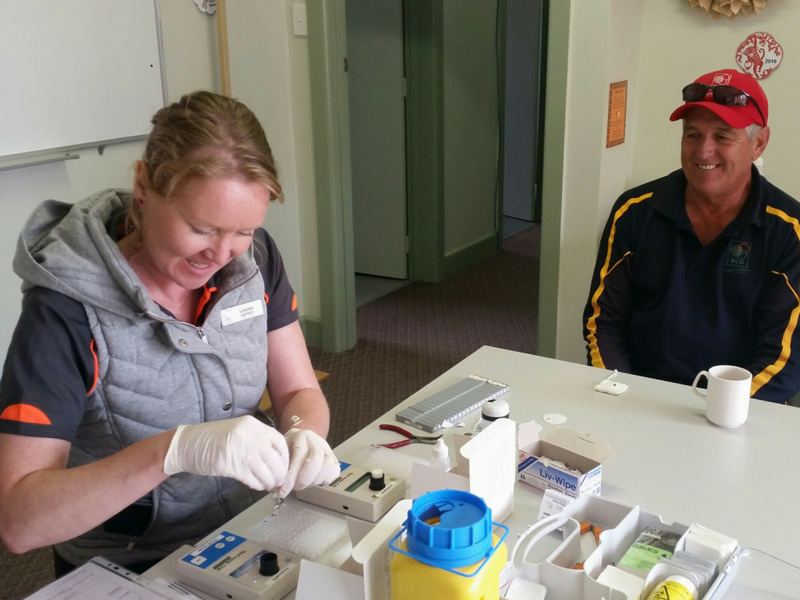
The NCFH developed the cholinesterase project with the support of Deakin University and the Shepherd Foundation Victoria. The research team have been testing a cohort of farmers from Lake Bolac, Penshurst and Coleraine in the Western District. BCG came on board to include farmers from the Wimmera and Mallee with BCG’s Louisa Ferrier organising and taking the blood tests.
The project started with each participant undergoing a baseline health check which included a respiratory assessment and fasting blood glucose test. Weight, blood pressure, wellbeing and a baseline cholinesterase reading were also recorded before the winter crop spraying season got into full swing.
Each month participants have provided a blood sample via finger prick to measure individual cholinesterase activity level. They also complete a chemical usage survey which records the chemicals used, level of exposure (prepared and applied) and amount of personal protective equipment (PPE) worn.
The research will collect 10-12 samples from participants for 10-12 months.
The testing method and technology being used for this project is a first for Australia, having been imported from the USA. It is also possibly the first time Mallee and Wimmera farmers have had their cholinesterase activity measured and to determine the effect of organophosphate exposure.
The Wimmera and Mallee participants are predominantly male, owner-operator farmers, however the research also accepted spray contractors because these individuals have a unique exposure to agrichemicals and one which may be higher than many farmers.
BCG project manager Louisa Ferrier said while the project was outside BCG’s core business of agricultural field research and extension, the organisation had a history of involvement in projects concerned with the health and wellbeing of farmers and their rural communities. These include the ‘Critical Breaking Point’ initiative and farmer ‘decision-making’ research carried out through the Grain & Graze project.
“Just as a frost or a drought can impact a farm business, health risks can also have serious implications for the business and the people behind it,” she said.
“We are proud to be part of an Australian-first research project that seeks to get direct results via a relatively simple and accessible testing process with simple equipment.”
Based in Hamilton, the National Centre for Farmer Health is a partnership between Western District Health Service and Deakin University. The NCFH is committed to improving the health, wellbeing and safety of farmers, families and communities across Australia. Results of this study will enable the researchers to further develop methods for monitoring individual agrichemical exposure in the field. For more information about this and other NCFH initiatives and services log on at: https://www.farmerhealth.org.au/