

Growing pasture in low rainfall areas is completely different to the practice in higher rainfall zones, with the typical pasture being made up of annual and regenerative varieties, rather than perennials.
To accommodate farming systems in the medium to low rainfall zones, growers have been seeking alternative hay options that differ from the normal oats or barley crops, but which may better suit their environment.
Having a pasture phase in the cropping rotation can have many benefits including nitrogen for the following crop, a disease break and financial benefits that flow from sheep production.
In 2016 BCG conducted a trail at the Warmur main site, to compare biomass production from mixed pastures, managed for early feed and hay.
The trial was sown into a fallow paddock with a clay loam soil and received 371mm of growing season rainfall in 2016.
NDVI (normalised difference vegetation index) assessments were performed during the growing season. NDVI measures greenness and can help determine biomass production. NDVI readings were compared to give insight into which pasture type or mix produced the most biomass at different times of the growing season.
The first NDVI measurement, which was taken on August 23, showed that the highest biomass production was achieved by Jilvet ryegrass, the oats/vetch mix, the barley/vetch mix, and the vetch crop. This showed that cereals, cereal mixes and vetch were able to establish faster than the slower growing legumes.
Thanks to the very favourable conditions in spring, the trial was able to produce an average of 6.3t/ha of dry matter over the site.
At anthesis biomass/hay production was highest for barley, Moby barley and oat/legume mixes, averaging 9.3t/ha.
Pasture mixes that included oats and vetch or barley and vetch were designed to deliver early feed from cereal which could then be sprayed out, allowing the vetch to bulk up in spring. While these plots show some of the largest early biomass, grazing was later than optimal and the vetch to be unable to recover.
Early NDVI measurements indicated that vetch crops were producing as much biomass as cereal/legume mixes, but by cutting time the cereals and cereal mixes had higher biomasses of 8.7t/ha. The faba bean plot also had significant biomass at 7.3t/ha, but considering the high value of this crop it is probably not economical to cut it for hay. Other legumes produced from 3.7t/ha to 4.4t/ha, while clover only achieved 2.5t/ha of biomass.
All of the cereals had higher biomass at anthesis than they did at August 23, the vetch and legumes, however, did not perform as well (Figure 1).
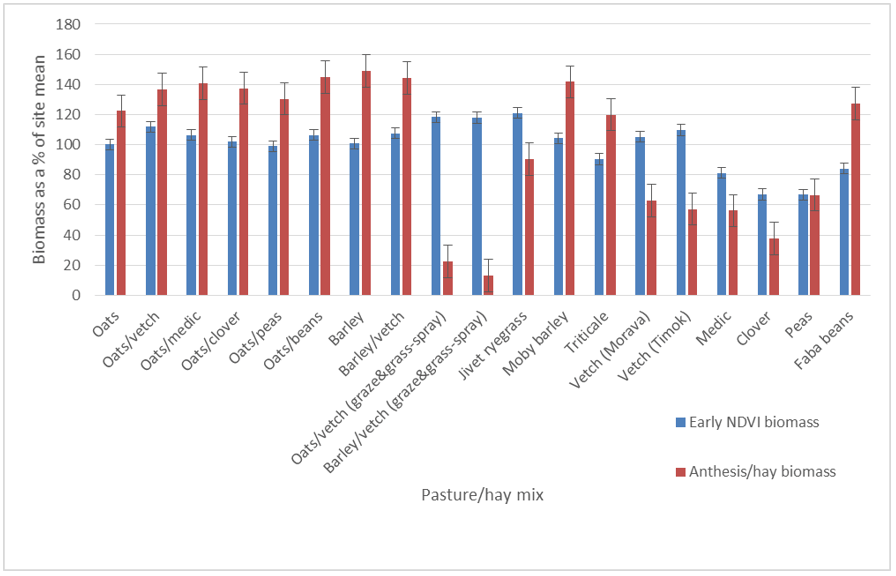
Figure 1. Biomass as a per cent of site mean as measured by NDVI on the 23 August and at anthesis, for all variety and mix combinations.
These results show that growers can reduce the cost of feed grown on farm simply by using seed commonly found on many mixed farming properties (i.e. cereals), and that by incorporating it into a pasture mix it is possible to produce feed amounts comparable to pure cereal stands and even better than pure legume stands.
When producing feed consideration also needs to be given to its digestibility and protein, which is why the cereal/legume mix can assist in both increased yield and quality. A pure legume stand will have the higher digestibility and protein content, which when coupled with cereal, can increase the fodder value of the cereal pasture (Dear et.al. 2005).
The legume component can also deliver nitrogen to the soil, thus reducing nitrogen input costs. In 2016, urea cost $412/t, therefore each unit of nitrogen was worth 90 cents (with urea being 46% N). Assuming that every 1t/ha of legume dry matter fixes 20kg N/ha, one tonne of legume dry matter would thus fix about $18 worth of nitrogen per hectare.
To hear more about this trial listen to Alison Frischke (BCG) and Colin Peace’s (JumbukAG) presentation from the 2016 BCG Main Field Day below.
https://soundcloud.com/bcg-birchip/mixed-pasture-systems-hay-marketing-alison-frischke-bcg-and-colin-peace-jumbukag?in=bcg-birchip/sets/bcg-main-field-day-14
Find more research here: https://www.bcg.org.au/choice-of-forage-crops-for-winter-feed/
References
Dear B., Kaiser A. and Piltz, J., 2005, NSW DPI Primefacts – Primefact 52, ‘Yield and digestibility of legume and oat forages’.