BACKGROUND
Increasing levels of atmospheric carbon dioxide (CO2) will affect all aspects of agriculture, irrespective of changes in temperature and rainfall. Atmospheric CO2 concentration has increased by 40% since 1860 and, by 2050, will increase another 40% from current levels to 550 parts per million. Research has shown that rising CO2 increases biomass and yield, decreases grain quality, increases nitrogen uptake and changes interactions of pests and diseases with crops. In addition, changes in rainfall, increasing temperatures and differences in soil type are expected to affect yield across the landscape.
International research has shown that current cultivars do not take advantage of increasing levels of CO2 to maximise yields and maintain quality. If the industry is to adapt to and profit from rising levels of CO2, information must become available about how to alter crop management and about which traits need to be selected to maintain productivity.
TAKE HOME MESSAGES
- elevated atmospheric CO2 increase yield of grains, but whether future yields increase depends on rainfall and temperature changes
- wheat grain protein decreases with elevated CO2
- breeding new cultivars will allow adaptation to increasing CO2
AIM
To gain knowledge that will allow the Australian grains industry to maintain productivity by adapting crops and cropping systems to the effects of elevated CO2.
METHOD
The Australian Grains Free Air CO2 Enrichment (AGFACE) experiment at Horsham, Victoria, is fully replicated (4 replicates) to study the effects of elevated CO2 on wheat and field pea in the paddock under a range of environments.
In the experiments, the anticipated atmospheric CO2 concentration by the year 2050 (550 parts per million) is being compared with the current CO2 concentration (370 parts per million). From 2007-2009, wheat only was sown. Two to eight cultivars of wheat have been sown over the experimental period. There are two levels of irrigation (rainfed and supplemental) and in the first three years sowing occurred at two separate times: standard (June) and late (Aug) for wheat.
In 2010, a rotation with wheat and field pea was begun to study the effects of nitrogen cycling on wheat production and measure the impact of elevated CO2 on nitrogen fixation.
Plant sampling occurred during vegetative growth, at flowering and at maturity. Soil water and nitrogen were measured at the beginning and end of the season. Non-destructive measurements were taken between these dates, allowing scientists to quantify growth, development, stress responses and soil status.
Pest and disease dynamics such as Wheat Crown Rot and Barley Yellow Dwarf Virus are being studied in the AGFACE facility and in growth chambers. Grain quality factors that affect human and animal nutrition and bread- and noodle-making quality are also being analysed.
Crop simulation modelling was used to predict future yields under elevated CO2. Inputs included initial soil water and nitrogen, emergence dates and atmospheric CO2 concentrations. These results were further linked to a landscape model (Catchment Analysis Tool) to “scale up” the results from Horsham to the state of Victoria. Inputs included soil type and yield results from the crop growth model at twelve times of sowing. Finally, these were linked with CSIRO climate simulation models (CCAM Mark 3) to include future rainfall patterns and changes in temperature (Intergovernmental Panel on Climate Change A1Fi scenario).
RESULTS
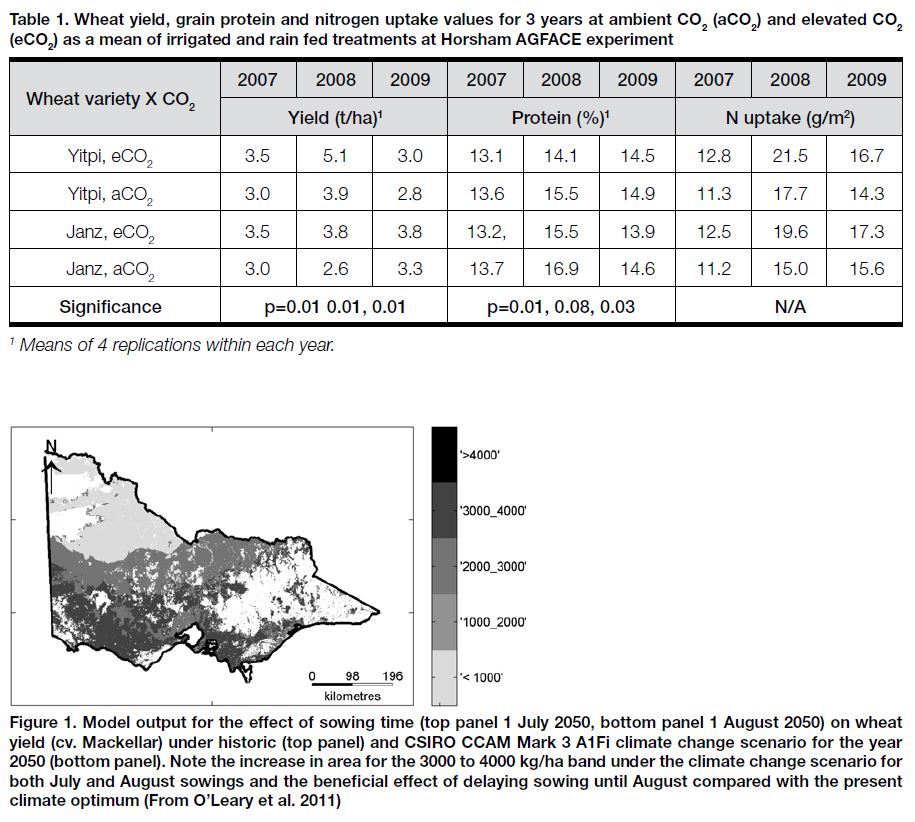
Here we report the results for the two cultivars sown across the first three seasons at standard time of sowing with no added nitrogen and averaged across the two irrigation treatments (Table 1).
The mean yield response (increase in yield at elevated CO2 over ambient CO2) for this data set was 22% across all three years. Yield increased significantly each year and grain protein content was significantly and consistently reduced by an average 0.8% in absolute percentage. Final whole-plant nitrogen uptake followed increases in biomass, both of which increased by 17% on average across all years (complete statistical analysis for N uptake is not yet available). There were no significant differences in harvest index in any year (data not shown).
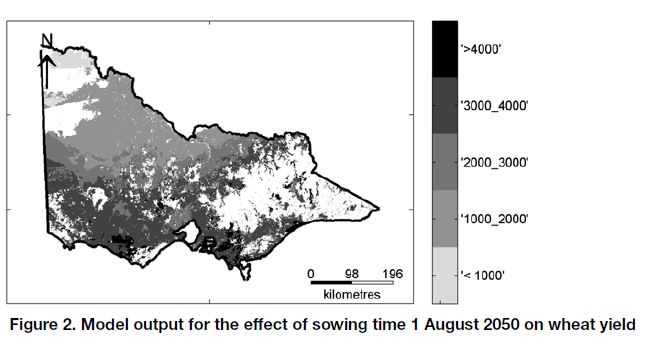
The data from 2007 was used to validate a crop model, which was in turn linked to a landscape climate model (see Methods section, Figure. 1). The resulting map shows modelled yields for the historic 68-year mean and predicted for 2050 for a slow-developing cultivar, Mackellar, sown in July and August. Yield in 1000 kg/ha intervals is shown in different shades of grey.
 INTERPRETATION
Depending on year and variety, the increase in yield varied from 7% to over 40% (Table 1). This variation in response to CO2 across these two cultivars alone indicates the potential to use existing cultivars to breed new, CO2 -adapted cultivars that can maximise yield under future climate conditions. However, if breeders continue with “business as usual”, they may not capture the yield components necessary to maximise yield under increasing atmospheric CO2.
Decreases in wheat grain protein have been shown to occur under elevated CO2 in international research and in AGFACE, but the causes for this are not entirely understood. This could affect human nutrition in lesser developed nations in which access to dietary protein is limited. It could also affect wheat grading and bread- and noodle-making quality and characteristics. This is currently being investigated by the AGFACE team. Screening for existing cultivars that have the least decrease in grain protein would be a valuable avenue of research.
Nitrogen uptake is linked to increases in biomass. In those areas in which biomass increases, more nitrogen fertiliser would need to be applied to take advantage of the elevated CO2 “fertilisation” effect. Whether the required nitrogen can be incorporated by rotation with legumes is currently being investigated.
Using current sowing times, yields may decrease by 2050 due to changes in rainfall and temperature, despite gains from eCO2 shift to later sowing (1 Aug) can help maintain yields. Adaptation to changes in cropping systems is possible through changing sowing times and selecting longer-season cultivars. The response varies across the landscape and modelling can assist in predicting where and by how much these changes can be expected in the future.
COMMERCIAL PRACTICE
Maintaining productivity in the future will require new crop cultivars that can maintain yield and grain quality under elevated CO2 in combination with changes in rainfall patterns and increasing temperatures. Because it can take up to twenty years for new cultivars to become available commercially, growers can accelerate this process by engaging with pre-breeders and funding bodies to ensure that they are available when needed.
In those regions in which biomass is predicted to increase, greater application of nitrogen fertiliser may be required to take advantage of increased yield potential; legumes in rotation might be able to supply at least some of this.
If nothing is done now, Australian agricultural productivity may continue to decline.
ACKNOWLEDGEMENTS
The AGFACE Program is a collaborative venture between the Victorian Department of Primary Industries and the University of Melbourne, with crucial additional funding from the Grains Research Development Corporation and Department of Agriculture, Fisheries and Forestry.