BACKGROUND
In response to the heightened risk of stem rust (Puccinia graminis f.sp. tritici), a majority of growers and advisors saw value in treating fertiliser with flutriafol (Impact® or Intake®). The residual activity of flutriafol for stripe rust control is assumed to be 8 to 12 weeks after sowing, depending on growing conditions (e.g. moist or dry). In the Mallee, under drier shorter seasonal conditions, the use of flutriafol may replace the need for in-crop fungicide altogether or at least delay application of a follow-up until flag leaf emergence. In the Wimmera, with a longer growing season, flutriafol is less likely to provide sufficient protection to avoid the need for follow up fungicides.
The effectiveness of flutriafol on other diseases such as stem rust and yellow leaf spot (Pyrenophora tritici-repentis) has been less well studied. With high stubble loads and in the presence of a green bridge from last year, inoculum levels of these diseases were high and yield losses likely.
As a direct response to this, BCG and Foundation of Arable Research (FAR) recognised the need for more information on the use of flutriafol for the control of stem rust, particularly at the 800ml/ha rate. As a consequence, BCG and FAR collaborated on a trial established in the southern Mallee.
TAKE HOME MESSAGES
- in a trial on Yitpi at Corack, there was no yield or margin benefit from using flutriafol (Intake®) on fertiliser at either the 400 or 800ml/ha rate, despite low level stem rust and yellow leaf spot infection in the top three leaves of the crop
-
at yields ranging from 3.0-3.5t/ha, the only fungicide treatment that improved profitability (net benefit $8/ha) was a single fungicide applied at flag leaf emergence (GS39) with no flutriafol on the fertiliser at seeding
- Using Prosaro® at 300ml/ha at flag leaf emergence (GS39) was the most effective fungicidetiming for yellow leaf spot control and 50% ear emergence (GS55) for stem rust control.
AIM
To evaluate the effectiveness of up-front flutriafol (Intake®) and in-crop fungicides for controlling stem rust and yellow leaf spot.
METHOD
Location: Corack
Replicates: 4
Sowing date: 17 May 2011
Seeding density: 150 plants/m2
Crop type: Yitpi wheat
Fertiliser:
sowing 50kg/ha MAP (10%N, 21.9%P)
17 June 90kg/ha GranAm (20%N, 24%S)
15 July 90kg/ha Urea (46%N)
2 August 90kg/ha Urea
Herbicides:
sowing 2L/ha Roundup PowerMax
2L/ha Triflur X + 2L/ha Avadex Xtra
14 June 25g/ha Monza
22 July 670ml/ha Velocity + 400ml/ha MCPA LVE
Seeding equipment: Gason parallelogram knife point, press wheel bar (30cm spacings).
Yitpi wheat was subject to 21 different fungicide treatments, composed of three different flutriafol treatments at seeding and seven foliar fungicide treatments superimposed during the growing season (Table 1). The trial was set up as a split plot design with the flutriafol treatments as the main plot and the foliar fungicides treatment as sub-plots. Foliar fungicides were applied with 120 L/ha water using TT-110-02 nozzles.

Growing season rainfall at the site was 153mm with 89mm available at planting (May 17th).
RESULTS
Disease control
Despite the low rainfall (153mm) during the growing season, both yellow leaf spot and stem rust developed to low levels (less than 10% infection severity) in the upper canopy (top three leaves, sheaths and peduncle) of the crop.
Yellow Leaf Spot Control
Yellow leaf spot developed over winter and was present in the crop when the first fungicide was applied at GS30. The disease continued developing throughout the season, infecting all top three leaves of the crop canopy to a low level. This gave an opportunity to assess the level of disease control given by a range of fungicide treatments applied later in the season (the disease having previously been restricted to the tillering period in BCG trials). Yellow leaf spot was first assessed at flag leaf emergence (GS37-38) 43 days after fungicide application at GS30 (Table 2).
Intake® gave no significant control of yellow leaf spot severity on the top four fully unfolded leaves when assessed at GS37-38. There was some evidence that the incidence of yellow leaf spot on flag-1 was reduced (from 36% plants showing infection to 23-25% plants infected), but the level of control assessed was less than 40% (data not shown).
Prosaro® applied at GS30 gave no control of the disease on leaves that emerged after application (flag-1 and flag-2) but was noted to give partial control of the disease (less than 40%) on the lower leaves flag-3 and flag-4 which received fungicide coverage.

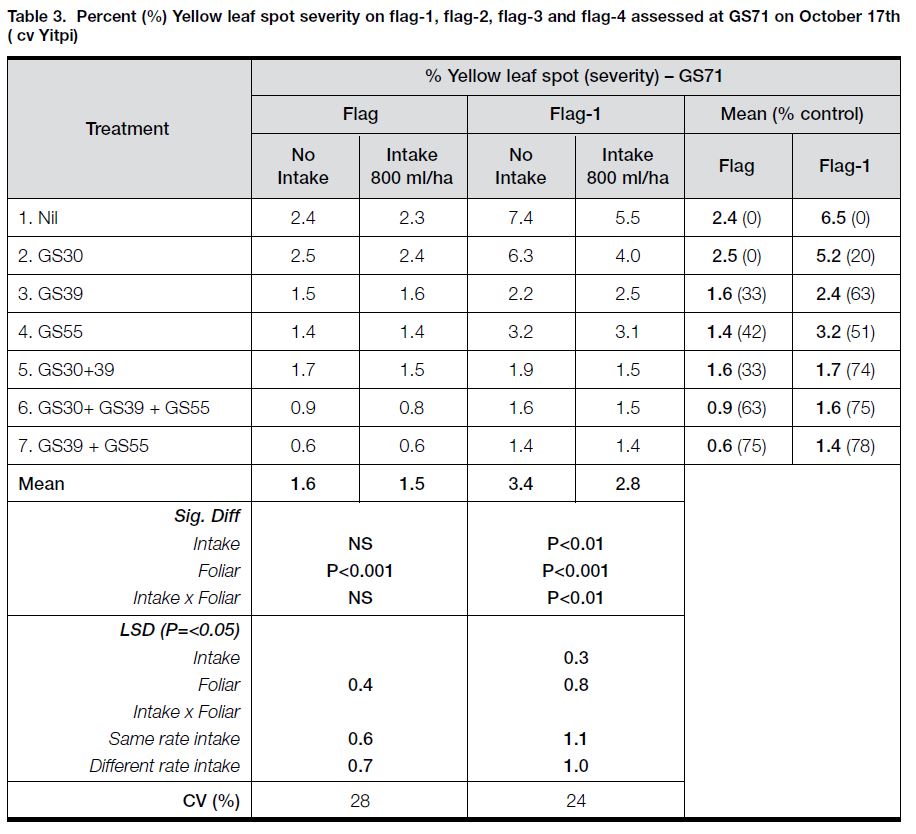
Yellow leaf spot was reassessed at the watery ripe stage (GS71) and had developed low level infection on the flag (less than 5% infection) and flag-1 (less than 10% infection). Only those treatments superimposed on the nil Intake and 800ml/ha Intake were assessed. In this assessment on flag leaf and flag-1, the most significant reduction in yellow spot severity came from fungicide treatments that incorporated a flag leaf (GS39) applied fungicide. This timing gave significantly better control of the disease on flag-1 (63% control) than the later 50% ear emergence timing at GS55 (51% control) and the earlier GS30 timing (20% control) which was effective on the lower leaves but not on the top two leaves (Table 3). Multiple spray treatments incorporating both a flag leaf and ear emergence spray gave the best control of disease at this assessment (75 – 78% control).
Stem rust control
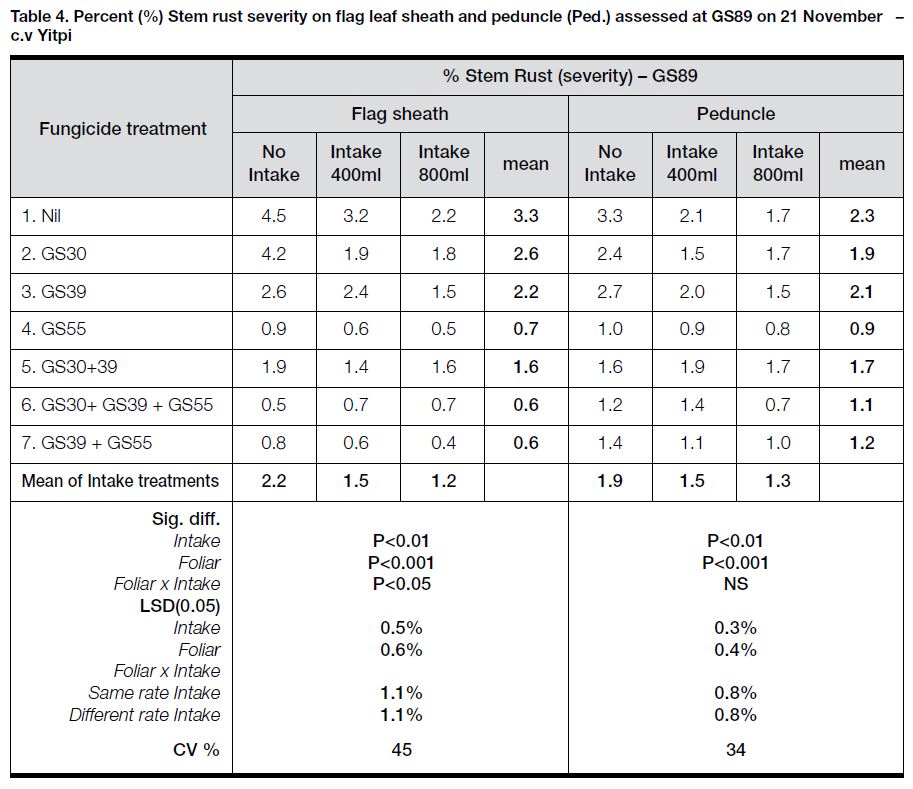
The trial was also assessed for a late stem rust infection that was first noted on 11 October at the late flowering stage (GS67-69). The disease increased in the untreated crop at the end of October at the late milky ripe stage (GS77). The disease was assessed on the peduncle, flag leaf sheath and flag-1 sheath at physiological maturity (GS89) on November 21st. The assessment revealed that Intake on the fertiliser at seeding had given some control of disease, despite the late infection. However, whilst there was a trend for Intake at 800ml/ha to be better than 400ml/ha, the difference was not statistically significant. If the effect of fungicide treatments were compared on the flag sheath (which had the highest level of infection – 5% severity), the most effective spray treatments were those that incorporated a partial ear emergence spray applied at GS55. There was no additional value of spraying foliar fungicide earlier than ear emergence, but the level of infection was reduced with Intake applied at seeding (Table 4). Where no foliar fungicide follow up was applied, Intake at 800ml/ha reduced infection by 51% on the flag sheath and at 400ml/ha by 30%. For comparison, where no Intake was applied, a foliar spray of Prosaro® at GS30 gave only 8% control of stem rust, a GS39 spray gave 42% control and a GS55 spray gave 79% control. The best stem rust control (although not statistically different from a single GS55 spray) was Intake® 800ml/ha followed by a flag and ear emergence spray (91% control).
Green leaf retention
Assessments of green leaf retention revealed contradictory results, depending on the assessment timing and method. The assessment conducted with the Greenseeker® crop sensor on 5 October at ear emergence (GS57-59) indicated that both Intake and the use of foliar fungicides reduced canopy greenness compared with the untreated when greenness was measured in terms of NDVI (Normalised Difference Vegetative Index). The differences were small but significant. When assessed 14 days later on 19 October, again with the Greenseeker®, the ear emergence spray applied at GS55 had discoloured the crop canopy very slightly, giving it a more lime green, scorched appearance on the upper surface of the flag leaf that had been exposed to the spray. Though the effect on canopy greenness was slight, it did show up as a significant reduction (p=<0.001) in NDVI compared with the flag leaf spray timing, which at this assessment gave the best NDVI (0.37). By comparison, the NDVI for the untreated was 0.35 and 0.34 for the single ear emergence spray.
Visual assessments of green leaf retention based on the lower canopy taken during grain fill revealed that the best green leaf retention was given by flutiafol (Intake) based fungicide treatments. This result, which is in contrast to earlier assessments with the Greenseeker®, might be due to measuring greenness in different parts of the crop canopy, since NDVI will take the greatest signal from the flag leaf and the leaf below compared to visual assessments based on flag-2.
Yield, Quality and Margin
The trial produced small but significant yield effects due to fungicide management (Figure 1). Averaging the fungicide treatments based on the three seeding treatments revealed no yield benefit from using Intake® at either the 400 or 800ml/ha rate (Table 5). Both Intake® rates significantly reduced yield despite being associated with better control of late stem rust (although not significant) and low levels of stripe and leaf rust (less than 1% infection – data not presented).
In terms of foliar fungicide application, there was a small but significant yield increase (0.13 t/ha) associated with the three spray fungicide treatments over the untreated and a trend for treatments that incorporated a flag leaf timing to be higher yielding. All other treatments, including those that gave the best control of the late stem rust infection, gave yields that were no better than the untreated. Any fungicide treatment incorporating a GS55 spray was significantly lower-yielding than the single flag leaf spray (Figure 1), a result that may relate to low level scorch that reduced crop canopy greenness.
The only significant effect of fungicide application on quality was on protein levels, Intake based treatments producing significantly higher protein than those treatments untreated at seeding. Results appear to be linked to the higher yields associated with no Intake at seeding i.e. higher yield diluting protein content.
Only one treatment (the single flag fungicide with no Intake) produced a higher margin than the untreated crop. The other 19 treatments produced no economic benefit, despite controlling low level yellow spot and stem rust infections.


INTERPRETATION
DISEASE CONTROL
Intake applied at seeding on the fertiliser gave no control of yellow leaf spot severity at either 400 or 800ml/ha. By contrast, foliar fungicide application (Prosaro®) was more effective for the control of this disease, with a flag leaf emergence spray being the most effective at protecting the top three leaves. However, levels of disease control were rarely more than 70% with foliar fungicide application, the best control being given on those leaves that were newly-emerged at the time of application. Early fungicide application at GS30 was more effective in controlling yellow leaf spot on the lower leaves (flag-3 and flag -4), but gave little protection to the top three leaves or any economic benefit. The ear emergence spray (GS55), whilst better than the early spray (GS30) for disease control, allowed the disease to develop for longer on the top three leaves before it was controlled.
At the end of grain fill, Intake® was proven to give partial control of stem rust (30-50% control depending on rate), the control obtained from the use of Intake® was significant over the untreated and more effective than the early stem elongation foliar fungicides applied at GS30. However, the best control of stem rust was given by a single Prosaro® application at ear emergence (GS55) which gave 79% control. Unlike other treatments, this fungicide timing covers the flag leaf sheath, the part of the stem which for the last two years has been most affected by the disease.
Yields and margins
The presence of low levels (less than 10% infection) of both yellow leaf spot and stem rust in the upper canopy (top three leaves and leaf sheaths) resulted in fungicide management generating small yield effects and largely negative margins. Yield effects from the application of Intake, despite giving a boost to stem rust control, were negative. The effects of foliar fungicides were positive where fungicides were applied at flag leaf, but, where applications were made early GS30 and late GS55, there was no yield improvement over the untreated. With the later sprays at GS55 which gave good control of low level stem rust infection, the yield reduction relative to the flag spray may have been the result of low level scorch that reduced the greenness of the flag leaf and flag-1 (assessed with the Greenseeker®). Only the flag leaf fungicide with no Intake at seeding produced a positive margin.
COMMERCIAL PRACTICE
For Mallee farmers, the principal conclusion from this work must be to avoid excessive expenditure on fungicide insurance before you know the risk that the spring weather patterns poses to the crop. Fungicide treatments could be used to control both yellow leaf spot and late stem rust infection, but these treatments, whilst controlling the disease, were in the main uneconomic at yields of 3- 3.5 t/ha.
Increasing the rate of Intake at seeding to 800ml/ha was shown to improve stem rust control compared with 400ml/ha, but was not associated with a yield or margin improvement; in fact in this trial it significantly reduced yield and margin. Therefore, whilst it is still a sensible insurance policy to cover stripe rust susceptible cultivars in your portfolio with flutriafol (Intake®) at seeding (or a proportion of them depending on your spray rig capability), there was no evidence to suggest it should be routinely used for stem rust control or that there was any benefit for the control of yellow leaf spot.
The study revealed that yellow leaf spot, even under low rainfall conditions in the Mallee, is difficult to control with fungicide management, compared with cereal rust diseases such as stripe rust. The disease was most effectively controlled when fungicide (in this case Prosaro®) was applied at flag leaf emergence. Earlier sprays were partially effective at controlling the disease on those leaves exposed to the fungicide, but offered little control of the disease on leaves that emerged after application and were uneconomic.
ACKNOWLEDGEMENTS
This work was funded by BCG members, through their membership and the Foundation for Arable Research (FAR).