BACKGROUND
Many commercial barley and wheat varieties lack adequate resistance to foliar diseases. Additional management is required to reduce the risk of penalising grain yield and quality. Foliar, fertiliser and seed treatment fungicides are the primary methods available to manage foliar diseases where there is a risk of loss from disease. However, it can be challenging to select the appropriate strategy to control the various diseases as each will respond differently to a given fungicide treatment.
As part of ongoing studies, DPI has been working with BCG to conduct experiments aiming to determine the most effective strategy for managing foliar diseases using foliar and fertiliser treatment fungicides. During 2011, experiments were conducted at Rupanyup to test a range of strategies in separate barley and wheat experiments.
The 2011 seasonal conditions were characterised by an extremely wet summer which favoured the carryover of rust on volunteers. This was followed by average or below average rainfall during the growing season, which was unfavourable for the splash-dispersed stubble-borne diseases. These conditions resulted in moderate to severe leaf rust (Puccinia hordei) and moderate spot form of net blotch (SFNB) (Pyrenophora teres f. maculate) infection in barley. In wheat, low level leaf spot (Pyrenophora tritici-repentis) and severe stripe rust (Puccinia striiformis) infections were observed. Only trace levels of scald (Rhynchosporium secalis) occurred.
TAKE HOME MESSAGES
-
it is important to consider the seasonal risk posed by diseases when developing an appropriate disease management strategy
-
avoiding susceptible barley and wheat varieties will significantly reduce the risk of grain yield and quality loss due to disease
-
both foliar and fertiliser fungicides can both provide effective disease management when applied to coincide with the critical development stages of disease epidemics
AIM
The aim of this study was to evaluate the effectiveness of various strategies for managing foliar diseases in separate barley (Experiment 1) and wheat (Experiment 2) experiments using foliar and fertiliser applied fungicides
METHOD
Location: Rupanyup (100 km south of Birchip)
Replicates: 4
Sowing date: 19 May 2011 (harvested 6 December)
Sowing density: 70-80 plants/m2
Seeding equipment: Direct drill, tractor mounted cone seeder, 22.5cm row spacing
Crop type: Experiment 1 – barley, Experiment 2 – wheat
Variety: Experiment 1 – Hindmarsh, Experiment 2 – Janz
Fertiliser: 19 May100kg/ha MAP, 3 Aug & 27 Sep 90kg/ha Urea
Herbicides:
14 July Axial® (0.3l/HA) +Adigor (0.4L/ha)
27 July Velocity® (670ml/ha) + MCPA LVE (350ml/ha)
Experiment design: six row plots, 10 x 1.5m, separated by wheat buffers
Fungicide Products:
Fertiliser = Impact® (250g/L flutriafol) @ 400ml/100kg fertiliser
Foliar = Prosaro® (210g/L prothioconazole 210g/L tebuconazole) @ 150 or 300ml/ha
Foliar application dates and growth stages:
Experiment 1 – 12 August (GS 31), 5 September (GS 39) and 22 September (GS55)Experiment 2 – 12 August (GS 31), 23 September (GS 39) and 28 September (GS55)
Treatments:
1. Untreated (Nil)
2. Impact and Prosaro @ GS31 (300 ml/ha), GS39 (150ml/ha) and GS55 (150ml/ha)
3. Impact
4. Impact and Prosaro at GS31 (300 ml/ha)
5. Impact and Prosaro at GS39 (300 ml/ha)
6. Prosaro at GS31 (300 ml/ha)
7. Prosaro at GS39 (300 ml/ha)
8. Prosaro at GS55 (300 ml/ha)
9. Prosaro at GS31 (300 ml/ha) and Z39 (300 ml/ha)
Assessments:
For both experiments, plant emergence was quantified on one occasion by estimating the number of emerged plants in two arbitrarily selected 0.5 m2 quadrats.
In Experiment 1, average disease severity of 10 tillers was assessed in each plot at GS 55 (16/9/11) and GS 89 (12/10/11). On the first occasion, the top 4 leaves (flag, flag-1, flag-2 and flag-3 ) were assessed in each plot for average % leaf area affected (%LAA) by disease. On the second occasion, a single estimate was made for average percentage of leaf area affected (%LAA) for the entire tiller.
In Experiment 2, average disease severity of the top two leaves of 10 tillers was assessed in each plot at GS 39 (16/9/11) and GS 65 (12/10/11) for %LAA by disease.
Grain yield was assessed for individual plots at harvest by measuring grain weight and plot size.
RESULTS AND INTERPRETATION
Experiment: barley
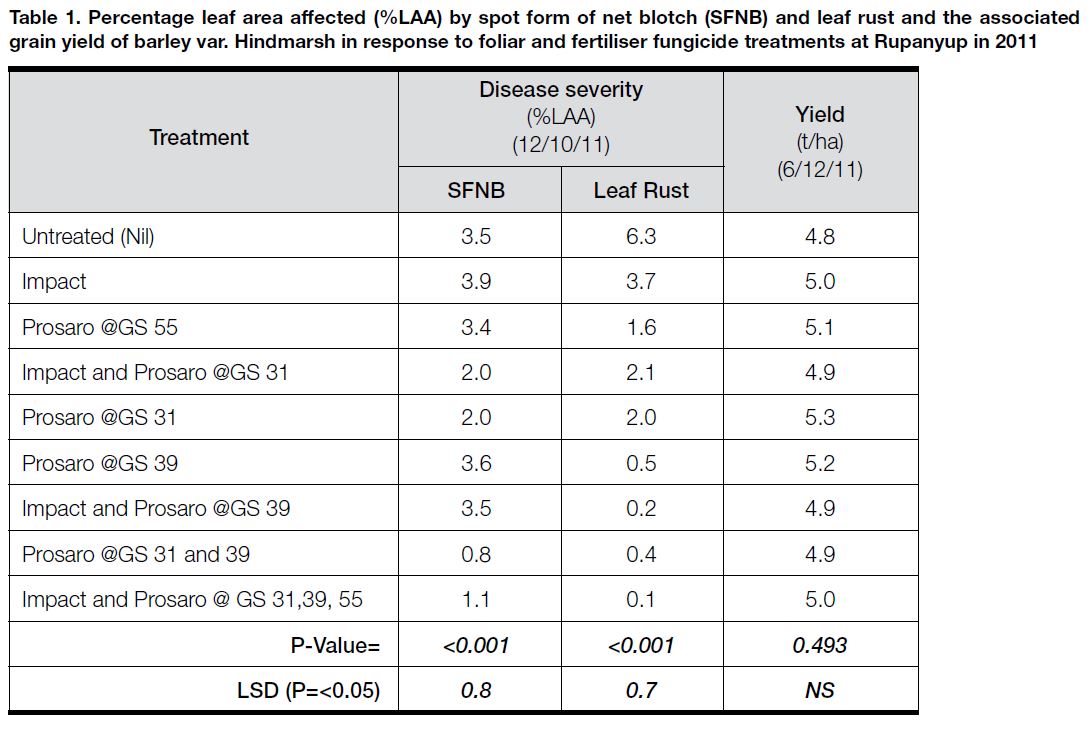
Moderate SFNB and leaf rust developed during 2011, resulting in approximately 5% of leaf area affected by each disease (Table 1). Neither disease became severe (as was observed in other nearby experiments, refer to Managing leaf rust article on page 102) due to the presence of partial resistance in c.v Hindmarsh to leaf rust, as indicated by its MS-S rating (refer to DPI Cereal Disease Guide), and unfavourable climatic conditions. As a result, no grain yield loss was recorded when the nil and full fungicide treatments were compared.
Foliar and fertiliser fungicides were effective in suppressing leaf rust and SFNB in Hindmarsh at Rupanyup during 2011, although the effectiveness of each treatment varied significantly. The most effective treatment for both diseases was a combination of application of foliar fungicide at stem elongation (GS 31) and flag leaf emergence (GS 39). This was due to the GS 31 application providing suppression at a critical stage in SFNB development, and the GS 39 application providing effective suppression of leaf rust prior to it becoming established in the crop.
The fertiliser treatment provided some suppression of leaf rust, but much better suppression was achieved when a foliar fungicide was also applied during the growing season, especially at GS 39. As was expected, the fertiliser treatment did not provide any suppression of SFNB as it is not effective on the net blotches. Very effective suppression of leaf rust was also achieved with foliar fungicide application at GS 55, but this was ineffective for SFNB.
Experiment 2: wheat
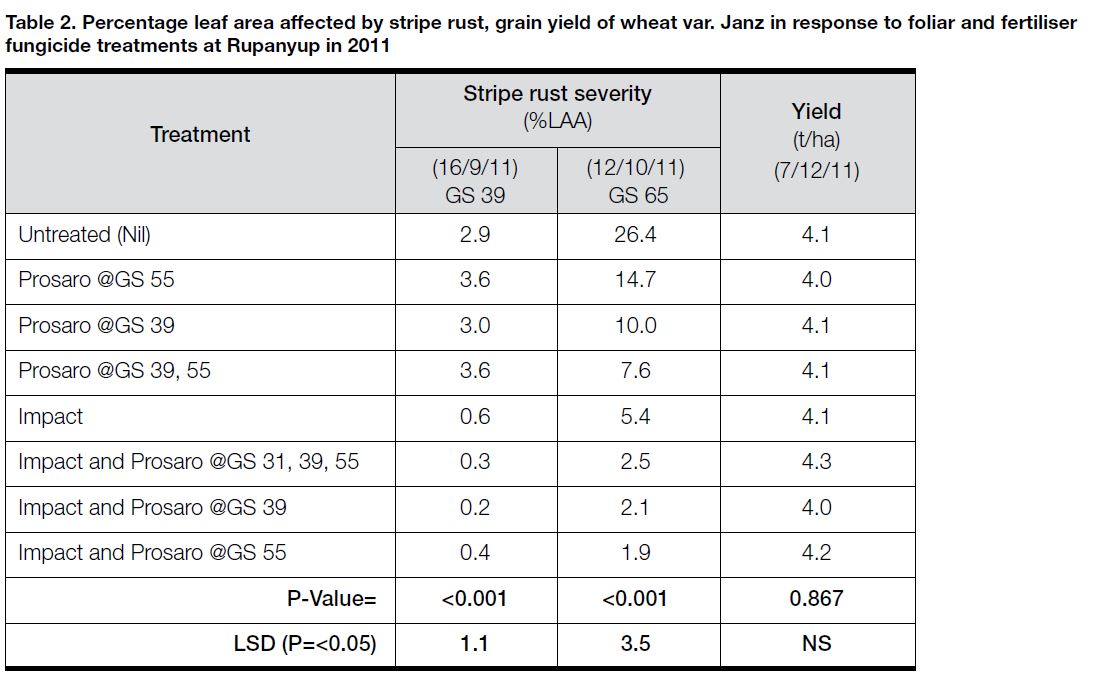
Moderate to severe stripe rust developed in the untreated (nil) plots, with up to 26% leaf area affected at flowering (Table 1). This was the case, despite c.v. Janz possessing adult-plant resistance, illustrating the risk after a wet summer that favoured inoculum carryover on the “green-bridge”. Despite the high infection, no grain yield loss was recorded when the nil and full fungicide treatments were compared, indicating that the moderate susceptibility provided sufficient protection during this season.
Both foliar and fertiliser treatments were effective in reducing stripe rust severity, with a combination of the two providing the best suppression. The effectiveness of this combination was demonstrated regardless of whether the foliar fungicide was applied at GS 39 or GS 55.
Application of fungicide to fertiliser provided significant suppression of stripe rust, indicating that its effectiveness was reasonably prolonged during the growing season. A single application and two applications of foliar fungicide (GS 39 and 55) also provided significant suppression, but were not as effective as when fertiliser-treated fungicide was applied.
COMMERCIAL PRACTICE
The two experiments conducted at Rupanyup during 2011 demonstrated that foliar and fertiliser applied fungicides can be used effectively to manage foliar diseases in barley and wheat. However, effective disease suppression does not always result in improved grain yield, as was observed in these experiments. This could be due to the interaction between resistance genes in the host-crop, environment, crop nutrition and the development of the disease epidemic. Therefore, the likelihood of receiving a yield benefit from applying fungicide or risk of yield loss by not applying fungicides needs to be considered with the associated costs in mind.
The best strategies for disease management involved fungicide applications that coincide with the developmental stages of disease. In this experiment, the most effective strategy for managing leaf rust in barley was a combination fertiliser and foliar fungicide application at GS 39 or later. The fertiliser applied fungicide would have provided suppression of early infection from volunteers, while the foliar application at GS 39 coincided with warming weather conditions (18-25°C) that were favourable for leaf rust development throughout the crop. Application at GS 31 was too early: its efficacy was reduced before epidemic development.
SFNB was effectively suppressed with foliar fungicide application at around GS 31, while scald has been shown to be effectively suppressed using similar timings in other DPI experiments at Horsham in 2011. These stubble-borne diseases need to be managed earlier in the crop’s development, as they start infection during the seedling stages.
Wheat stripe rust was best suppressed using the fertiliser applied fungicide in combination with foliar fungicide. It is important to apply fungicides early in the development of rust to reduce exponential development of an epidemic. This can occur relatively early in the growing season as the pathogen is suited to cool temperatures (12-20°C), by contrast with other rust pathogens that prefer warmer temperatures (20-25°C).
Net form of net blotch and powdery mildew in barley, together with yellow leaf spot, Septoria tritici, leaf and stem rust in wheat also pose a potential risk to production. They should be considered when deciding on disease management strategies. When making these decisions, consideration should be given to disease inoculum levels, variety susceptibility, climatic factors and potential grain yield and quality.
ACKNOWLEDGEMENTS
These experiments were funded by GRDC (DAV00111) and Victorian DPI and were in collaboration with the BCG. Technical support was provided by David Hoffmann, Graham Exell and Peter Oxley (DPI).