Take home messages
- where blackleg disease pressure is low, fungicide application is not necessary
- the greater the amount of canola grown, the more likely is an infestation of blackleg. Consequently, in 2012, blackleg disease pressure may increase in the Wimmera and Mallee.
- a buffer of 500m from the previous year’s canola stubble is desirable when selecting canola paddocks
- growers should utilise the “Blackleg Risk Assessor” and the current “Blackleg Ratings” on the GRDC website
Background
In 2012, Prosaro® (registered product of Bayer) will be registered for blackleg (Leptosphaeria maculans) control in canola. Prosaro® can be applied at the 4-6 leaf stage at a rate of 375-450ml/ha. Previous trials have shown that blackleg severity can be reduced by applying Prosaro® (210g/L prothioconazole + 210g/L tebuconzole) at the 4-6 leaf stage and that it can be mixed with most commonly used herbicides. Past research also found the best results occurred when Prosaro® was used in conjunction with a seed dressing (Jockey®) or fungicide applied fertiliser (Impact®). Prosaro® at 375-450ml/ha is valued between $24.75-30/ha. If 2012 canola plantings are sustained throughout the Wimmera and Mallee from 2011 levels, then the incidence of blackleg is likely to increase due to higher inoculum levels.
Aim
To compare different fungicides for control of blackleg.
Method
The replicated field trial was designed as a complete randomised block. Due to the heavy barley stubble load, the trial area was burnt prior to sowing. Various seed, fertiliser and in-crop fungicide treatments were applied (Table 1). Emergence was measured on 5 July (GS12.5). Treatments were observed throughout the season for blackleg incidence and severity. Medium level mouse activity was observed and the trial was baited. Grain yield and quality were statistically analysed and fungicide input costs compared.
Location: Rupanyup
Replicates: 4 (Plots 14m x 1.74m)
Sowing date: 20 May 2011
Seeding density: 3 kg/ha
Crop type/s: open pollinated Canola 44C79 (Blackleg rating = MS)
Inputs/Fertiliser: 50kg/ha MAP at sowing, 15 August: Urea (90kg/ha)
Seeding equipment: Parallelogram (knife point, press wheels, 30 cm row spacing).
Herbicide spray: 20 May: TriflurX® 2L/ha, Avadex Xtra® 2L/ha
Intervix® 750ml/ha, Hasten® 0.5%
Select® 500 ml/ha, Liase2%, Hasten 1%
16 Nov: Reglone 1.5ml/ha, Spreadwet 1%
GSR (Apr-end Oct): 157 mm Decile 1
Table 1. Rupanyup blackleg fungicide treatments

Results
Incidence of blackleg
The incidence of blackleg was low at the site and no differences were observed between varieties.
Emergence, yield and quality
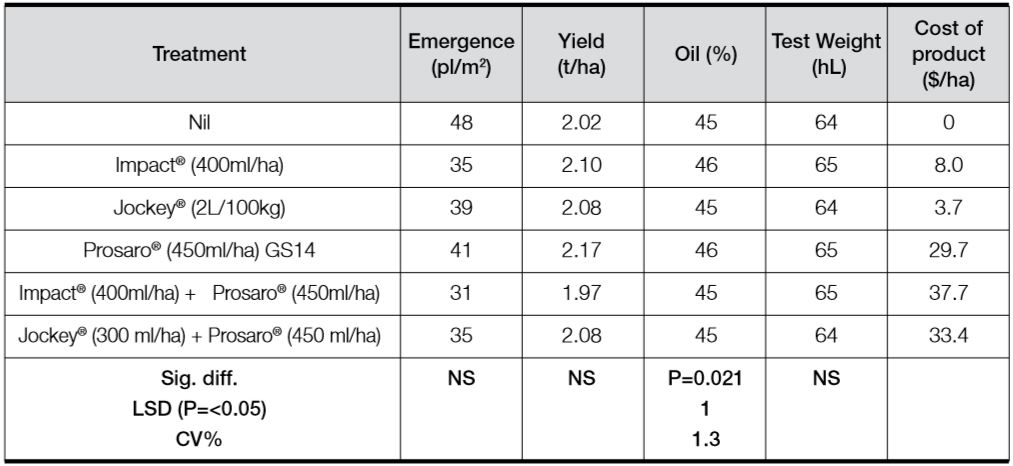
There were no differences between fungicide treatments for emergence and yield. However, oil percentage for Impact and Prosaro treatments when applied individually, were significantly higher than other fungicide treatments. There were no differences between varieties and test weight.
Table 2. Emergence, yield and quality results, including treatment costs.
Interpretation
Emergence, yield and quality parameters, including oil and test weight, were analysed for statistical differences. Oil content was the only parameter to show a statistically significant difference (1%). Even though the individual Impact in-furrow and Prosaro (GS14) treatments recorded an oil content of 46%; when these products were combined, an oil content of only 45% resulted.
Although the canola variety, 44C79 was moderately susceptible to blackleg, consistent yield results of 2t/ ha or more suggest the incidence and severity of blackleg was minimal. Visual observations supported this assumption. Having few canola paddocks sown in close proximity to the trial site in 2010 and 2011 would have reduced the amount of canola stubble available to harbour blackleg and wind-blown inoculum. Favourable stored soil moisture to assist crop growth, combined with low growing season rainfall, may have contributed to low disease levels.
Commercial practice: what this means for the farmer
This study showed that, in a Wimmera clay soil, under conditions of high stored moisture, low district disease pressure and a growing season rainfall of decile 1, the incidence and severity of blackleg disease was minimal. Fungicide applications had no significant effect on yield.
However, due to high canola plantings in 2011, it is likely that blackleg disease inoculum will increase in 2012. If canola plantings are similarly high in 2012 and if seasonal conditions are favourable, then it is probable that blackleg disease expression will also increase. A buffer of 500m from the previous year’s canola stubble is desirable when selecting canola paddocks for 2012.
Foliar fungicides are generally warranted in areas of high rainfall and intensive canola production. However, all growers should choose resistant varieties, use a seed dressing fungicide and employ appropriate cultural practices (see ‘Blackleg Risk Assessor’ on the GRDC website).
If crops are monitored each year for blackleg, growers may make informed decisions on whether to apply foliar fungicides in subsequent years.
Acknowledgments
This project was funded by BCG members, through their membership fees.