BACKGROUND
Pulses are an important part of cropping systems in the Mallee and Wimmera. Chickpeas are one pulse option for farmers, with varieties available with good adaptation to the region, improved ascochyta blight resistance and increased yields.
Suited to southern Australia, the medium-to large-seeded kabuli type varieties GenesisTM 114 and GenesisTM 115 are available through Australian Agricultural Crop Technologies. They both have moderate foliar resistance to aschocyta blight (AB) and provide kabuli growers with alternatives to Almaz but, like this variety, will still require a strategic fungicide strategy to control this disease. Both varieties have similar but generally higher yields in southern Australia than Almaz but lower yield than the smaller seeded GenesisTM 090. These medium to large seeded types have improved foliar AB resistance over the older variety Kaniva, and will improve returns to some growers in favourable environments. However, they require foliar fungicides to be applied strategically prior to flowering, together with sprays during the flowering and podding stages (likely to be 3-4 per season).
Also suitable to southern Australia, the smaller-seeded kabuli varieties Genesis 090 and GenesisTM 079 have foliar resistance to AB and require only foliar fungicides at the onset of podding. They are also higher-yielding than the medium- to larger-seeded types, but will not attract the higher prices of the largerseeded types. Growers still need to be aware that all current kabuli varieties do have some limitations in agronomic adaptation and marketability and will not be suited to all areas or all situations.
PBA Slasher continues to provide chickpea growers with a desi chickpea variety that combines foliar AB resistance, high yield and good seed quality. It has a greater than 10% long term yield advantage in all districts of SA over the small-seeded kabuli type Genesis 090, providing a high-yielding desi option with alternative marketing. PBA Slasher has medium-sized desi tan-brown coloured seed that is suitable for both the split and whole seed markets as it has improved seed size and colour over varieties like GenesisTM 509 which are likely to be suited only for split seed markets. PBA Slasher has very good foliage resistance to AB and will require only one fungicide application from the start of podding to prevent seed infection. Like all current chickpea varieties, PBA Slasher is susceptible to botrytis grey mould (BGM) and will require a preventative fungicide spray at the canopy closure stage. It will require additional sprays in favorable growing seasons in BGM prone areas.
SELECTION CRITERIA
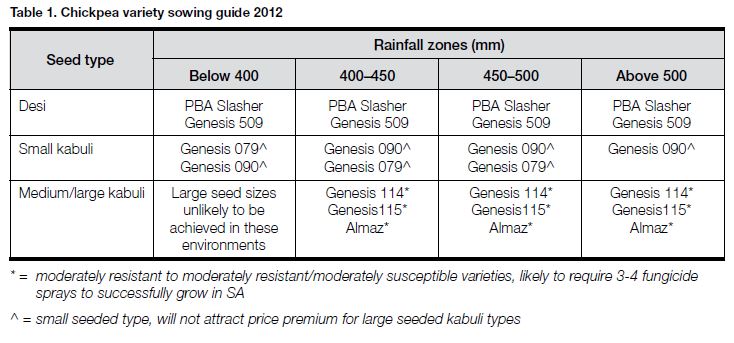
The list of suggested varieties for 2012 is shown in Table 1. A large range of variety choice is now available, offering growers the opportunity to exploit particular management and/or market opportunities. However, all current varieties still have limitations which growers need to know and manage.
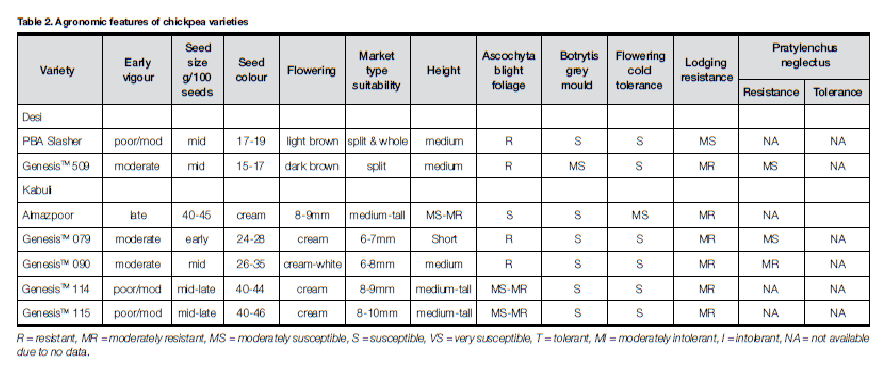
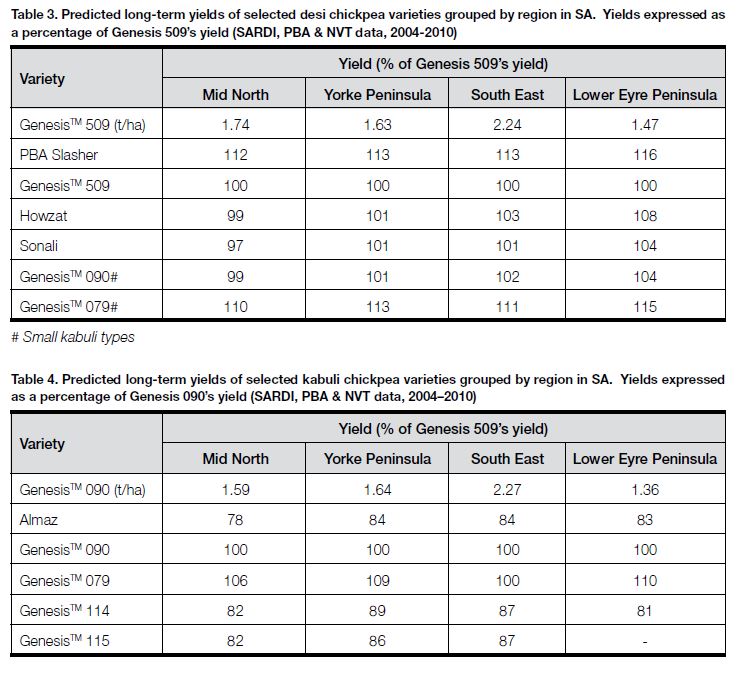
Information on key selection criteria and yield for each variety can be found in Tables 2, 3 and 4. When selecting a chickpea type and variety to grow, growers need to make their decision on the basis of AB resistance, yield, price, marketability and availability of likely target markets. Other agronomic traits such as susceptibility to cold, root lesion nematode susceptibility, maturity and lodging resistance need to be considered also.
When comparing yields, growers need to bear in mind that under high AB pressure, varieties with moderate resistance or less may suffer greater yield losses than the more resistant lines, even with the application of foliar fungicides. Larger-seeded kabuli varieties generally yield 15 to 25% lower than desi types and the smaller-seeded varieties generally yield similarly, but some can be up to 10% lower than PBA Slasher and also will not attract the high prices of the larger-seeded kabuli types.
The major price difference is between the desi and kabuli types, but small differences do exist between varieties based on seed size, appearance and marketability (Table 2).
CHICKPEA TYPES
Desi types
Larger seeds are preferred for desi types, regardless of whether their end use is splitting or whole seed. There has been an increasing use of large whole-seeded desi types in a range of food preparations in the sub continent and a small premium has been available for types fitting this use. Genesis 509 has quality of older desi chickpea types such as Tyson and is suited to splitting markets. Hence it is unlikely to achieve the prices of larger, more attractive seed types such as the northern region varieties Jimbour and Kyabra. PBA Slasher has improved quality characteristics over Genesis 509 and is suited for both the whole and split markets.
Small kabuli types
Genesis 090 is a 7–8mm seeded kabuli variety suited to bulk kabuli markets. Markets for these smaller kabuli grades have historically not been supplied by Australia and are still being developed, but prices are expected to be at least that of desis and generally slightly higher. However, growers need to be aware that while these markets are still being developed: they may have to store or hold seed from time to time as the marketing opportunities are not always available or are limited in terms of size and price. Seed size of Genesis 090 is smaller than Kaniva, Almaz and Genesis 114, so it will not attract the high prices of larger-seeded kabuli types. A number of marketers have expressed interest in Genesis 090 and have indicated the potential for a premium over the desi prices. Further premiums may be obtained by selling the seed for size. Genesis 079 produces predominantly 6-7mm seed for the bulk small kabuli markets and its fit will be guided by the success of Genesis 090.
Medium-large kabuli types
Almaz, Genesis 114 and Genesis 115 produce predominantly 8 to 10mm seed for traditional larger seeded kabuli markets where seed size is important to attract premium prices.
Selected desi chickpea varieties
PBA SLASHER (PBR)
PBA Slasher is a new desi-type chickpea with foliar AB resistance and high yields in all chickpea growing areas of SA. It has a semi-spreading plant type with mid-flowering and mid-maturity similar to Howzat. PBA Slasher has improved seed quality compared with Genesis 509, with larger seed size and superior seed colour. PBA Slasher is suitable for both the split and whole seed markets as it has improved seed size and colour over varieties like GenesisTM 509 which are likely to be suited only for split seed markets. Fungicide management trials have indicated that foliar sprays only during podding are required to successfully grow this variety (as for Genesis 090 and 509). Seed is licensed to Seed Net.
GENESISTM 509
Genesis 509 is a widely adapted desi chickpea with foliar resistance to AB. Its flowering and maturity timing are earlier than Genesis 508 and Howzat. Genesis 509 has medium plant height and moderate resistance to lodging. Seed size will predominately be in the 5-6mm range, smaller and darker than Howzat and PBA Slasher. Genesis 509 has generally yielded similarly to Genesis 090 but less than PBA Slasher in SA. Fungicide management trials have indicated that foliar sprays are required only during podding to successfully grow this variety. Seed is available through Australian Agricultural Crop Technologies.
Selected kabuli chickpea varieties
Almaz (PBR)
Almaz is a medium-to large-seeded kabuli type commercialised by AWB Seeds. Seed size is generally larger than Kaniva, with superior foliar AB resistance but inferior to that of Genesis 090. It has been 15-35% lower yielding than Genesis 090 in southern Australia and will generally require two to four foliar fungicide sprays, including a first application six to eight weeks after sowing, to successfully grow it in this region.
GENESISTM 079
Genesis 079 is a high yielding small seeded kabuli type with foliar resistance to AB and is likely to require fungicide sprays only during podding. Genesis 079 has small seed (6-7mm) and very high relative grain yields in short season environments. Genesis 079 has produced high and consistent yields in medium and low rainfall districts of SA and may have a greater potential to be crop topped and/or wick-wiped to control resistant rye grass than other varieties in these environments. Some seed of Genesis 079 is available through Australian Agricultural Crop Technologies.
GENESISTM 144
Genesis 114 is a medium-to large-seeded (8-9 mm) kabuli type chickpea with yields higher than Almaz and Kaniva but less than the smaller seeded Genesis 090. Genesis 114 has moderate foliar resistance to AB which will require strategic fungicide management to protect yield and ensure high quality seed is produced. Its flowering time is similar to Almaz and later than Genesis 090 and its plant height is medium to tall, with an erect plant type. Harvestability of Genesis 114 is excellent with greater height to lowest pod than Genesis 090 and Almaz. Seed size will predominately be in the 8 and 9 mm range and other grain quality characteristics are generally consistent with other kabuli chickpea varieties. Genesis 114 will be available through Australian Agricultural Crop Technologies.
GENESISTM 090
Genesis 090 was the first kabuli type released in Australia with foliar resistance to AB. It is a small-to medium-seeded kabuli and is therefore unlikely to attract the higher prices of larger seeded types eg Almaz and Genesis 114. Genesis 090 has medium height with semi-erect branches. Under high AB disease pressure, Genesis 090 will require fungicide protection during podding to prevent seed blemish and yield loss. It has similar (Genesis 509) or slightly lower (PBA Slasher) yields, but a current price higher than desi varieties in southern Australia. As a result, this variety offers chickpea growers a high-yielding AB resistant alternative to desi chickpeas with potential for higher returns in some years and environments. Seed is available through Australian Agricultural Crop Technologies.
GENESISTM 115
Genesis 115 is a large-seeded kabuli type similar to Genesis 114, but with later flowering and larger seed size. Genesis 115 has the largest seed size of all commercial kabuli types: it is more able to meet the size requirements of premium high valued markets. However, yield and disease resistance are inferior to the small kabuli types and equivalent to Almaz and Genesis 114. It is commercialised by Australian Agricultural Crop Technologies and limited quantities of seed may be available for 2012.