BACKGROUND
This placed a greater emphasis in 2011 on ensuring adequate nutrition levels for achieving optimal cereal growing conditions. Increasing grain protein in wheat at flowering can be very valuable. This is especially critical if wheat reaches the minimum protein level of 13% for achieving Australian Hard (AH) grade. Achieving a higher grade justifies the expenditure of additional N fertiliser, provided that there is a corresponding increase in price. The extent to which late applications of UAN can increase grain protein is not fully known, but previous BCG studies suggest that the potential is there. Therefore, some further investigation needs to be carried out to know exactly how beneficial late N applications can be.
Grain protein is very sensitive to many factors (particularly during grain filling). This makes it difficult to manage accurately (Mason and Brennan 2009). Weather, varietal choice and other nutrients besides nitrogen affect grain protein. Previous trial work relating to late applied nitrogen can be found in, 2010 BCG season research results, page 114.
TAKE HOME MESSAGES
-
to justify the use of late-applied nitrogen(N), a premium for H2 wheat (almost $60/t over ASW) was required in 2011
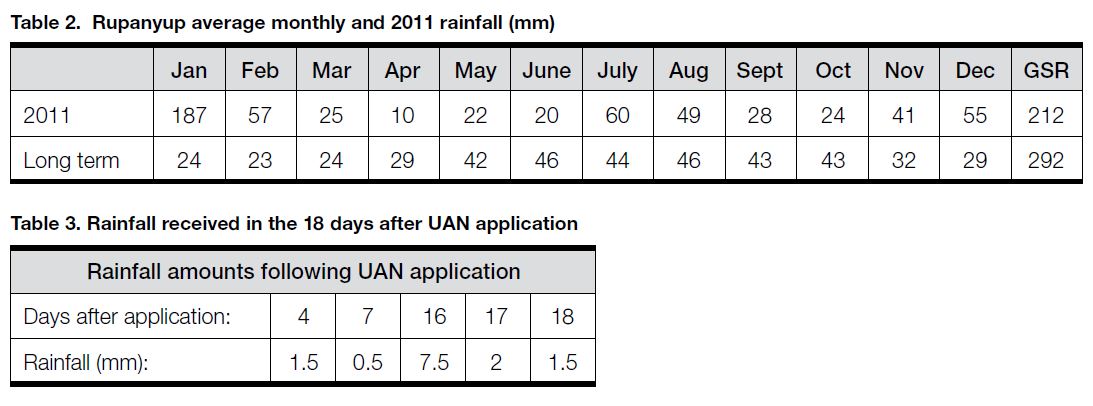
- UAN still increased protein despite, rainfall 15 days after application
-
2011 highlighted the need to apply N during tillering to promote biomass and encourage greater yield potential
AIM
To assess grain protein following late applied foliar nitrogen at booting stage in wheat
METHOD
Location: Rupanyup
Replicates: 4
Sowing date: 28th May 2011
Seeding density: 125 plants/m2
Crop type/s: Derrimut wheat
Crop Growth Stage at UAN application: head Emergence (GS55)
Inputs/Fertiliser: 70kg/ha MAP
Seeding equipment: 20 cm row spacing, knife points and finger harrows
Date of application: 5 October 2011
Fertiliser product: UAN (42% N v/v)
Organic carbon: 0.95%
Mineralised N: 27kg/ha
The trial was established on an existing wheat crop (cv. Derrimut) sown using farmer equipment into chickpea stubble. All pests, weeds and diseases were managed throughout the season accordingly to the farmer’s practice. Foliar nitrogen (UAN) was applied using a hand held 1.5m boom. Streaming jet nozzles (04) were used to reduce any effect of scorching. On the day of spraying (October 5) conditions were cool, with 100% cloud cover. Total soil nitrogen at time of application was 87kg/ha N to a depth of 1m determined through a soil test.

RESULTS
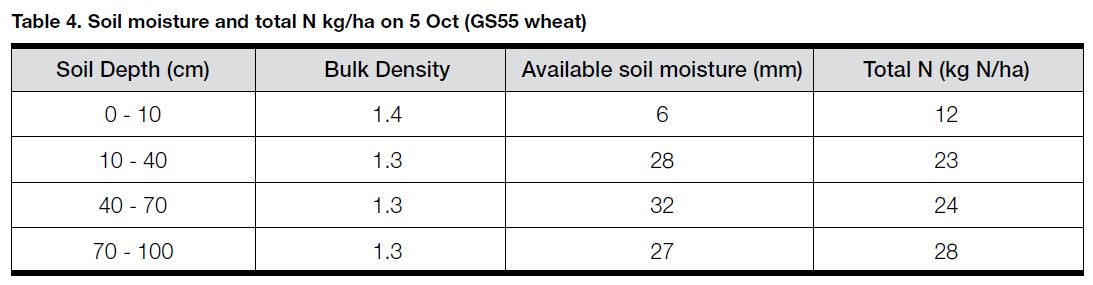
The soil analysis identified 87kg N/ha was available to the crop at GS55 to a depth of 1m (Table 4). Crop canopy was thin, with a biomass of only 4.6t/ha. Available soil moisture was 93mm, of which 87mm was recorded in the 10 to 100cm layer, a significant amount of stored water, even for a grey cracking clay (Table 4).
Applying a late application of N at GS55 did not have any effect on wheat yield. However, a significant difference was recorded in the grain protein levels amongst all treatments. Protein was found to increase as higher rates of N were applied, achieving superior grain quality (Table 5). When 56kg N/ha was applied, protein increased by 1.9% and achieved APW classification, compared with the control which achieved ASW. A premium grade of H2 wheat was achieved when 128kgN/ha was applied, with an increase in protein of 3%.

ECONOMICS
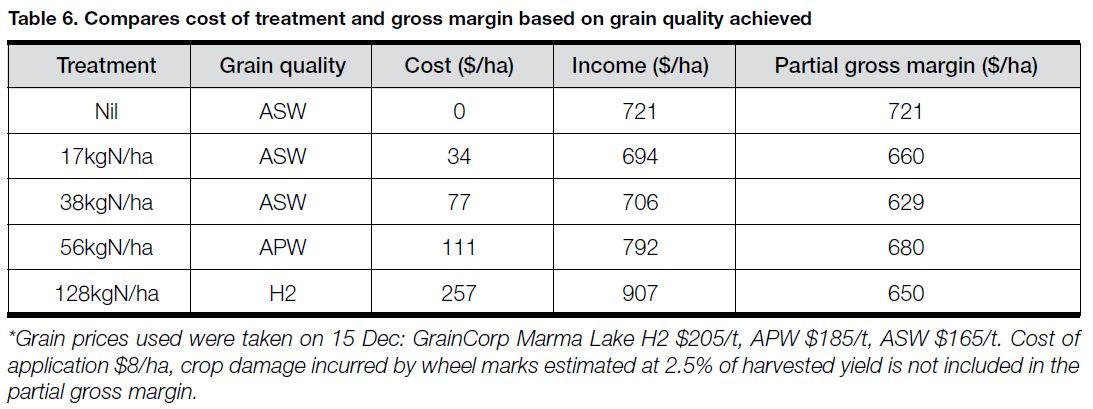
Despite achieving a higher quality of grain through increased N fertiliser rates, in the 2011 season lower than average grain prices, combined with high fertiliser costs, failed to achieve a positive return on investment. Table 6 identifies that the best gross margin based on the trial results was the nil treatment by $47/ha. In order to obtain H2 classification, treatment 5 highlighted that 128kg N/ha was required to raise the protein to 11.7%. H2 needed to be at least $58.5/t more than ASW to get a return on investment. This however is unlikely to occur as grain price spreads of this size are rare. Increasing from ASW to APW gave a positive return on the investment of UAN. However, for the partial gross margin, there is a negative ROI for all treatments (except for the nil treatment).
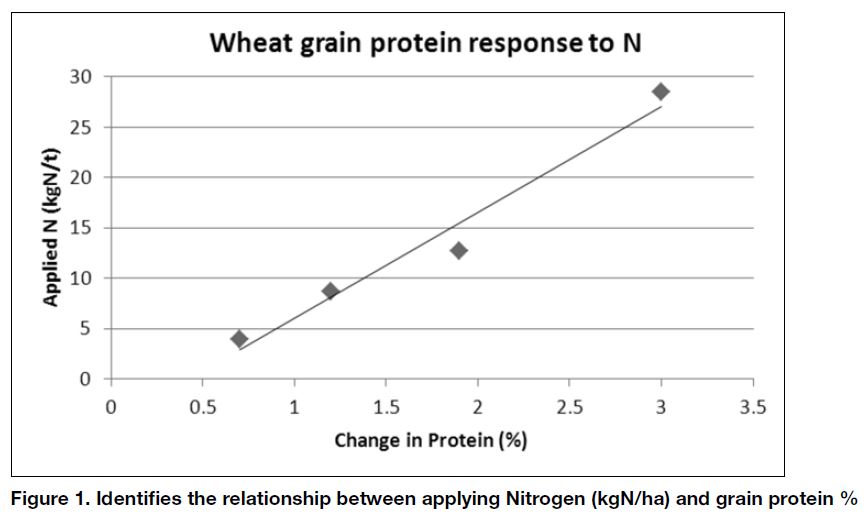
It was evident in the 2011 season that there was a close relationship between applied N and increased grain protein (figure 1). The trial identified that on average 7.5kgN/ha/t of grain produced was needed to increase protein by 1%.
INTERPRETATION
This trial highlighted that Nitrogen can have a significant effect on wheat (c.v Derrimut) grain protein levels when applied at GS55, but that a yield response is unlikely to be achieved. It could be concluded that the combination of a dry top-soil at the time that treatments were applied and the fifteen days that elapsed before a significant rainfall may have influenced the plants’ ability to uptake the nitrogen sufficiently quickly to influence yield. Despite fifteen days before a sufficient rainfall, the UAN still increased protein.
An ‘Increasing grain protein with late nitrogen application trial’, conducted by BCG in 2010, found that to increase wheat grain protein by 1% in a 5t/ha crop, 13kg N/t of harvested yield is needed. Long term rule of thumb indicates requirements at about 10kg N/t of harvested yield.
This trial supports these findings, as treatment 5 required 9.5kg N/t of harvested yield in order to increase protein by 1%. Furthermore, it can also be stated that in 2011 the association between applied nitrogen and protein response was very close to linear. This trial identifies an average of 7.25kg N/ha/t of harvested yield was needed for a response, of increasing grain protein by 1%.
Above average rainfall over the summer months of December 2010 and January 2011 at Rupanyup enabled the heavy self-mulching clay soils to build up a considerable amount of stored water for the 2011 season. However, this resulted in high levels of de-nitrification, which meant that the majority of soils were low in available nitrogen. If growers were to achieve high quality wheat they needed to apply excessive levels of nitrogen fertiliser throughout the season. As this trial identifies, achieving high protein wheat in 2011 would have incurred an unsustainable cost, to the point at which the risk was far greater than the return.
COMMERCIAL PRACTICE
In 2011, to break even on the investment based on applying 128kg N/ha of UAN, a grower would need to increase yield by 0.3t/ha and still achieve a 3% increase in protein. With a thin crop canopy and a low level of N in the top-soil, this trial strongly supports the importance of applying N during tillering to promote biomass and a greater yield potential.
The small premiums earned for producing a higher quality product hardly justify the extreme cost and risk of attempting to achieve them. The assertion that “Yield Is King” stands true in this trial and the 2011 season overall.
ACKNOWLEDGEMENTS
This project was funded by BCG members, through their membership fees.