Take home messages
- lambs grazed on forage brassica at Jil Jil from November 2011 to early January 2012 achieved adequate growth rates (230 g/head/day). The forage brassica provided green paddock feed for nearly two months during harvest, saving stubbles for later use and avoiding hand feeding
- Winfred is a forage brassica with a high vernalisation requirement which makes bolting unlikely when sown in winter in the southern Mallee. Winfred responds to late spring and early summer rainfall events providing nutritious green feed during this traditional feed gap period
Background
Managing stockfeed during the spring feed gap between senescence of annual pastures and when stubbles become available often presents a challenge to livestock managers in the southern Mallee. Forage brassica crops have a spring and summer growth habit, but when sown in winter, can utilise late winter and early spring rainfall to produce high quality feed for early summer. This can provide an option to manage the feed gap.
Forage brassica crops are a highly digestible feed source with good protein (18%) and energy (12+MJ ME/kg DM) levels. Winfred is a forage brassica which is a cross between turnip and kale. Winfred has better regrowth potential than other brassicas and is able to withstand long dry spells. In low rainfall areas it can be sown from early May to early August; capturing spring rain for maturity at about October, at which time it is ready to graze. Winfred is very resilient and will respond to late spring and summer rainfall events, providing nutritious green feed during the October-December period when medic pastures have senesced and stubbles are not yet available.
Winfred is ready for grazing when it matures, which can be as early as 75 days after winter sowing or when the margins of leaves begin to turn purple. It can be grazed for several weeks. Winfred can be grazed rotationally, but it is often easier to graze it continuously. Rotational grazing provides an advantage when regrowth is expected.
Aim
To demonstrate the feed value of a forage brassica as spring/early summer grazing option and to measure lamb growth rate performance.
Method
Location: Jil Jil
Sowing date: 9 June 2011
Seeding density: 3 kg/ha
Crop type/s: Winfred forage brassica
Sheep breed & class: Merino lambs
Inputs/Fertiliser: MAP @ 50 kg/ha + top-dressed twice with urea totaling 180 kg/ha
Seeding equipment: 10 inch row spacing, knife points and press wheels
A 2 ha paddock was prepared with a knockdown of Roundup @ 2L/ha, Estercide 800 (200ml/ha), and Goal @ 75 ml/ha on 26 May, and worked up with the Avon seeder on 6 June to prevent trash flow issues at sowing.
The paddock was then sprayed with Triflur X @ 1.5 L/ha and 2 L/ha Roundup and sown on 9 June with Winfred forage brassica at 3 kg/ha treated with Gaucho seed dressing, using minimum tillage. On 10 June, Mouse-off was broadcast across the paddock for mouse control. On 3 August, 100 kg/ha urea was broadcast; a further 80 kg/ha urea was applied on 26 September. On 3 October, an in-crop herbicide spray of Select (500ml/ha) was applied, using 1% Hasten.
On 10 November, 32 Merino lambs were weighed, drenched and introduced to the paddock (a stocking rate of 16 lambs/ha). Feed was visually assessed by an experienced assessor, and the number of potential grazing days estimated for the flock size. No supplements were given to the lambs.
Three weeks later (30 November) lambs were weighed to measure growth rates during the adjustment period, when the rumen makes microbial changes to digest a new feed type. They were returned to the paddock and left to graze for three weeks, weighed again, and returned to the paddock for a final three week grazing period.
On 2 January 2012, sheep were removed and weighed for a final time.
Results
Visual assessment of feed on the day lambs were introduced, 10 November, estimated 2 t/ha dry matter available, which equated to 60 grazing days for the 32 Merino lambs. Body weight of lambs averaged 27.5 kg/head at the time of introduction to the Winfred.
When weighed three weeks later on 30 November, lamb bodyweight averaged 29.7 kg/head, the change in bodyweight equalling an average growth rate of 100g/head/day.
By 20 December, lamb bodyweight averaged 36.3 kg/head, equaling an average growth rate of 330 g/ head/day for that three-week period.
Due to dry conditions, feed was finished after 52 days, on 2 January, 2012. The final weigh measured an average body weight of 39.6 kg/head, indicating an average growth rate of 275 g/head/day as the Winfred was finishing growing.
The average weight gain/lamb/per day was 230 grams over the 52 day period (Table 1).
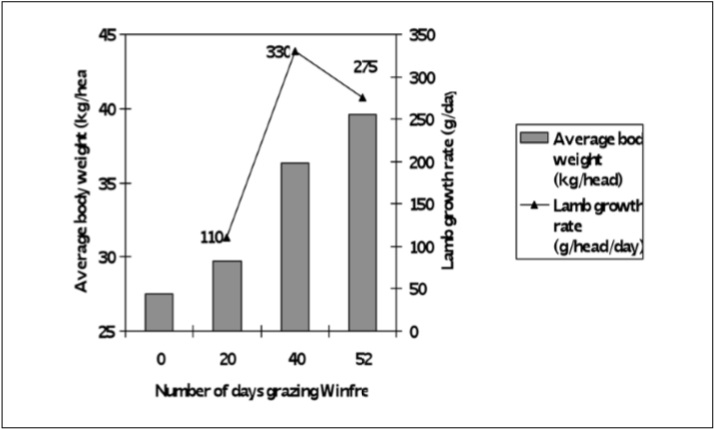
Figure 1. Production of lambs grazing Winfred forage Brassica at Jil Jil, 10 Nov 2011– 2 Jan 2012.
This forage brassica variety was also grazed over the summer of 2010-2011. The property livestock manager, Warrick McClelland, made a comment that the forage crop made use of some smaller paddocks, usually used to handle stock rather than cropping. Having the brassica crop meant that they did not have to hand feed lambs while waiting for stubbles, and avoided the risk of losses due to grain poisoning. The forage crop was able to make use of moisture late in the season when medic and vetch pastures had finished.
In 2010-11 they were impressed by Winfred’s ability to recover from multiple grazing events and keep producing green forage right through until February. However, spring and summer rainfall of 2010-2011 was well above average, which enhanced forage production. The summer of 2011-12 received much lower rainfall, and has demonstrated the plant’s performance in a different season.
Interpretation
Winfred forage brassica provided nutritious forage for the growing lambs for 52 days at a time when regenerating pastures had finished and stubbles were not yet available, or were just becoming available as harvest proceeded. It provided a paddock that didn’t require supplementary feeding expenses or time, and green feed to continue rumen development.
As expected, growth rates over the first 3 weeks began slowly with the change of diet. As the lambs became accustomed to the new feed and their rumens adjusted to accommodate it, growth rates rose to average 309 g/head/day for the remaining 4.5 weeks. Growth rates began to decline as Winfred reached maturity.
The Merino lambs averaged 230 g/head/day over the total grazing period, which is quite acceptable given the June sowing and dry conditions. In most situations Merino lamb growth rates are around 200 g/head/day (B. Ashton, Sheep Consultancy Service Pty Ltd).
Commercial Practice:
- in a low rainfall Mallee system, sow a smaller paddock to Winfred to facilitate better grazing management. A large paddock will be hard to stock adequately, to graze evenly and keep up with plant growth rates. Ungrazed leaves will age, becoming less palatable and eventually die: a waste of feed.
- sow in early (May) rather than later in this environment, due to the occurrence of unreliable springs and to sporadic summer rainfall. However, be careful not to sow too early, as plants may mature prematurely and not be able to capitalise on late season rains to fill the feed gap between medic pastures and grain stubbles.
- while it’s tempting to leave weeds for feed, do not compromise on weed control. This ensures that there is no competition with the forage crop, and that the brassica fulfils its break crop role in the paddock rotation.
- Warrick McClelland is pleased to have an alternative forage source for his lambs for the late spring/ early summer feed gap that sustains growth rates and has low management needs (reducing labour requirements).
- next season, Warrick plans to sow four small paddocks totalling 50 ha. This will prevent lamb losses from over-eager consumers of grain and provide nutritious green feed for his lambs over the OctoberDecember period.
Acknowledgments
This demonstration was supported by Grain & Graze II, Stephen Pasture Seeds and Birchip Best Wool Best Lamb group.