BACKGROUND
Often one of the challenges of high yielding seasons is ensuring the grain protein falls within the premium malt grades (9-12% protein). Premiums for Malt barley are attractive, especially if there is not a lot around, but attempting to increase proteins with late applications becomes difficult. Rates and timing can dramatically influence the increase in protein; the challenge is to avoid exceeding the maximum of 12% protein. In the past, we have tried to apply nitrogen before stem elongation (GS30) to avoid to the risk of high protein in drier finishes. Recently, some growers have taken to applying a small amount of Easy N® (or UAN), 25-30L/ha, during late booting to flowering, simply to increase protein. Anecdotally, farmers and advisors claim that this does significantly increase protein, but to what extent is not known.
As part of a continued GRDC-funded tri-state project (DAV00138, previously DAV00104), BCG is investigating the specific agronomy management practices for new barley varieties in a no-till farming system. These include responses to time of sowing, nitrogen and disease management (particularly scald). This paper reports on the findings of a trial conducted in 2011 comparing different barley varieties’ response to late nitrogen (N) application for increasing protein.
TAKE HOME MESSAGES
-
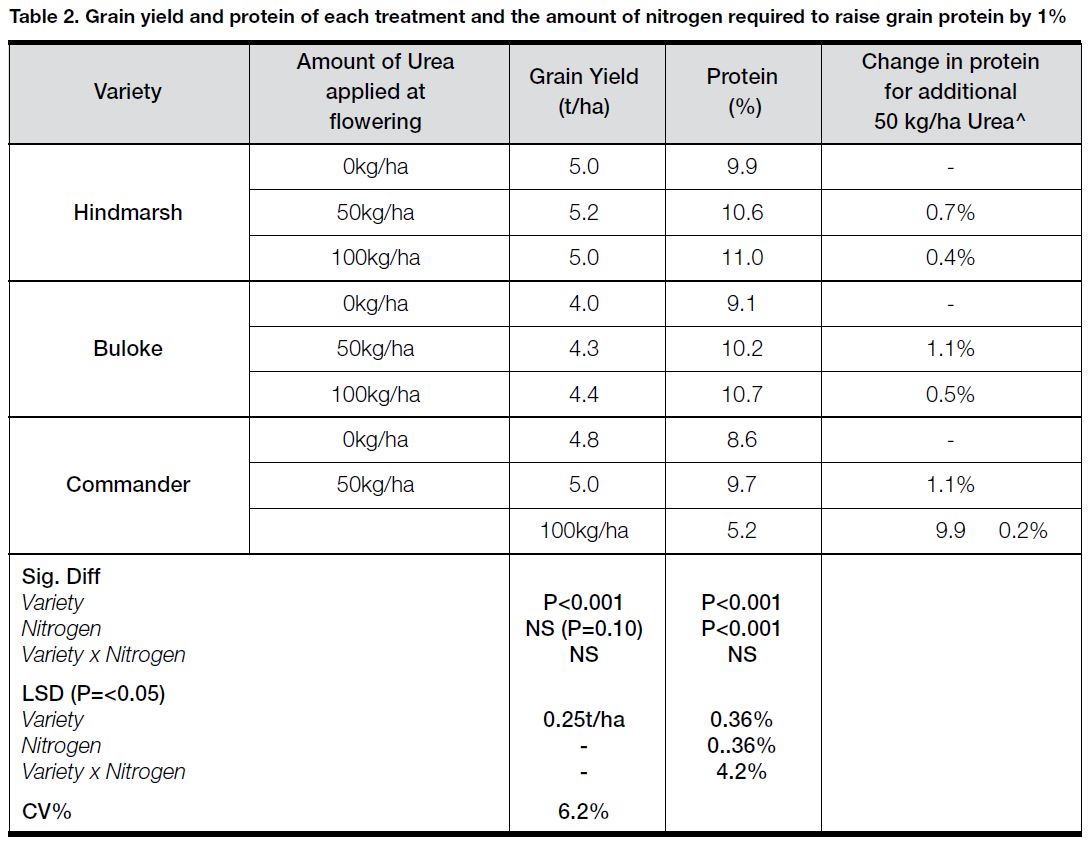
Commander was the only variety which did not meet the minimum protein of 9% to achieve malting quality. 50kg/ha Urea was required to increase Commander’s protein into the malt range from 8.6% to 9.7%
-
to increase grain protein by 1%, 10kg/ha Urea is required for every tonne of expected yield. For example, a 5t/ha crop requires at least 50kg/ha Urea.
-
applying nitrogen (N) later in the season, when the yield potential is relatively certain, knowing the N (available soil N, mineralisation and applied N) available to the crop, will help refine the amount of N required.
AIM
To measure increases in grain protein in various barley varieties at flowering with different
METHOD
Location: Rupanyup
Replicates: 4
Trial design: complete randomised block
Sowing date: 20 May 20011
Target plant density: 150 plants/m2
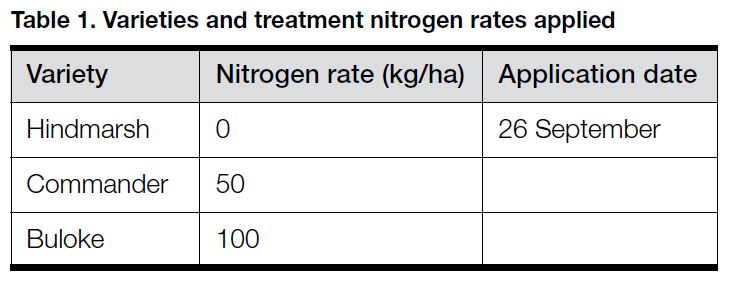
Varieties: Hindmarsh, Buloke, Commander
Sowing rates: 74kg/ha Hindmarsh, 84kg/ha Buloke, 76kg/ha Commander
Fertilisers:
20 May – 50kg/ha MAP (10% N)
25 June – 90kg/ha Urea (46% N)
3 August – 90kg/ha Urea
26 September – treatment application (see Table 1)
Herbicides:
20 May – Roundup PowerMax® 2L/ha + Goal 100ml/ha Triflur X® (2L/ha) + Avadex Xtra® (2L/ha)
27 July – Velocity® 670ml/ha + MCPA LVE® 350ml/ha
Fungicides: 13 October – Prosaro® (300ml/ha) + BS1000 (0.25% v/v)
Seeding equipment: BCG Gason Parallelogram seeder (knife point, press wheels, 30cm row spacing)
A handheld GreenSeekerTM was run over individual plots at regular intervals (27 July, 22 Sept, 27 Oct) to determine differences in the “Canopy Greenness”. The GreenSeeker measures the light reflectance from the crop canopy at different wavelengths. The reflectance in the red and infrared wavelengths is strongly influenced by chlorophyll content (“greenness”) which is related to the leaf area and biomass of the crop. The GreenSeeker was used in this trial to identify any increase in the canopy greenness with the application of N during flowering.
The trial was harvested using a Kingaroy plot harvester on the 23 November. A sub-sample was retained to determine the individual grain quality for variety and treatment. Grain protein was measured using a FOSS grain infratec analyser.
An analysis of variance was used to test for significant effects of treatments and interaction between treatments. Least significant differences were calculated at the 95% confidence level.
RESULTS AND INTERPRETATION
From the soil analysis taken in April, there was 109kg N/ha (0-100cm) available to the crop following the previous 6-7t/ha barley crop. These figures were based on both nitrate and ammonium N.
Soil plant available moisture in the profile measured 120mm. The site received 467mm of rain from January to November. Of that, 163mm was received during the growing season (April to October). Assuming the starting N and moisture, with a yield potential of 5-6t/ha, further N would be required.
No significant differences were found in plant emergence between the varieties and the nitrogen rates as expected. The targeted plant density of 150plants/m2 was not achieved. The average plant density across all treatments was 115plants/m2. At sowing, there was high level of mouse activity. The site was baited multiple times with Mouse-off® at 1kg/ha, shortly after sowing, but mice had consistently eaten a seed every 7-10cm along the drill rows. This is likely to have accounted for the 30-40 fewer plants in the density. As there were no differences between any of the varieties and treatments, lower plant density probably had no bearing on the subsequent results.
Nitrogen was applied in two separate applications of 90kg/ha Urea on 25 June and 3 August. This was to ensure that the yield was not limited by N. Based on the rainfall to date and the number of heads, the yield potential of each variety was between 4.5 and 5t/ha. Subsequently, the total N rate was revised to 50 and 100kg Urea/ha to achieve the targeted 5 and 10kg N/tonne of expected yield/ hectare required to increase protein by 1%. By September, when the target application was due, the site did not receive sufficient rainfall until the 28th, when 15mm was recorded over five days. The treatments were applied prior to this event on 26 September. This meant the growth stage was closer to full head emergence and flowering than to mid-late booting.
Grain protein of both Hindmarsh and Buloke were above 9% without the addition of any further N (Table 2). Commander was lower in protein than both Buloke and Hindmarsh, and in the absence of further N, was below the minimum protein specifications for Malt. However, the application of N increased the protein level by 1% at 50kg/ha Urea; subsequently, it achieved Malt classification (Figure 1). There was a strong effect of nitrogen rate and variety, but there was no interaction between variety and nitrogen. This means that even though varieties may differ in their grain protein, they all respond similarly to N applied at flowering.
There was no measurable difference in grain yield identified from the application of N at flowering in any of the treatments. Both Commander and Hindmarsh yielded similarly (around 5t/ha), whilst Buloke was lower (4t/ha.). When comparing the change in protein with the different amounts of applied N, the 50kg/ ha rate was found to have a much higher change in protein than the 100kg/ha. The change in protein from the first 50kg/ha doubled the change at the next 50kg/ha.

The N applications had no significant effect on retention, screenings and test weight.
INTERPRETATION
Adding nitrogen at flowering increases protein. Hindmarsh and Buloke had protein levels sufficient to meet the Malt grade without further N, so there was no economic benefit. If no further N was applied to Commander, the protein would not have achieved Malt. So was it worth the investment to top-dress? Given grain protein levels for both Buloke and Hindmarsh, applying further N only incurred a higher cost and subsequently produced a lower return. Where a protein difference did occur, in Commander, there would have been an increase of $90/ha income, easily accounting for the cost of the N ($37/ha).
There was no statistically significant effect on yield found in this trial. However, there was a significant difference in yield at the 50kg/ha rate, assuming a 90% confidence (P=0.10). If we can assume a yield increase, then the practice of late N application may be considered to be low risk. This is because there needs to be only a 200-300kg/ha yield increase to cover the cost of the N. Measuring such small difference in yield requires a higher number of replicates than was used in this trial.
Results from BCG trials in 2010 showed slightly less N was required to increase protein in barley compared with wheat. There was a 0.8% increase for 25kg N/ha, applied as UAN, in late sown Gairdner barley. This is consistent with the findings in this trial. However, there was no yield increase after application of additional N late in either wheat or barley. An article on increasing protein in wheat with late-applied nitrogen can be found on pages 91-94.
COMMERICAL PRACTICE
Knowing the starting soil N and moisture, together with what has been applied and mineralised, the practice of predicting the amount of N required to increase protein becomes simpler. Without this knowledge the practice is more difficult. The risk of late N applications appears lower for barley than for wheat if those parameters are known, principally because its yield is more certain than that of wheat.
Varietal choice can have a greater impact on the bottom line than quality. Growing a 5t/ha Hindmarsh crop (Hindmarsh Malt or Feed) with no further N would be more profitable than Buloke Malt at any N rate. That being said, Commander yields similarly to Hindmarsh. If protein is expected to be below 9%, then applying N after head emergence may be more profitable.
ACKNOWLEDGEMENTS
This project was funded by GRDC (Project code: DAV000138)