BACKGROUND
Pulse Breeding Australia (PBA), in conjunction with lentil commercial seed partner PB Seeds Pty Ltd (Horsham,) will be releasing the first lentil variety with improved herbicide tolerance for 2012 sowings. PBA Herald XT (CIPAL 702) will be released with improved tolerance to label rates of flumetsulam (Broadstrike®, Multitude®).
Post emergent applications of flumetsulam at label rates have regularly resulted in yield losses of up to twenty percent in all current lentil varieties on alkaline soils. The availability of PBA Herald XT will provide growers with a variety less prone to yield loss when an application of flumetsulam is required to control certain broadleaf weeds.
PBA Herald XT also shows reduced sensitivity to some sulfonylurea and imidazolinone herbicide residues from previous crop applications, but product label rates, plant-back periods and directions for use must still be adhered to in this variety. PBA Herald XT is part of a concerted effort by the PBA lentil program to improve weed control options in lentil. Further work targeting tolerance to alternative herbicide groups is ongoing.
A large range of lentil variety choice is available, offering growers the opportunity to exploit particular agronomic management and/or market opportunities. When selecting lentil varieties, growers need to take into account varietal differences in grain yield, disease resistance (botrytis grey mould and ascochyta blight), agronomic adaptation, marketability and now new herbicide tolerance.
However, all current varieties have some limitations of which growers need to be aware and for which they must manage. Careful variety selection, together with the correct implementation of recommended agronomic management packages (see PBA variety release brochures, Lentil ute guide and Pulse Australia’s website for detailed management information), will increase the chances of maximising grain yield and quality.
Growers can spread their disease, yield and marketing risks by growing more than one variety, providing that the varieties chosen differ in their disease, maturity and marketing characteristics. Variety purity is very important in lentils, with a restriction of 1% for varieties not of the same type. This is of particular concern when growing varieties with different seed coat colour and/or different cotyledon colour (Table 2). Be aware of the potential for contamination from volunteer or ‘escaped’ lentils in paddocks when changing to new varieties with different seed coat colours i.e. Northfield to Nipper, Nugget to PBA Flash or Aldinga to PBA Jumbo. Seed dressings are recommended, particularly if growers are sowing seed which was infected with disease the previous year.
Price differences can occur between varieties across seasons, but growers need to produce high quality seed in all varieties to secure markets and achieve the highest prices. On-farm storage can assist in attaining the highest price for grain in some seasons, allowing for lentils with poor quality issues or contaminants to be stored until appropriate cleaning and marketing can occur. Timely harvesting is recommended in lentils to minimise seed discolouration and weather damage and to reduce the risk of yield loss from strong winds when the crop is ripe.
SELECTION CRITERIA
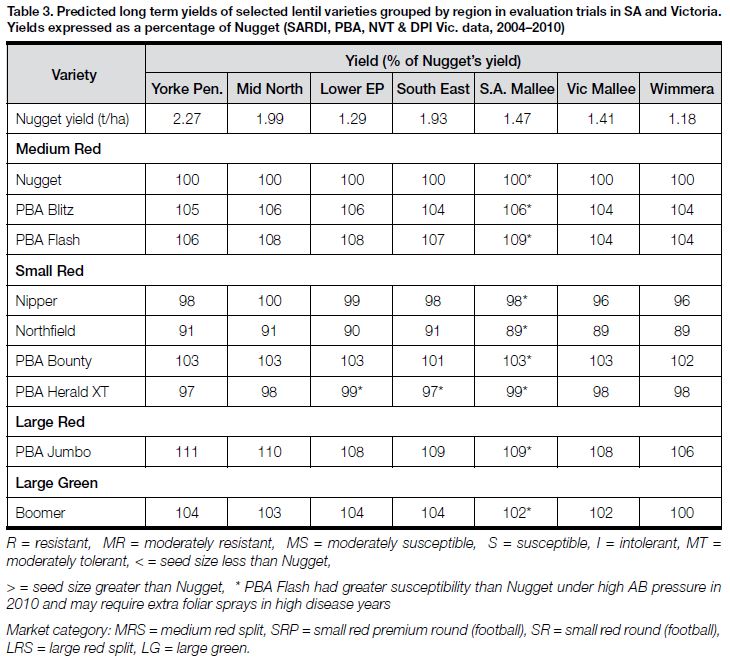
Information on the most important selection criteria, grain yield, disease resistance, maturity, standing ability, shattering and seed type/quality for each variety can be found in Tables 2-3. When selecting a variety, growers also need to consider their individual farm and paddock situation and the access and availability of likely target markets and to make their selection on all available information.
Notes on selected varieties
Medium Red Lentils
PBA Blitz (PBR)
PBA Blitz is suited to all current lentil areas. It is particularly suited to shorter-season areas where its combination of mid to early flowering, early maturity, high yield, good disease resistance and medium to large seed size will improve lentil reliability and economics of production. PBA Blitz is the earliest maturing lentil variety and the best option where crop topping and/or delayed sowing are practised. PBA Blitz’s improved early vigour is superior to that of all other red lentils varieties and it is an erect plant type. It is rated as resistant to foliar and moderately resistant to seed ascochyta blight (AB); moderately resistant to botrytis grey mould (BGM), similar to Nugget and improved compared with PBA Flash. It is well suited to no-till and inter-row sowing into standing residue. PBA Blitz is a medium-sized red lentil (larger than PBA Flash and Nugget), with a grey coloured seed coat and is commercialised by PB Seeds.
PBA Flash (PBR)
PBA Flash is a high yielding red lentil with a green seed coat and medium seed size. It is well-suited to shorter season and lower-yielding lentil growing areas where its higher yield and earlier maturity improves reliability. Earlier maturity also makes PBA Flash better suited to crop topping than Nugget, although caution is still required with this practice due to seasonal variation in weed and crop maturity. It is moderately susceptible to AB and may require foliar fungicide sprays prior to flowering and at podding to control this disease under high intensity situations or in disease prone environments. PBA Flash is susceptible to BGM but has improved tolerance to boron and salinity compared with Nugget. PBA Flash has improved standing ability at maturity relative to other lentil varieties, which may make it more prone to pod drop in windy environments; timely harvest is required. PBA Flash is less likely to split than Nugget and is usually well suited to medium red lentil grain markets.
SMALL RED LENTILS
PBA HERALD XT
PBA Herald XT was evaluated as CIPAL 702 and relseased in 2011. It is a mid to late flowering and maturing red lentil, similar to Nipper in many characteristics with low plant height, round seed shape and grey seed coat colour. It is resistant to ascochyta blight and moderately resistant to BGM. PBA Herald XT has improved tolerance to some group B herbicides, including flumetsulam (Broadstrike®, Multitude®) at the registered rate for lentils. Post emergent applications of flumetsulam have regularly resulted in yield losses of up to twenty percent in lentil varieties at label rates on alkaline soils. The availability of PBA Herald XT will provide growers with a variety that is less prone to yield loss when application of flumetsulam is required to control certain broadleaf weeds. Preliminary herbicide screening experiments on alkaline soils indicate that PBA Herald XT has increased sensitivity to metribuzin when compared with Nugget, PBA Flash, PBA Jumbo and PBA Blitz but similar to that observed in Nipper. Seed will be available from PB Seeds for 2012 sowings.
PBA BOUNTY (PBR)
PBA Bounty is a high-yielding small seeded red lentil that is broadly adapted and suited to most lentil growing environments with high relative yields in the southern Mallee region of Victoria. PBA Bounty is moderately resistant to AB, moderately susceptible to BGM and has greater tolerance to salinity than Nugget. PBA Bounty has a prostrate growth habit early in the season compared with all other varieties. PBA Bounty produces a small round seed that is slightly larger (10%) than Nipper, but still likely to be sold into similar markets for splitting or the productionn of “footballs” (whole seed with the seed coat removed).
NIPPER (PBR)
Nipper has resistance to both ascochyta blight and BGM and is a low cost, low disease risk option in disease prone areas. Nipper has a seed size similar to Northfield but is grey in colour. Nipper, like Northfield, flowers later than Nugget, but often matures earlier. Long-term yields in southern Australia show that Nipper generally yields more than Northfield and similarly to Nugget. However, it has been lower yielding than Nugget in short season environments or situations in which it has produced less growth. Due to its disease resistance, only one fungicide application (at canopy closure) will be required to effectively control BGM in most situations. Nipper is also favoured for the practice of early sowing due to the combination of lower biomass production and high level of disease resistance. Nipper is more sensitive to metribuzin than other varieties and caution is required to avoid application when conditions are conducive to damage. Nipper is licensed to Seed Net.
Large Red Lentils
PBA Jumbo
PBA Jumbo is the highest-yielding large-seeded red lentil and is a direct replacement for Aldinga. It is suited to most current lentil growing areas, where it has consistently yielded around 15% higher than Aldinga. Attaining larger seed size is more likely in medium to high rainfall zones. PBA Jumbo is moderately susceptible to BGM and this disease needs to be managed in disease prone areas. It has resistance to foliar and seed AB, an improvement from Aldinga. Plant type and lodging susceptibility is similar to those of Aldinga and, like this variety, PBA Jumbo is well-suited to no-till, inter-row sowing into standing residue. PBA Jumbo is more tolerant of soil boron and salinity than either Aldinga or Nugget. It has a seed size and shape similar to Aldinga’s (20% larger than Nugget) and a grey seed coat. Like Aldinga, it is well suited to the post-harvest removal of small broadleaf weed seeds. Milling quality is better than Nugget and it is well suited to premium large red split markets such as those in Sri Lanka. PBA Jumbo is commercialised by PB Seeds.
Large Green Lentils
Boomer
Boomer is a large-seeded high-yielding green lentil released as Australia’s first adapted green variety for all lentil growing areas. It has superior seed size to Matilda (approximately 30% larger), making it more competitive than this variety in world export markets. Boomer has a large plant type and can produce prolific amounts of growth which makes it prone to lodging under favourable growing conditions. In less favourable growing conditions its improved vigour and plant height can be an advantage. It has improved resistance to AB and BGM compared with Matilda. Boomer will be best adapted to medium rainfall areas of southern Australia with mild finishing conditions to ensure that the large seeds can fully form. Ascochyta blight must be managed during podding to avoid disease blemish on the seed coat. Boomer is moderately susceptible to shattering at maturity (more susceptible than current varieties). Delayed harvest under some conditions can result in shattering and/or loss of green seed colour resulting in downgrading. Boomer is licensed to Seed Net.