BACKGROUND
During the 2011 growing season, barley crops were subject to severe leaf rust (Puccinia hordei) infection. Other stubble-borne diseases, such as spot form of net blotch (Pyrenophora teres f. maculate), were also present but were less of an issue. This was due to an extremely wet summer, which favoured the carry over of rust on volunteers, and to a dry period during the spring months, which was unfavourable for splash dispersed pathogens such as net blotch.
Leaf rust is typically prevalent in barley crops throughout Victoria. However, following dry summers, it is generally found at low levels and has minimum impact on yield (McLean et al. 2010). Under high disease pressure, yield losses of up to 30-40% have been found to occur (Loughman 2002). Spot form of net blotch (Pyreophora teres), (SFNB), is also a common disease in barley in Victoria (McLean et al. 2010) and was present in this field experiment at moderate levels. A severe infestation can cause yield losses, but it is more likely to result in reductions to grain quality.
The climatic conditions experienced during 2011 allowed BCG to quantify the effects of leaf rust on grain yield in an experiment that was originally designed to assess varieties for their tolerance to scald (Rhynchosporium secalis). As the first trial with variety-specific data collected in Victoria, it is extremely valuable.
The experiment was part of the GRDC-funded Southern Barley Agronomy (DAV00138) project, in which new and current barley varieties were investigated for variety-specific management. This included comparison between eight different varieties, with and without fungicide treatment. The project involves BCG working collaboratively with the DPI pathology team, led by Grant Hollaway and Mark McLean.
TAKE HOME MESSAGES
- severe leaf rust infections can cause yield losses of up to 26%
-
grain yield, straw strength, retention, screenings and test weight are all affected by leaf rust infection
-
growing resistant barley varieties significantly reduced the amount of leaf area affected by leaf rust as well as the associated grain yield and quality
AIM
To assess new and current varieties for their tolerance to leaf rust (Puccinia hordei)
METHOD
Location: Rupanyup (100 km south of Birchip)
Replicates: 4
Sowing date: 20 May 2011 (harvested 22 November)
Target plant density: 150 plants/m2
Seeding equipment: BCG Gason parallelogram seeder (knife point, press wheels, 30cm spacing).
Crop type: barley
Varieties: Commander, Hindmarsh, Buloke, Fleet, Scope, Wimmera, Oxford, Gairdner
Fertiliser:
20 May 50kg/ha MAP (10% N, 21.9% P)
5 July 217kg/ha Urea (46% N)
3 August 90kg/ha Urea
Herbicides:
20 May Roundup PowerMax (2L/ha) + Goal (100ml/ha), TriflurX (2L/ha) + Avadex Xtra (2L/ha)
27 July Velocity (670ml/ha) + MCPA LVE (350ml/ha)
Experiment design: Split plot with, minus and plus fungicide
Fungicide Product: 300 ml/ha Prosaro® (prothioconazole + tebuconzole) + BS1000 (on fungicide treated plots only)
Application dates: 14 July (GS13), 8 August (GS30-1), 26 August (GS37-8), and growth stage: and 13 October (GS71)
Note: Commercially no more than two applications of 300ml/ha Prosaro are registered in wheat and barley in one season. The number of applications and rate used in this trial was necessary to ensure that the treated plots were not subjected to late infections and/or other diseases. It is stressed that, commercially, no more than two applications should be used.
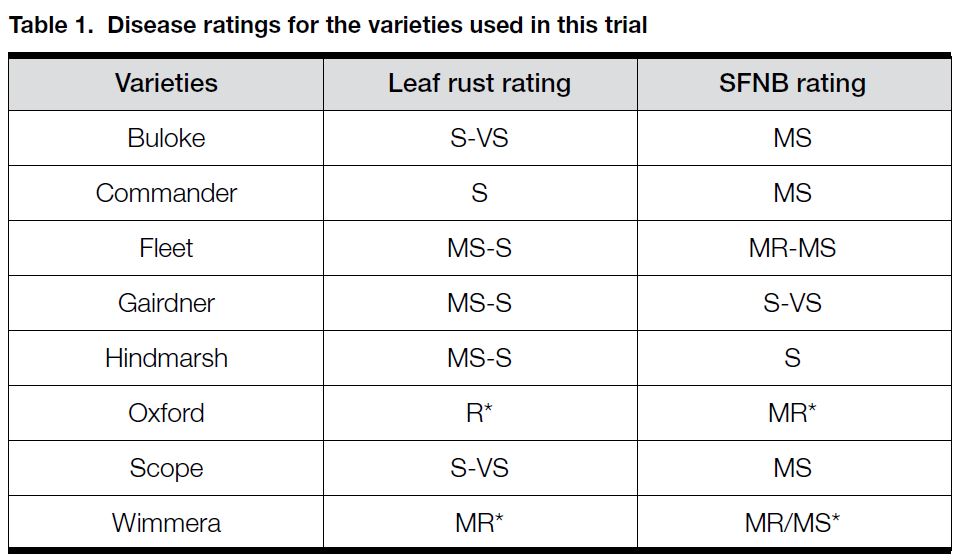
Disease ratings have been obtained from the DPI ‘Winter Crop Summary 2011’ guide and the Department of Primary Industries “Cereal Disease Guide”. * These are preliminary ratings that are based on limited data.
The trial was sown using a split-plot design with four replicates. The varieties (8) were randomly allocated to main plots and fungicide treatments (2) were randomly allocated to split plots within them.
A handheld GreenSeeker® was run over individual plots at regular intervals (GS31, 55, 77) to determine differences in the “Canopy Greenness” of fungicide treated and untreated plots. The GreenSeeker measures the light reflectance from the crop canopy at different wavelengths. The reflectance in the red and infrared wavelengths is strongly influenced by chlorophyll content (“greenness”) which is related to the leaf area and biomass of the crop.
Leaf rust and SFNB severity were visually scored as a percentage of leaf area infected for each barley plot on 12 October. Lodging assessments were visually scored by estimating the percentage of the total plot that was lodged. Head counts were initially completed after harvest using a 0.1m2 quadrat, but the variation was too great and a repeat measurement was taken using a larger 1x1m2 quadrat at three locations throughout each plot, but only for Buloke, Hindmarsh and Fleet.
The trial was harvested using a plot harvester on 22 November. A sub-sample was retained to determine the individual grain quality for variety and treatment.
An analysis of variance was used to test for significant effects of treatments and interaction between treatments. Least significant differences were calculated at the 95% confidence level.
RESULTS AND INTERPRETATION
DID THE LEAF RUST AFFECT GRAIN YIELD?
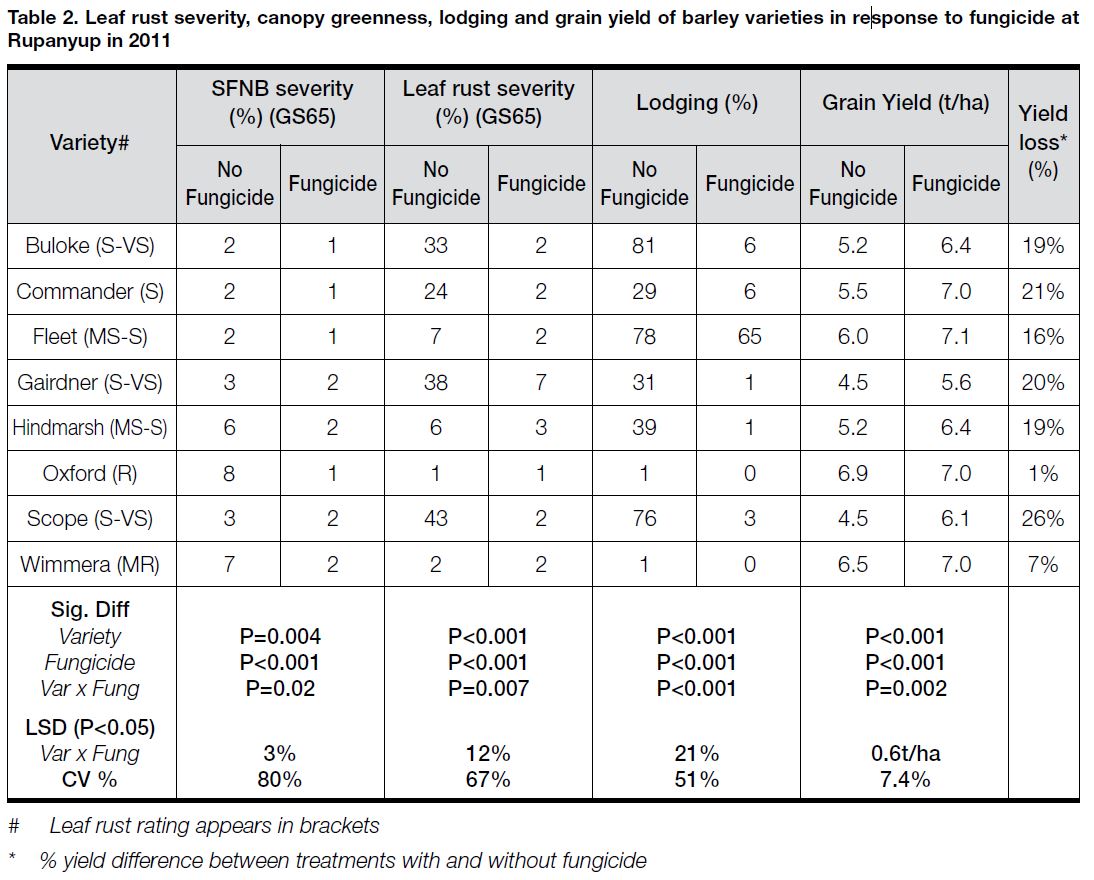
Leaf rust was initially observed at low levels in late August and developed slowly during September due to cool, dry weather conditions. Wet weather at the end of September (23mm) resulted in rapid development of leaf rust symptoms, with severe infection throughout the crop canopy. Leaf rust severity observations made in mid-October revealed significant differences between varieties depending on the disease rating and the fungicide treatments (Table 2).
Buloke (S-VS), Scope (S-VS), Gairdner (MS-S) and Commander (S) had the highest leaf rust infection and subsequently suffered the greatest penalties in grain yield (up to 26%) and quality, with up-to 36% reduction in retention, 8% increase in screenings and 6% reduction in test weight (Table 2). Gairdner also had severe leaf rust infection and suffered a 20% yield loss which contributed to the rating for this variety being downgraded to S-VS. Fleet (MS-S) and Hindmarsh (MS-S) had moderate to severe leaf rust infection, with a grain yield loss of 16-19%, and grain quality loss to retention of 4% and test weight of up to 3%. While the resistant varieties, such as Oxford (MR) and Wimmera (MR), were observed to have trace levels of leaf rust, yield loss was less than 10% and grain quality loss in retention up to 6%. Grain protein was not affected in any of the varieties.
At harvest, it was evident that some varieties also had lodged which was notably worse where the fungicide had not been applied. This was most severe in Buloke and Scope. Fleet, which is notorious for lodging, was badly lodged in both plots, regardless of the fungicide treatment.
The reflectance of the canopy (measured as NDVI) was inconclusive in determining differences in biomass between the unsprayed and fungicide treated plots.
Despite the previous barley residue being burnt prior to sowing, there was still adequate inoculum to affect the susceptible varieties (Table 2). SFNB severity observations indicated that Oxford, Wimmera and Hindmarsh were moderately affected, which was likely to have contributed slightly to grain yield loss.
WAS THE YIELD LOSS COMPOUNDED BY LODGING?
The yield loss found in this trial was substantial, with Scope suffering the greatest loss of up to 26%. Given that some of the varieties were badly lodged at harvest, particularly Scope, the actual yield loss from leaf rust was open to question. Correlations in the data were analysed with grain yield. There was a strong correlation between leaf rust severity and yield loss. A weaker correlation was shown for lodging and head loss with yield. This suggests that yield loss was related to leaf rust more than lodging. If anything, the leaf rust may have weakened straw strength, causing the lodging. Alternatively, the fungicide could have increased straw strength, reducing lodging and head loss. If this were the case, then why did Fleet (notorious for lodging) still lodge badly when the fungicide was applied?
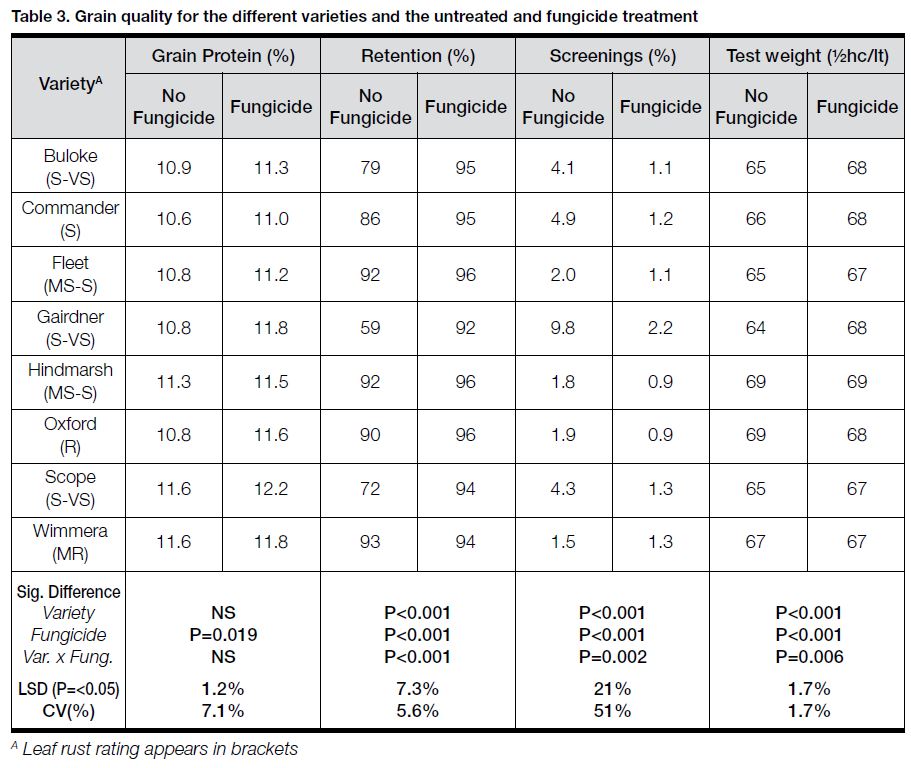
Differences in grain quality suggest the yield loss was due to more than just lodging. Retention, screenings and test weight were also strongly correlated to leaf rust scores, with a similar trend being seen in the response to fungicide (Table 3). When leaf rust was controlled, retention and test weight were significantly higher, and screenings lower. All varieties, however, were within each of the respective malting parameters, achieving malt 1 classification regardless of the variety or treatment.
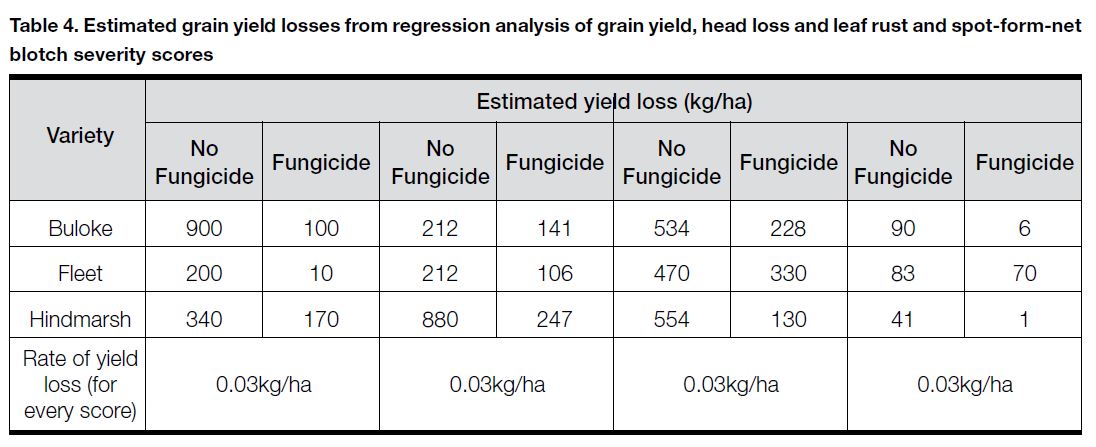
After harvest, the head loss of three varieties (Buloke, Hindmarsh and Fleet) was measured to help determine whether the yield response can be attributed to leaf rust, head loss or lodging. Using the head loss data, a regression analysis was completed to try and predict what the yield loss of each may have been (Table 4). The varieties selected had similar yield loss but varied in the level of yield loss from leaf rust, SFNB and lodging. The regression analysis produced a value for the rate of yield loss for every score: leaf rust, SFNB and head loss. In this case, the leaf rust scores, presented in Table 2, were multiplied by the predicted yield loss rates produced by the regression analysis. This creates the values presented in Table 4. Because the leaf rust, head loss and SFNB score were highly correlated to the yield loss, it helps illustrate what the major effect in each variety was. If this analysis is correct, then the yield loss for Hindmarsh was potentially influenced by SFNB more than leaf rust. The actual yield loss from lodging, based on the scores, did not compound the yield reductions found in this trial.
COMMERCIAL PRACTICE
The large impact of leaf rust on yield on the different varieties in this trial may come as a surprise. In terms of grain yield, the yield losses were similar to previous findings (20-30%). The notable difference was in straw strength at maturity which was probably the most surprising. Harvestability has become an important determinant when choosing a variety; to see varieties such as Hindmarsh and Gairdner lodge is a matter for concern. The outcome of the trial should not be seen as an exact yield loss figure per se. It is also important to remember that leaf rust does not occur every year and the losses seen in this trial may be indicative of the worst case scenario.
With most “azole” fungicides able to effectively control the disease, it is actually a reasonably cheap and easy solution to the problem. A prophylactic approach will always be more effective and efficient than a curative. Even low levels of the disease seemed to have an effect on grain yield and quality; no easy threshold can be used that is representative of each season and yield potential.
Based on this trial, if leaf rust is affecting more than 5-7% leaf area, not only will yield be compromised but straw strength, head retention and grain quality may all be reduced. The essence is that if you have a potentially high-yielding crop (>3t/ha), and greater than 5% of leaf area affected, take action.
REFERENCES
Loughman R, (2002) ‘Fungicide strategies in integrated management of wheat and barley leaf diseases in southern WA’ GRDC Eureka: A final report summary, www.grdc.com.au
McLean MS, Howlett BJ, Hollaway GJ (2010) ‘Spot form of net blotch, caused by Pyrenophora teres f. maculata, is the most prevalent foliar disease of barley in Victoria, Australia.’ Australasian Plant Pathology, 39, 46-49.
ACKNOWLEDGEMENTS
This project was funded by GRDC (Project DAN00138 Southern barley agronomy)