Take home messages
- frost and heat shock events can cause significant damage to grain crops during flowering and grain filling
- to reduce the risk of frost or heat events reducing yield, it is advisable to sow different varieties with different maturity lengths right through the sowing window to ensure that not all the wheat sown on the farm flowers at the same time
- an alternative practice would be to sow a mix of two different maturity length varieties in the same paddock. This will ensure that the whole crop will not flower at the same time, thereby reducing the exposure of the crop to a frost or heat shock event
Background
Opportunities to sow early arise when there is sufficient moisture in the soil to germinate and grow crops in April. A major limitation to early sowing is frost risk at flowering. One management practice to reduce the risk of frost damage is to sow a couple of paddocks with a longer season wheat first, followed by a couple of paddocks with a shorter season wheat, followed by the longer season wheat and so on. This will ensure that not all the wheat sown flowers in the same week, which would make the whole program less susceptible to a frost. Another management practice with a similar outcome could be to mix varieties of different seasonal length and sow them in the same paddock. The two varieties will flower at different times, reducing the potential impact of a frost.
In this trial we sowed on three different dates (in April, May and June) with two different mixes of wheat varieties (Axe mixed with Yitpi and Young mixed with Derrimut). In each case, a short-season wheat was mixed with a mid-season wheat.
Aim
To demonstrate a strategy to reduce the risk of frost and heat shock damage.
Method
Variety mixes of:
(i) Axe as the early season wheat with Yitpi as the mid-long season wheat
(ii) Young as the early season wheat with Derrimut as the mid-long season wheat were prepared and sown at the Corack Main Research Site on 14 April, 16 May and 7 June. Nitrogen was applied at GS13 (3-leaf) and GS30 (end of tillering) for each sowing date.
Location: Corack
Replicates: four
Sowing dates: 14 April, 16 May and 7 June 2011
Variety mix 1: Axe and Yitpi wheat
Variety mix 2: Young and Derrimut wheat
Seeding density: 75 plants/m² for each variety to equal 150 plants/m² for the mix
Fertiliser: sowing: MAP Zn at 65kg/ha
in- crop: GS13 – 28kg N/ha and GS30 – 40kg N/ha
Seeding equipment: Gason parallelogram, knife point, press wheel (30cm spacings).
Table 1. Treatments for sowing a variety mix trial

Results
Frost risk at flowering
The varieties used in each mix flowered at very different times (Table 2). For each variety mix, there was a two to three week difference in flowering time between the short and mid-long season variety used in the mix.
Table 2. Flowering dates for the two variety mixes
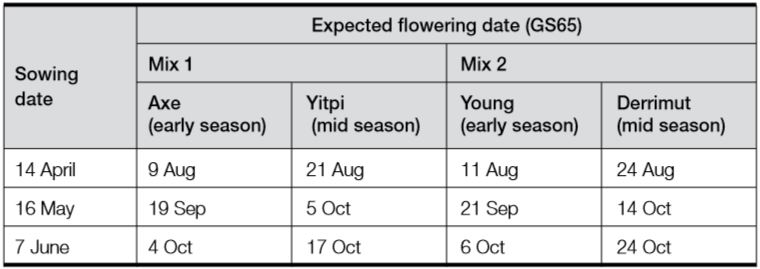
In the southern Mallee, the frost risk (<0°C) for crops flowering in mid August is around 30% (in 30% of years a moderate to severe frost is likely to occur); if crops flower in late September to early October, the frost risk reduces to 2%; after the first week of October the frost risk is even less.
In the 2011 season, no moderate or severe frosts coincided with the flowering dates listed in Table 2.
Yield for variety mixes sown at three different times
There was no significant difference in yield between the two variety mixes (Yitpi/Axe and Derrimut/Young). However, sowing date significantly affected yield, with the early sown crops (14 April) yielding significantly less than crops sown on 16 May and 7 June (Figure 1).

Figure 1. Yield of two variety mixes sown at three different times (14 April, 16 May and 7 June). Note the error bars refer only to the significant difference in TOS (LSD = 0.23 t/ha); the yields of the variety mixes were not significantly different from each other.
Grain protein for two variety mixes sown at three different times
There was no significant difference between the variety mixes in grain protein. However, grain protein of the variety mixes sown early (14 April) was significantly less than the crops sown mid (16 May) and late (7 June) (Figure 2).
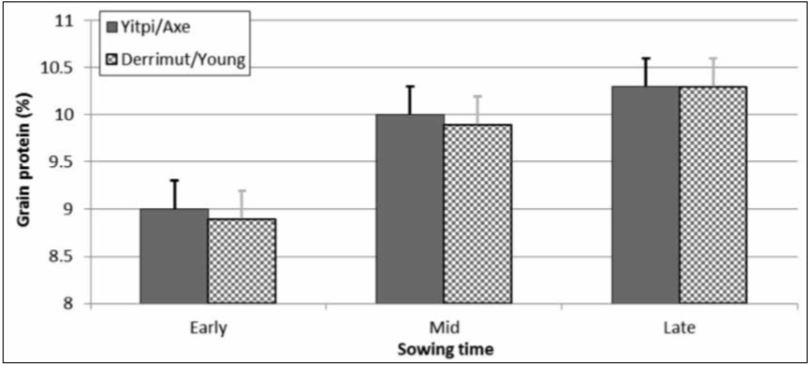
Figure 2. Grain protein of two variety mixes sown at three different times (early (14 April), (mid) 16 May and late (7 June). Note the error bars refer only to the significant difference in TOS (LSD = 0.3 % grain protein); the grain protein in the variety mixes was not significantly different from each other.
Screenings and test weight for two variety mixes sown at three different times
There were no significant differences in screenings and test weight between the two variety mixes and three times of sowing (screenings were less than 5%; and test weight was above 74kg/hL).
Delivery classification was APW2 for the 16 May and 7 June sowing and ASW1 for the 14 April sowing (due to low protein).
Interpretation
There were no significant differences in yield and protein between the two variety mixes of Yitpi/Axe and Derrimut/Young. There was a difference for sowing time with the early sowing (14 April) being significantly lower in yield and protein compared with the later sowing times (16 May and 7 June).
As neither a frost nor a severe heat event occurred this year during flowering and grain filling, the true benefit of sowing a mix of two varieties with different maturity could not be demonstrated.
Commercial practice: what this means for the farmer
Sowing a mix of two varieties with different maturity lengths can be used to reduce the risk of frost or heat shock affecting the crop at flowering and grain filling. It is an alternative practice compared with sowing the two varieties separately in different paddocks. The mixing of seed of two varieties is often used in WA and is called a grain shandy. In WA, grain can be delivered and a % contribution of each variety can be listed on the delivery docket.
Acknowledgments
The project is supported by funding from the Australian Government under its Climate Change Research Program and the GRDC.