Take home messages
Sowing cereals in early April on a soil profile full of water is possible if:
- long season varieties are planted to ensure that the crop does not flower before the high-risk frost period has passed
- the topsoil is moist at seeding to ensure that the crop germinates and allows for early root growth down into the stored water in the subsoil
- weeds can be controlled. Many pre-emergent herbicides are not very effective if used when there is a prolonged dry period after sowing
Background
At the beginning of the 2011 cropping season, the soil profile was, unusually, full of water. The immediate question was how early could cereals be sown without falling into the high-risk frost window at flowering. There are quite a few options available for wheat and barley with different maturity lengths.
The maturity length of cereal varieties is controlled by their response to day length (photoperiod) and cold requirement (vernalisation). The different genetic make-up of various wheat and barley varieties is reflected in their photoperiod and vernalisation characteristics.
Photoperiod is the plant’s response to day length (hours of daylight). Lengthening days induce the plant to speed up the rate of change from vegetative to reproductive development (from growing leaves to the development of flowering organs).
Vernalisation occurs when a plant is subjected to cold temperatures for a specific time. When the vernalisation requirement has been reached, the plant speeds up the rate of change from vegetative to reproductive development. True ‘winter’ types require a long vernalisation period before the crop will develop into its reproductive phase (for example Rosella wheat). Most ‘spring’ types of wheat have little or no requirement for a cold period and will continue to grow and develop throughout the season (for example Catalina wheat).
In theory, it should be possible to grow longer season wheats, such as the winter wheats, in the Mallee, if there is a soil profile full of water and the crop is sown early. This practice should ensure that the crop flowers at the ‘normal’ time, targeted to be just outside the high frost risk period.
Aim
- to demonstrate the possibility of sowing long-season wheat and barley varieties when a soil profile is full of water at the beginning of the season
- to discover the pitfalls of this practice
Method
Location: Corack
Replicates: four
Sowing dates: 8 April, 2011
Seeding density: 50 plants/m² seed was treated with imidacloprid for barley yellow dwarf Virus (BYDV) control
Crop type: wheat and barley (see table 1 for variety choice)
Fertiliser: sowing: MAP Zn at 50 kg/ha, treated with flutriafol at 400ml/ha urea at 60kg/ha was applied in-crop on May 20
Seeding equipment: Gason parallelogram, knife point, press wheel (30cm spacings).
Table 1. Wheat and barley varieties and their maturity group, as sown in the Early Cereal sowing trial
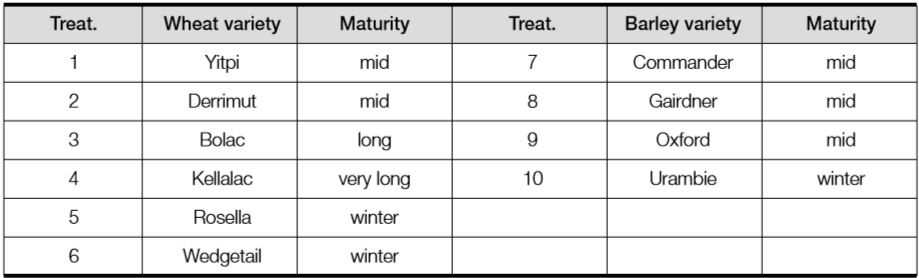
Note: winter wheat, Rosella and Wedgetail, and winter barley, Urambie, should be suited to early sowing because they will not go into the reproductive phase of growth until the cold requirement for vernalisation has been reached.
Results
Sowing and the season break
Emergence: The crop was sown on 8 April into dry topsoil. Early emergence was very poor and the crop did not emerge properly until late May. The crop was sown at a low seeding rate, targeting a low plant population of 50 plants/m2. Sowing at such low plant numbers was done deliberately to target 300 to 400 heads/m2. Early sown wheat and barley should be able to produce six to eight viable tillers to achieve the head number required.
Unfortunately there was little or no rain after sowing until May 20 (18mm). Crop emergence was slow and very uneven. Even though the site was baited for mice, they still caused significant damage to the emerging wheat and barley seedlings.
Weeds: Immediately prior to sowing the site was sprayed with Roundup Power Max (2 L/ha) plus TriflurX® (2L/ha) and Avadex Xtra® (2L/ha). Unfortunately, because of the dry conditions, the herbicides had little activity on barley grass which emerged with the majority of the crop in late May.
Season growth
The crop was sparse and struggled to compete with grass weeds. Even though the crop was sown 8 April, the effective sowing date was more like mid May. The different varieties struggled through a dry June and July until 25mm of rain fell in mid-August: hardly ideal conditions for early sowing of long season cereal varieties.
Yield
Wheat yield was lower than expected, primarily due to lateness of the opening break which resulted in poor germination and establishment, and severe pressure from barley grass and brome grass (pre-emergent herbicides were not effective due to the dry conditions). The winter wheats Rosella and Wedgetail and the long season wheat Kellalac performed similarly to the southern Mallee standard, Yitpi (Table 2). The mid season barley varieties outperformed the winter barley Urambie, which was not competitive.
Table 2. Yield of the wheat and barley varieties sown in the early cereal sowing trial

Interpretation
Early sowing of long season and winter wheat and barley varieties in years when there is a soil profile full of water is a practice which could work, but only if the topsoil at seeding is sufficiently moist to ensure a germination. This would ensure that the crop roots can grow into the stored subsoil moisture. Another very important criterion for early sowing is that weeds must be able to be controlled in crop. The dominant weed which germinated at the trial site was barley grass which could not be effectively controlled due to the dry conditions. For both reasons – poor germination due to a lack of topsoil moisture and poor weed control – yields were well below expectations and potential.
Commercial practice: what this means for the farmer
Sowing very early with long season and winter wheat and barley varieties is an option when the soil water profile is full after a wet summer and good summer weed control. But only if:
- the topsoil is sufficiently moist to allow a germination so that the crop roots can grow into and access the stored subsoil moisture
- weeds can be controlled in crop because most of the pre-emergent herbicides on the market are not effective under prolonged dry conditions.
Acknowledgments
The project is supported by funding from the Australian Government under its Climate Change Research Program and the GRDC.